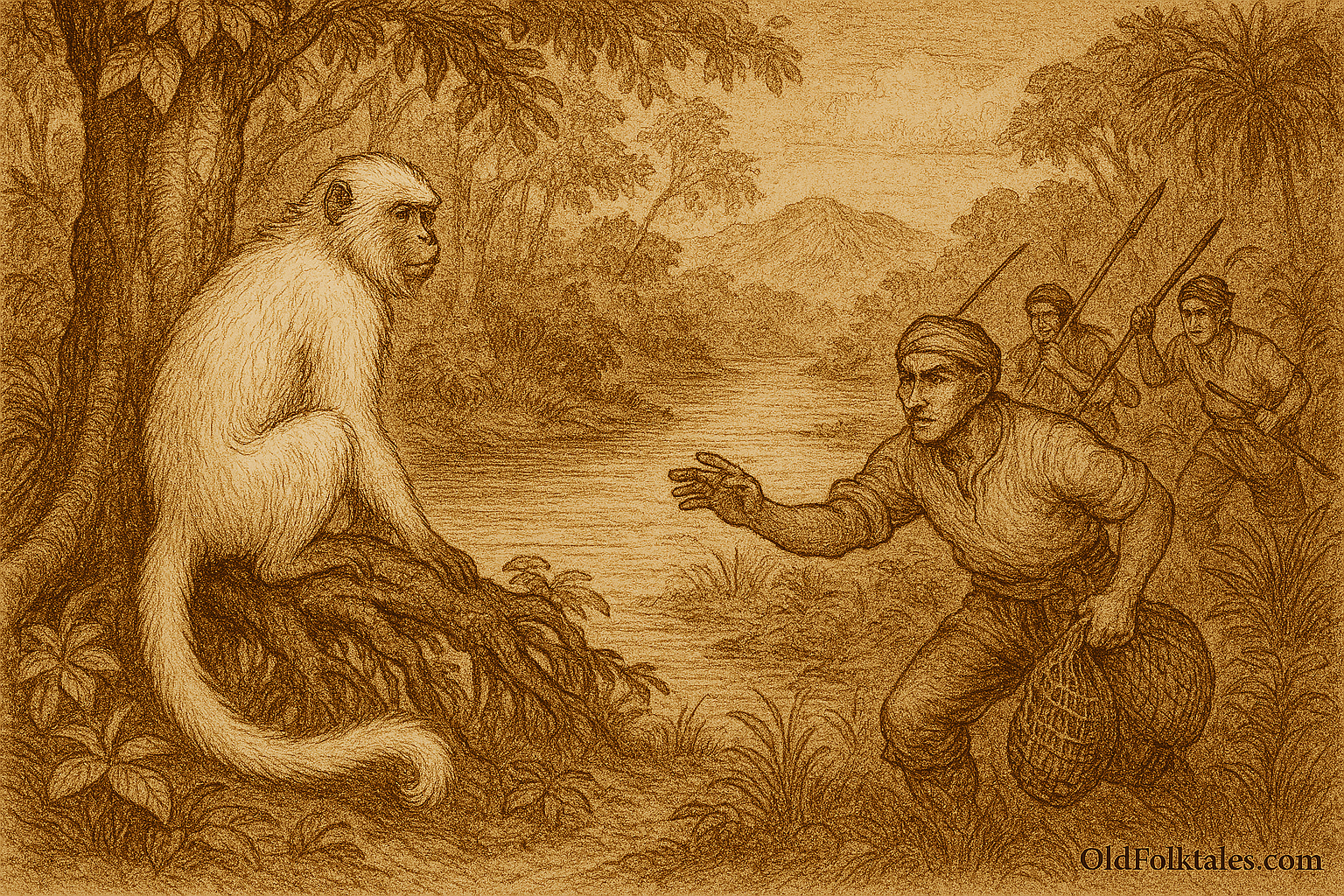
In the lush, green heart of Brunei, where the Tutong River winds through dense rainforest like a silver serpent, there once lived a creature unlike any other. The villagers who made their homes along the riverbanks spoke of it in hushed, reverent tones, a white monkey whose fur gleamed like moonlight on water, whose eyes held the wisdom of ages, and whose presence meant protection for all who lived beneath the forest canopy.
The Tutong River was the lifeblood of the communities that flourished along its course. Its waters provided fish in abundance, its banks offered fertile soil for growing rice and vegetables, and its current carried boats laden with goods between villages. The people knew every bend and pool, every shallow crossing and deep channel. But they also knew that the river could be unpredictable sudden floods could sweep away homes, and enemy raiders sometimes used the waterway to launch surprise attacks on unsuspecting settlements.
Click to read all East Asian Folktales — including beloved stories from China, Japan, Korea, and Mongolia.
It was the white monkey who kept them safe.
The creature appeared without pattern or warning, materializing from the dense foliage like a ghost made flesh. It would perch on the highest branches overlooking the river, its luminous white fur standing out against the dark green leaves like a beacon. Sometimes it would call out in a voice that was not quite animal, not quite human a sound that echoed through the valley and made the hair on people’s necks stand on end.
The elders understood these warnings. When the white monkey appeared shrieking at dawn, they knew to move their belongings to higher ground, for the rains would come heavy and the river would swell beyond its banks. When it showed itself at dusk, racing along the riverbank and gesturing frantically toward the forest, they knew that danger approached from upstream enemy raiders or hostile forces that meant them harm. Time and again, the white monkey’s warnings saved lives, protected children, preserved harvests.
The people honored the creature as a sacred guardian, a spirit sent by their ancestors or perhaps by the forest itself to watch over them. They left offerings at the river’s edge fruit and flowers, rice cakes wrapped in banana leaves, small tokens of gratitude for protection received. And the white monkey, glimpsed occasionally in the early morning mist or the purple twilight, seemed to accept these gifts, for they would always be gone by the next day.
Generations passed in this way, with the villagers and their mystical protector existing in harmony. Parents told their children stories of the white monkey’s interventions, of the time it warned them of the great flood that nearly destroyed the village, of the night it revealed the presence of raiders creeping through the darkness. The children grew up knowing that they were watched over, protected by something greater than themselves.
But as it often happens, greed eventually found its way even to this peaceful place.
Traders from distant lands came up the river, bringing exotic goods and foreign ideas. One day, a group of hunters arrived, men who made their living capturing rare animals to sell to wealthy collectors in faraway cities. They heard the stories of the white monkey and saw not a sacred guardian but a valuable prize. A white monkey would fetch an enormous sum, they said among themselves. They could retire on the profits from such a rare creature.
The villagers protested. The elders warned that the white monkey was not an ordinary animal to be trapped and caged. It was their protector, a spirit being, and to harm it would bring disaster upon them all. But the hunters laughed at these superstitions. They were practical men, they said, who dealt in facts and coin, not in tales and spirits.
They set their traps with cunning and skill. They placed nets in the trees where the white monkey was often seen. They scattered bait along its known paths. They waited with weapons at the ready, determined to claim their prize.
For days, they pursued the creature through the forest. The white monkey seemed to know their intentions, staying always just out of reach, watching them from high branches with eyes that held what looked disturbingly like sadness. It no longer called out its warnings to the village. It no longer appeared at the river’s edge at dawn and dusk.
Then, one morning, the white monkey was simply gone.
The hunters searched for weeks, but it was as if the creature had dissolved into the mist and vanished from the world entirely. Eventually, they departed, empty-handed and frustrated, muttering about wasted time and superstitious villagers.
But the villagers knew. They had lost something precious, something that could never be replaced. And they were right to fear.
The misfortunes began slowly at first. The rains came, but without the white monkey’s warning, families were caught unprepared. Homes were damaged, rice stores were ruined by water, and two children nearly drowned in the swollen river. Then came the drought the river shrank to a trickle, and fish died in the shrinking pools. Crops withered in the fields under the merciless sun.
Sickness followed. A fever spread through the village, leaving even the strongest men weak and bedridden. Elders who had lived through many seasons succumbed. Mothers wept over sick children, and the sound of mourning filled the air where once there had been laughter and contentment.
The people understood. By allowing the hunters to pursue the white monkey, by failing to protect their protector, they had broken the sacred trust. The spirit guardian had withdrawn its blessing, and now they suffered the consequences of their negligence.
The village elders called for a gathering. They must make amends, they said. They must perform rituals of atonement, must demonstrate their remorse and their renewed commitment to honoring the spirits of the forest and river. For three days and three nights, they fasted and prayed. They made elaborate offerings at the river’s edge their finest woven cloths, their most precious heirlooms, their heartfelt apologies spoken into the rushing water.
They asked forgiveness for allowing outsiders to threaten their sacred guardian. They promised to never again permit such disrespect, to protect the white monkey as it had protected them, to honor the balance between human and spirit worlds that had kept them safe for so many generations.
On the third night, as the village slept in exhausted supplication, the eldest among them had a dream. The white monkey appeared to him, no longer sad but radiant with an otherworldly light. It spoke without words, communicating directly to his spirit.
The guardian would return, it conveyed, but only so long as the people kept their promise. They must respect the forest and river as living beings, not merely resources to be exploited. They must refuse those who would harm the natural world for profit. They must teach their children to honor the old ways, to understand that some things are sacred and must never be sold or captured or possessed.
The elder woke with tears streaming down his face, filled with relief and renewed purpose. He shared his vision with the village, and from that day forward, the people of Tutong River kept their covenant. They turned away hunters who came seeking rare creatures. They protected the forest from those who would clear it without thought. They taught their children the stories of the white monkey with new urgency, ensuring that the lessons would not be forgotten.
And sometimes, in the early morning when the mist rises from the river, or in the purple twilight when the day surrenders to night, villagers catch a glimpse of white fur moving through the trees. The white monkey has returned, they whisper to one another. Our guardian watches over us still. And they are careful, always so careful, to honor the promise that keeps them safe.
Click to read all Southeast Asian Folktales — featuring legends from Thailand, Indonesia, Vietnam, and the Philippines.
The Moral Lesson
The legend of the White Monkey of Tutong River teaches us that nature’s gifts including protection and abundance are not unconditional entitlements but sacred trusts that require our reciprocal respect and stewardship. When we allow greed to override reverence, when we permit the exploitation of that which should be protected, we break an ancient covenant with the natural world. The villagers’ suffering following the white monkey’s disappearance demonstrates that material profit gained at the expense of spiritual and environmental harmony ultimately leads to collective loss far greater than any individual gain.
Knowledge Check
Q1: What was the white monkey’s role in the Tutong River communities of Brunei?
A1: The white monkey served as a sacred guardian and protector of the villages along Tutong River in Brunei. It warned villagers of impending floods by appearing and shrieking at dawn, signaling them to move to higher ground. It also alerted communities to approaching danger, such as enemy raiders, by appearing at dusk and gesturing toward the forest. The creature was revered as a spirit being sent by ancestors or the forest itself to watch over the people.
Q2: How did the villagers honor the white monkey of Tutong River?
A2: The villagers honored the white monkey by leaving offerings at the river’s edge, including fruit, flowers, rice cakes wrapped in banana leaves, and other tokens of gratitude. They treated the creature with reverence, recognizing it as a sacred guardian rather than an ordinary animal. They also taught their children stories of the white monkey’s protective interventions, ensuring respect for the spirit guardian was passed down through generations.
Q3: Why did hunters want to capture the white monkey in the Brunei legend?
A3: Hunters from distant lands saw the white monkey as a valuable commodity rather than a sacred guardian. They believed a rare white monkey would fetch an enormous sum from wealthy collectors in faraway cities, enough for them to retire on the profits. Driven by greed and dismissive of the villagers’ spiritual beliefs, they pursued the creature with traps and weapons, viewing it as merely an exotic animal to be captured and sold.
Q4: What misfortunes befell the village after the white monkey disappeared?
A4: After the white monkey vanished, the village suffered a series of devastating misfortunes. First, floods came without warning, damaging homes, ruining rice stores, and nearly drowning children. Then a severe drought struck, causing the river to shrink and crops to wither. Finally, a fever spread through the community, leaving people weak and claiming the lives of elders and threatening children, filling the village with mourning where there had once been prosperity.
Q5: How did the villagers seek atonement for the loss of their guardian spirit?
A5: The village elders organized rituals of atonement that lasted three days and three nights. The villagers fasted and prayed, making elaborate offerings at the river’s edge including their finest woven cloths and most precious heirlooms. They spoke heartfelt apologies into the rushing water, asking forgiveness for allowing outsiders to threaten their sacred guardian and promising to protect the white monkey and honor the balance between human and spirit worlds.
Q6: What does the White Monkey of Tutong River symbolize in Bruneian folklore?
A6: The White Monkey symbolizes the sacred covenant between humans and nature, representing the protective spirits that watch over communities when they live in harmony with their environment. In Bruneian culture, it embodies the principle that nature’s protection and abundance are conditional upon human respect and stewardship. The legend teaches that greed and exploitation break this sacred trust, while reverence and protection maintain the balance that ensures community wellbeing. The white monkey serves as a reminder that some things are sacred and should never be commodified.
Source: Adapted from Brunei Folklore and Legends.
Cultural Origin: Brunei Darussalam, Southeast Asia.