The Tihama coastal plain stretches along Yemen’s western edge like a ribbon of heat and shimmering air. Its villages, built of sun-dried brick and shaded by clusters of date palms, have always depended on the simple gifts of the land and sea. Here, where the Red Sea breeze meets the desert’s dry breath, salt has long been gathered from shallow flats and traded across markets.
In one such village lived a hardworking farmer known for harvesting salt each year. It was grueling work: days spent under the blazing Tihami sun, scraping crystallized salt from the beds, washing it, drying it, and carrying it home in coarse sacks. Yet the farmer believed that this year his fortune would change, for his harvest was plentiful, enough to fill several sacks to the brim.
When the season ended, he loaded the sacks onto his donkey and set out for the market. The souq was alive with noise, traders calling out prices, children weaving between stalls, and fishermen displaying the day’s catch still glittering with seawater. Among the crowd, a traveling merchant spotted the farmer’s salt and approached with a gleaming offer.
“I will give you this bag of gold,” the merchant said, shaking it lightly so the farmer could hear the coins sing, “in exchange for your entire salt harvest.”
The farmer stared at the gold. Never in his life had he held such wealth. Its shine dazzled him, and the murmurs of bystanders praising gold’s value tightened his admiration. Without hesitation, he agreed and handed over every sack.
He returned home that evening triumphant, the bag of gold clutched to his chest. But his wife, a woman known for her steady judgment, studied him quietly.
“You traded all the salt?” she asked.
“Yes,” he said proudly. “For gold. We are rich now.”
She said nothing more, though a troubled silence settled in her heart.
Weeks later, the sky turned harsh. A drought swept through the Tihama plain. Rain clouds passed without blessing the fields, and crops withered under relentless heat. Soon the village markets grew empty. Fishermen caught fewer fish. Grain sellers held tightly to their stores to feed their families. Even those with gold could buy nothing, for nothing remained to sell.
The farmer’s confidence slowly crumbled. He carried his bag of gold from house to house, hoping to buy grain or fish, but each neighbor gave the same hopeless answer: “We have nothing, not even for ourselves.”
His wealth was useless.
Seeing her husband’s despair deepen, the farmer’s wife finally revealed the wisdom she had kept hidden. Without his noticing, she had stored away one single sack of salt before he traded the rest. She understood salt’s worth in a land where food spoiled quickly and where fishermen depended on it to preserve their catch before it rotted in the coastal heat.
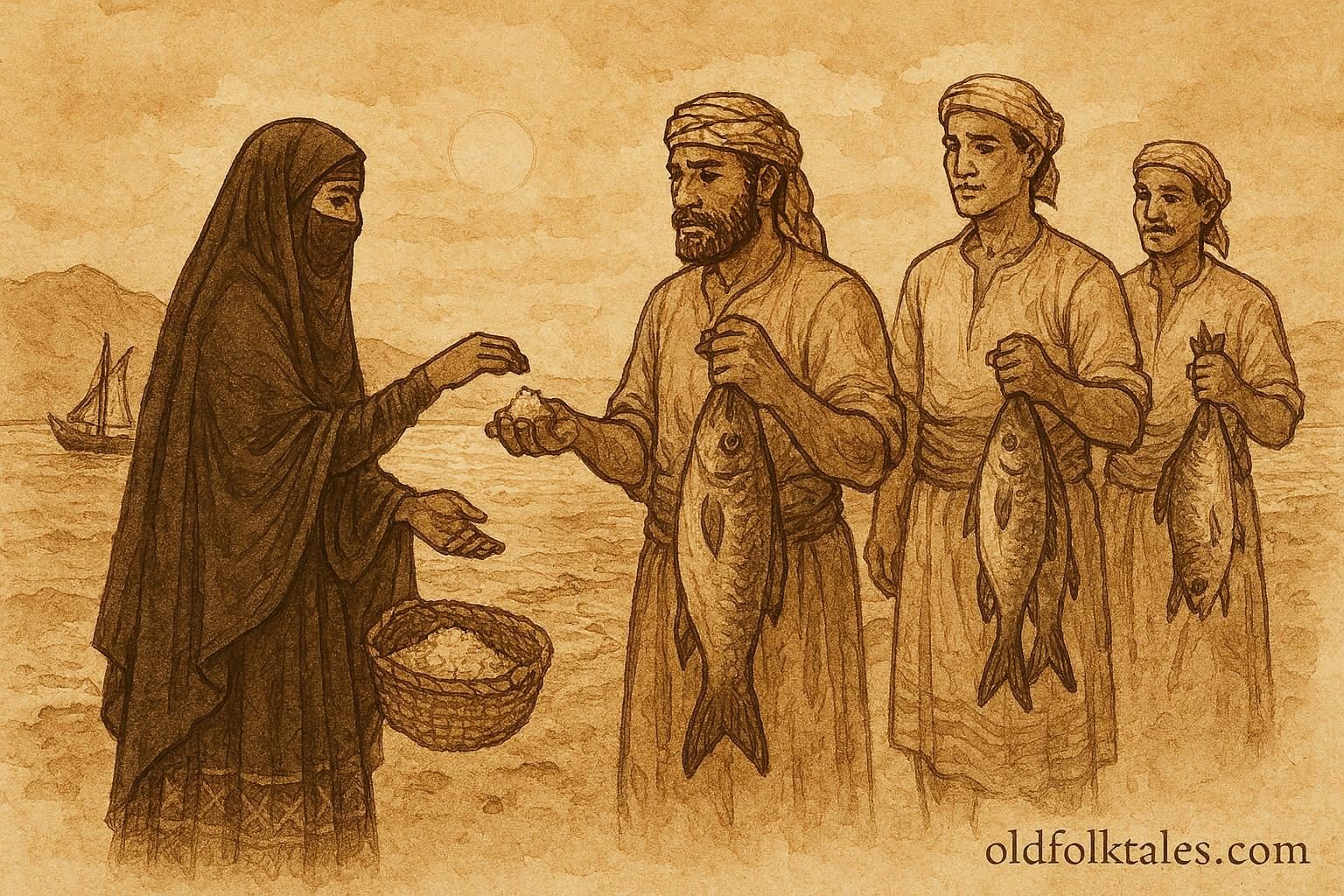
Carrying the sack on her back, she made her way to the coast. There she found a group of fishermen cleaning what little fish they had caught. They looked up as she approached, surprised to see someone offering salt when the markets had been barren for days.
“Just a pinch?” one fisherman asked eagerly. “We cannot keep the fish fresh without salt.”
She divided the salt sparingly, trading small portions for fish. Within the hour she had filled her basket. With the fish in hand, she returned inland to a grain-seller she knew, a man whose family was struggling to survive. He welcomed her, for fish had become rare and valuable during the drought. After thoughtful negotiation, the wife bartered the fish for grain.
She continued this chain of quiet, careful trade over the next several days. With each exchange, salt for fish, fish for grain, grain for other needed goods, she rebuilt what her husband had thought they lost forever.
When she returned home with baskets full of food and supplies, the farmer stared in amazement.
“How did you do this?” he asked, overwhelmed with relief.
His wife set the last basket down and said gently, “Gold shines, but salt preserves. In hardship, what sustains life is more precious than what glitters.”
Her words struck him deeper than any misfortune. The gold he had admired so fiercely now seemed dull. It could never have fed them. It could never have preserved the fish or filled the grain baskets. Salt, ordinary, humble salt, had kept them alive.
The farmer bowed his head in gratitude, not only for his wife’s foresight but for the lesson he had finally grasped: true value lies not in appearance, but in usefulness, resilience, and the ability to support life.
From that day on, he approached the marketplace differently. He still traded, bargained, and sold his goods, but never again was he blinded by glittering promises. He had learned, as the people of the Tihama plain often said, that the harshest seasons reveal the truest worth.
Moral Lesson
In times of ease, gold may seem priceless, but in hardship, true value belongs to what sustains life. Practical resources can outweigh riches when survival is at stake.
Knowledge Check
1. Why did the farmer trade all his salt for gold?
He was dazzled by the merchant’s offer and believed gold meant greater wealth.
2. Why was gold useless during the Tihama drought?
No one had food or goods to sell, so gold could not buy anything.
3. What item did the farmer’s wife secretly keep?
She preserved one sack of salt from the harvest.
4. How did she use the salt to help the family survive?
She traded pinches of salt to fishermen for fish, then bartered the fish for grain.
5. What lesson did the wife teach her husband?
That salt, which sustains life, is more valuable than gold in difficult times.
6. What cultural theme does this Yemeni folktale highlight?
The strength of traditional barter systems and the practical wisdom of rural communities.
Source
Adapted from the Yemeni folktale “The Salt Smarter Than Gold,” Folktales from Yemen by Nabil Al-Maqaleh, Tihama Tales chapter.