In a fertile valley called Vaihmid, nestled among the rugged hills of western Afghanistan, peace once reigned. Farmers tended their crops under golden sunlight, herds grazed along the banks of clear streams, and laughter echoed across the fields. But that peace was shattered when a monstrous serpent rose from the depths of a nearby lake. Vast as a river and black as storm clouds, its scales gleamed like molten iron, its eyes blazed red as fire. Wherever it moved, the earth withered. It devoured flocks, poisoned wells, and filled the valley with terror until the once-living land grew silent beneath its shadow.
The elders whispered that this creature was no ordinary serpent. Long ago, it had been a proud jinn who defied the will of Heaven. As punishment, an angel cast it into the lake and cursed it to live as a beast until a pure-hearted man could face it unarmed. To calm its wrath, the people began offering sacrifices. Each year, at the first full moon of spring, a young maiden was led to the lake’s edge as tribute. The villagers prayed the serpent would spare them in exchange for her life.
Discover more East Asian Folktales from the lands of dragons, cherry blossoms, and mountain spirits.
Among those who lived in Vaihmid was a shepherd’s son named Dilmurad. Known for his quiet courage and kindness, he lived simply, guiding his flock and caring for the weak. But when fate chose his betrothed as the next offering, grief and anger rose within him. He could not bear to watch innocence perish for fear of a monster. So, he sought guidance from a wandering darvish who lived in the hills. The old man listened in silence, then spoke softly: “Fear not the fang of clay, for the breath of faith can quench the fire of doom.”
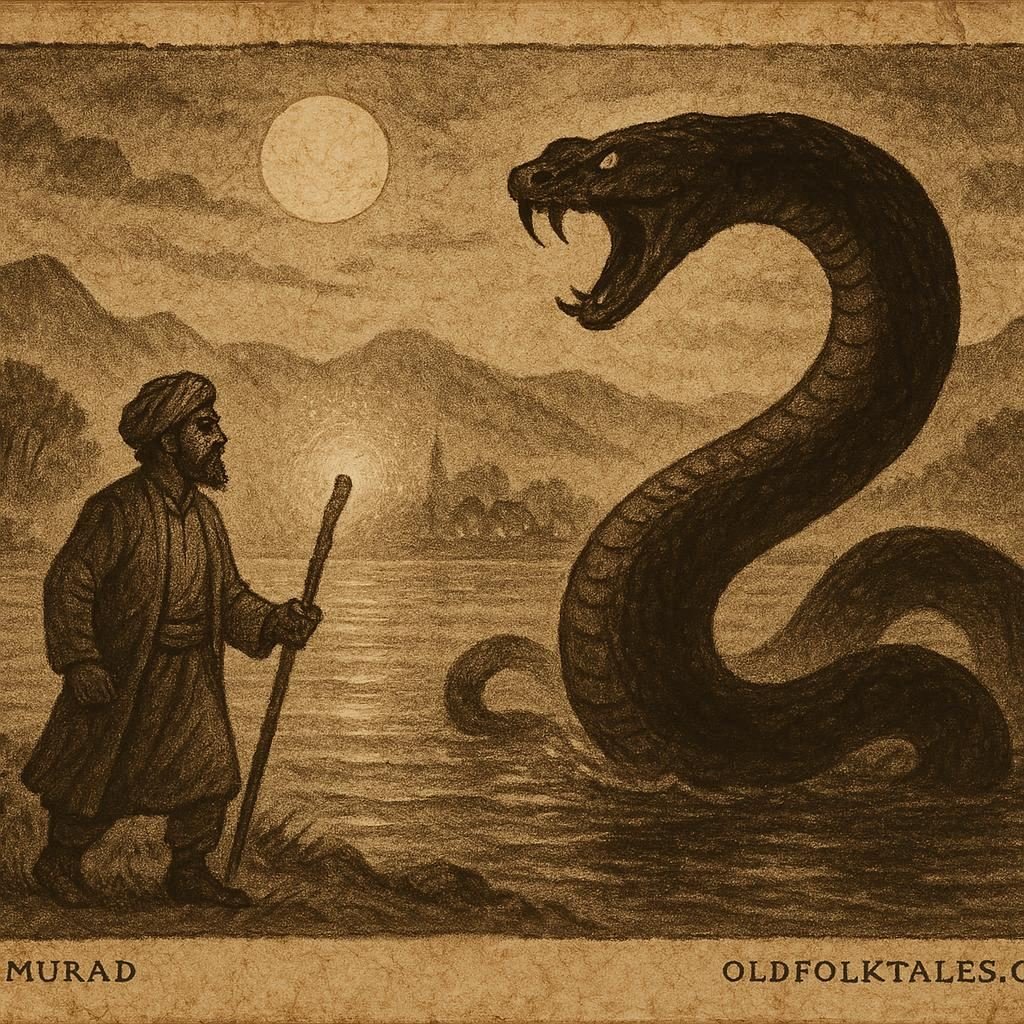
With only his staff and those words in his heart, Dilmurad returned to the valley. As dawn broke, he rode to the serpent’s lake. Mist hung low over the water, and the air trembled with distant rumbling. From the lake’s depths came a hiss that split the morning silence. The serpent rose, towering above him like a mountain of scales and smoke. Its breath scorched the reeds, and its voice thundered across the hills. Yet Dilmurad did not move. He stood firm, calling upon the name of God.
The serpent lunged, jaws wide as a gate. In that instant, Dilmurad struck, not in rage, but in faith. He drove his wooden staff into the beast’s throat, and from the wound gushed a torrent of pure water that spilled across the valley. The poisoned lake turned clear, the blackened earth revived, and the serpent, thrashing in its death throes, sank beneath the healing flood. The storm ceased, the clouds parted, and light poured over the mountains once more.
When the villagers returned, they found Dilmurad beside a new spring that flowed where the monster had fallen. The water was cool, sweet, and healing. It washed away sickness and restored life to the barren fields. The people called it Chashma-i-Najat—the Fountain of Deliverance. They offered Dilmurad wealth, land, and honour, but he refused them all, saying, “I fought not for reward, but that the innocent may breathe and the guilty may repent.” He chose instead a life of solitude, building a small hut beside the spring. There he prayed and tended to travellers until his final day. When he died, the villagers buried him beneath a tamarisk tree, and it is said that a gentle light shone above his grave each night, guiding the lost and the weary.
Moral lesson
The tale of The Serpent of Vaihmid teaches that true strength lies not in weapons or might, but in purity of heart and faith in divine justice. The serpent represents the evil within, fear, pride, and doubt, that poisons the soul. Dilmurad’s victory reminds all that the greatest battle is not fought with swords, but within the spirit. He who conquers himself conquers all.
Knowledge Check
1. Who is Dilmurad in “The Serpent of Vaihmid”?
Dilmurad is a humble shepherd’s son whose faith and courage save his valley from a cursed serpent.
2. What caused the serpent’s curse?
It was once a rebellious jinn, condemned by an angel to live as a beast until defeated by a pure-hearted man.
3. Why did the villagers offer maidens to the serpent?
They believed the sacrifice would appease the monster and protect the valley from destruction.
4. How did Dilmurad defeat the serpent?
Using only his staff and faith in God, he pierced its throat, turning the poisoned lake into a healing spring.
5. What is the Fountain of Deliverance?
A sacred spring that emerged from the serpent’s wound, symbolising cleansing, renewal, and divine mercy.
6. What moral lesson does the tale teach?
Faith, humility, and courage are stronger than any weapon; conquering evil within oneself brings true victory.
Source: Charles Masson, Legends of the Afghan Countries, in Verse (1848), pp. 40–53.
Region of Origin: Western Afghanistan, the “Vaihmid” district (likely a poetic rendering of a valley near Herat).