
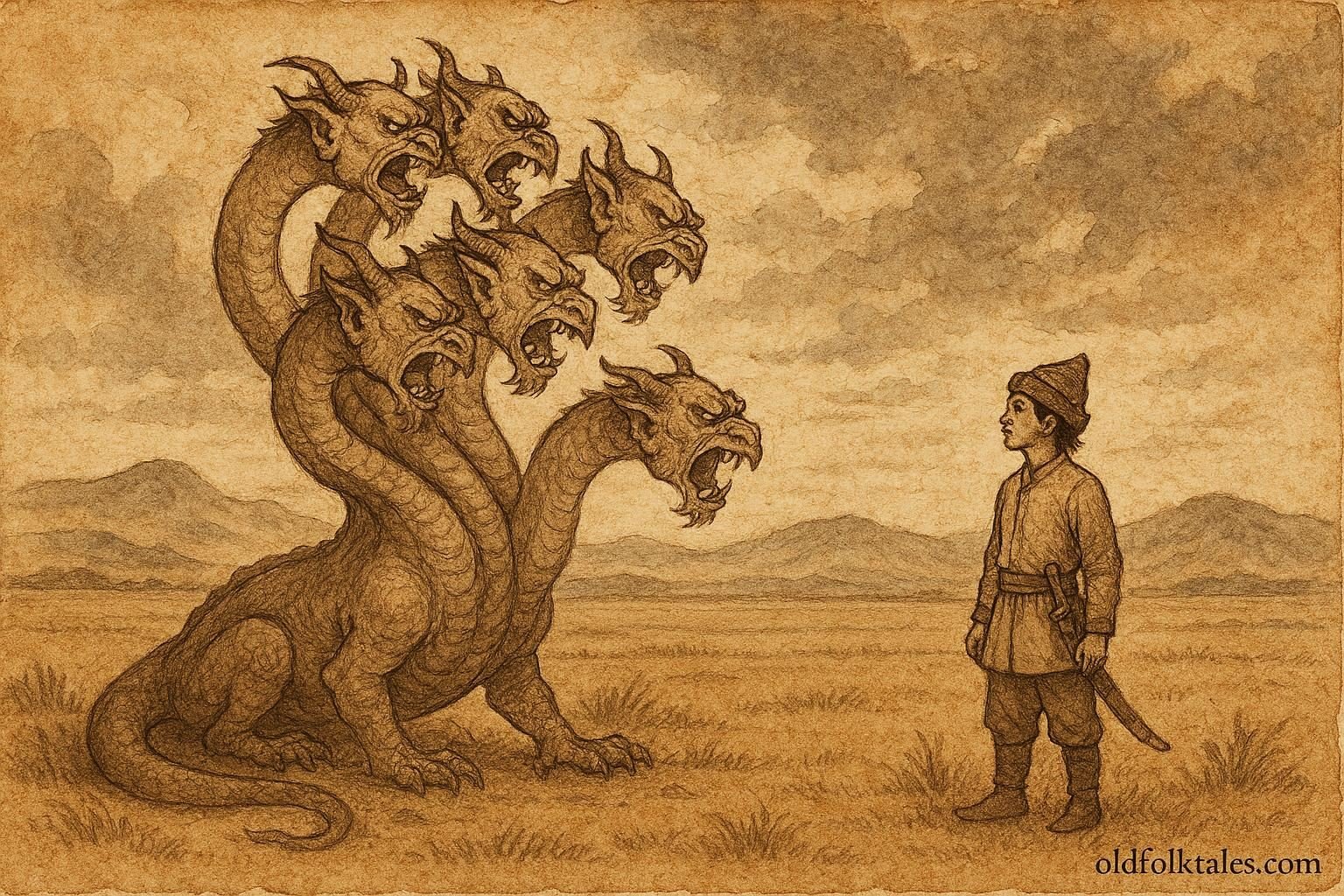
Across the wide and wind-swept Kazakh steppe, where the land stretches farther than memory and silence carries ancient warnings, there once arose a terror unlike any other. From the most remote wastelands emerged a seven-headed dev, a monstrous being feared not only for its size and strength, but for its cunning mind. Each of its seven heads possessed its own voice, its own thoughts, and its own schemes. Together, they spread chaos among the villages that lay scattered across the plains.
The dev came without warning. One night, herds vanished. Another night, watchtowers were shattered. Fires were extinguished by its breath, and the echoes of its many voices drifted across the land, sowing fear before the creature itself was ever seen. Warriors rode out to confront it, confident in their weapons and courage, yet none returned victorious. Those who relied only on force soon learned that strength alone could not overcome a creature that thought as fiercely as it fought.
Discover more East Asian Folktales from the lands of dragons, cherry blossoms, and mountain spirits.
The dev was clever. While one head mocked its enemies, another watched silently. While one raged, another plotted. Warriors who charged blindly were confused by the dev’s shifting tactics, deceived by false retreats, or trapped by arguments between the heads that masked sudden attacks. Before long, the people believed the monster invincible.
At last, a young hero stepped forward. He was not the strongest in the village, nor the most famous. Yet he possessed something rare: patience. Instead of riding out immediately, he asked questions. He listened to survivors’ tales and studied the patterns of destruction. Then, rather than seeking battle, he chose to observe.
For several days, the hero followed the dev from a distance. He watched as it rested in rocky ravines and argued with itself beneath the moon. One head demanded violence, another urged caution, a third boasted endlessly of its power. Their voices clashed, each trying to dominate the others. In these moments, the hero understood the truth: the dev’s greatest strength, its many minds, was also its weakness.
When the time came, the hero approached the dev openly, without drawing his weapon. The seven heads laughed, jeered, and threatened him. Calmly, the hero spoke not to all of them, but to one head at a time. To one, he praised its intelligence above the others. To another, he questioned why its advice was ignored. To a third, he suggested that the others feared its strength.
Suspicion took root.
The heads began to argue more fiercely than ever before. Accusations flew. Voices overlapped. The dev grew distracted, its unity breaking apart as each head fought for dominance. In its confusion, it failed to notice the hero positioning himself carefully, waiting for the moment when chaos would consume the creature from within.
When the dev finally turned on itself, the hero struck—not wildly, but decisively. Weakened by discord and blinded by its own quarrels, the monster fell. The earth trembled as the seven voices fell silent, one by one.
Peace returned to the steppe.
The villagers welcomed the hero not with grand celebrations, but with deep respect. They understood that what saved them was not brute force, but wisdom, patience, and insight. From that day on, elders retold the story to remind future generations that unity brings strength, and inner conflict invites defeat.
Journey through enchanted forests and islands in our Southeast Asian Folktales collection.
Moral Lesson
This folktale teaches that intelligence, patience, and understanding one’s enemy are more powerful than strength alone. True victory comes from wisdom and unity, while internal conflict leads even the strongest forces to ruin.
Knowledge Check
1. What is a dev in Kazakh folklore?
A dev is a giant or demon figure representing chaos, danger, and destructive intelligence.
2. Why is the seven-headed dev so difficult to defeat?
Because each head thinks independently, making it both cunning and unpredictable.
3. How does the hero defeat the dev?
By exploiting the dev’s internal arguments rather than relying on physical strength.
4. What lesson does the story emphasize?
Wisdom and patience are stronger than brute force.
5. What does the dev symbolize in Kazakh tradition?
Disorder, internal conflict, and the danger of unchecked power.
6. Why is unity important in the story?
The dev falls because its lack of unity becomes its greatest weakness.
Source: Kazakh dev (giant/demon) tales preserved in steppe oral tradition
Cultural Origin: Kazakhstan (Kazakh magical folklore)








