Long ago in a small village in Indonesia, there lived two half-sisters whose names reflected the humble vegetables of their homeland: Bawang Merah, meaning “Shallot,” and Bawang Putih, meaning “Garlic.” Though they shared a home, the two girls could not have been more different from one another.
Bawang Merah, the biological daughter of the household’s mother, lived a life of leisure and indulgence. She spent her days admiring herself, demanding treats, and avoiding any form of work. Her mother doted on her endlessly, turning a blind eye to her laziness and her increasingly greedy nature. Together, they treated the younger sister with coldness and disdain.
Click to read all Southeast Asian Folktales — featuring legends from Thailand, Indonesia, Vietnam, and the Philippines.
Bawang Putih, the stepdaughter, carried the weight of the household on her young shoulders. Each morning before dawn, she would rise to sweep the floors, prepare the meals, and tend to the garden. She washed the clothes, fetched water from the well, and completed every task without a single word of complaint. Despite the harshness she faced, Bawang Putih remained gentle in spirit, her heart untainted by resentment. She worked diligently, hoping that perhaps one day, her kindness would soften her stepmother’s heart.
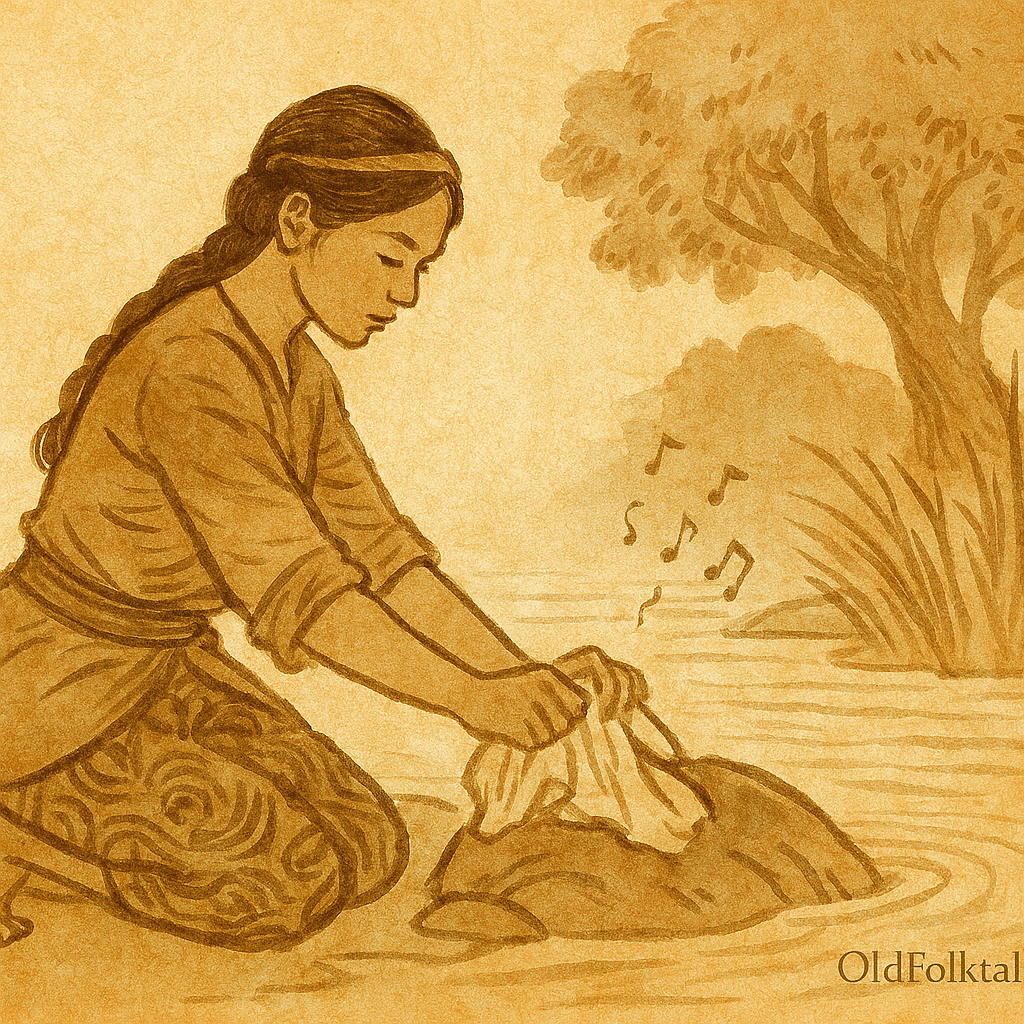
One bright morning, Bawang Putih made her way to the river to wash the family’s clothes. The water was cool and clear, flowing gently over smooth stones as she knelt on the riverbank. She scrubbed each garment carefully, singing softly to herself to pass the time. But as she wrung out a delicate scarf, the current suddenly grew stronger. The fabric slipped from her fingers and was carried away downstream before she could catch it.
Panic seized her heart. The scarf belonged to her stepmother, and she knew there would be harsh punishment for losing it. Bawang Putih hurried along the riverbank, searching desperately among the reeds and rocks. After what seemed like hours of searching, she came upon a small, modest cottage she had never seen before. Standing at the door was an elderly woman with kind eyes and silver hair tied in a simple bun.
“Excuse me, grandmother,” Bawang Putih said respectfully, bowing her head. “Have you seen a scarf that may have floated past here?”
The old woman smiled warmly. “Yes, child. I found it caught on the rocks near my home. But I will only return it to you if you help me for a time. I need someone to cook my meals and clean my house.”
Without hesitation, Bawang Putih agreed. For several days, she stayed with the old woman, preparing delicious meals with care and keeping the cottage spotlessly clean. She tended the small garden, swept the floors until they shone, and even mended the old woman’s worn clothing. Throughout it all, she worked cheerfully, treating the elderly woman with the same respect and kindness she wished she received at home.
When the time came for Bawang Putih to return home, the old woman was deeply moved by the girl’s pure heart and tireless work. She returned the scarf and then led Bawang Putih to her garden, where two pumpkins grew on twisted vines.
“You have served me well, dear child,” the old woman said, her eyes twinkling. “As a reward, you may take one of these pumpkins home with you. Choose whichever you wish the small one or the large one.”
Bawang Putih looked at both pumpkins. The large one was impressive and heavy, but she did not want to appear greedy. “Thank you, grandmother. I will take the smaller one. It will be easier for me to carry home.” She bowed deeply, thanked the old woman again, and began her journey back to the village.
When Bawang Putih arrived home and carefully cut open the small pumpkin, she gasped in wonder. Instead of orange flesh and seeds, the pumpkin was filled to the brim with glittering jewelry gold necklaces, precious gems, silver bracelets, and sparkling rings that caught the lamplight like captured stars.
Her stepmother and Bawang Merah stared in stunned silence before jealousy twisted their faces. They immediately demanded to know where this treasure had come from. When Bawang Putih explained what had happened, their greed consumed them entirely.
The very next day, Bawang Merah and her mother rushed to the river. They deliberately threw their scarves into the current and followed them downstream to the old woman’s cottage. When they arrived, they barely offered a greeting before demanding their scarves back.
The old woman, sensing their intentions, offered them the same arrangement. But unlike Bawang Putih, they worked grudgingly and poorly. They burned the rice, left dirt in the corners, and complained constantly. They counted every minute, eager to claim their reward.
When the old woman finally offered them a choice between the two pumpkins, Bawang Merah and her mother didn’t hesitate. They snatched the largest pumpkin without a word of thanks and rushed home, already imagining the fortune that awaited them.
But when they split open their pumpkin, they screamed in horror. Instead of jewels and gold, venomous snakes slithered out, hissing and striking at the air. The greedy pair fled from their own home in terror, learning too late that their selfishness had earned them not riches, but consequences.
Bawang Putih, with her newfound wealth, lived comfortably ever after, never forgetting the lesson that true rewards come to those who work with honesty, humility, and a pure heart.
Journey through enchanted forests and islands in our Southeast Asian Folktales collection.
The Moral of the Story
This timeless tale teaches us that good character is rewarded while greed and selfishness lead to misfortune. Bawang Putih’s kindness, humility, and diligent work brought her blessings, while Bawang Merah’s laziness and her mother’s greed brought them suffering. The story reminds us that our choices and the way we treat others reflect our true character, and that genuine goodness comes from within, not from what we hope to gain.
Knowledge Check
Q1: Who are the main characters in the Bawang Merah Bawang Putih folktale?
A1: The main characters are Bawang Putih (Garlic), a kind and hardworking stepdaughter; Bawang Merah (Shallot), her lazy and spoiled half-sister; their greedy stepmother; and a wise old woman who rewards virtue and punishes greed.
Q2: What does Bawang Putih lose at the river in the Indonesian folktale?
A2: Bawang Putih loses a scarf while washing clothes at the river. The scarf is carried away by the current and found by an old woman downstream.
Q3: Why does the old woman give Bawang Putih a pumpkin filled with jewelry?
A3: The old woman rewards Bawang Putih with a pumpkin filled with jewelry because of her kindness, diligence, and humble attitude. Bawang Putih worked cheerfully without complaint and chose the smaller pumpkin, showing her lack of greed.
Q4: What happens when Bawang Merah and her mother open their pumpkin?
A4: When Bawang Merah and her mother open their large pumpkin, they find it filled with venomous snakes instead of jewels, punishing them for their greed and poor character.
Q5: What is the cultural origin of the Bawang Merah Bawang Putih story?
A5: Bawang Merah Bawang Putih is a traditional Indonesian folktale that is also popular in Malaysia. It is similar to the Cinderella story but with distinctly Southeast Asian cultural elements.
Q6: What moral lesson does the Bawang Merah Bawang Putih folktale teach?
A6: The folktale teaches that kindness, humility, and hard work are rewarded, while greed, laziness, and selfishness lead to negative consequences. It emphasizes that true character is revealed through our actions and choices.
Source: Indonesian folktale, Indonesia