Every evening in Manila, as the church bells toll the Angelus and twilight settles over the city, a curious ritual unfolds. Thousands of people make their way toward the bay, some in carriages drawn by spirited Filipino ponies, others on foot through the lamplit streets. They gather at the Luneta, the jewel of the city, an elliptical garden adorned with green lawns and encircled by a broad driveway where electric lights transform night into brilliant day.
Two bandstands anchor the oval ends, and military bands fill the tropical air with music. Officers in bright uniforms stand alongside American ladies in white dresses, Spanish señoritas draped in black mantillas, and Filipino girls wearing gaily colored camisas. When the final notes of the “Star-Spangled Banner” echo across the garden, every head bows in respect until the last chord fades. Then the musicians disperse, carriages roll away, and people drift homeward.
Click to read all Southeast Asian Folktales — featuring legends from Thailand, Indonesia, Vietnam, and the Philippines.
But many linger on the benches or wander down to the beach, watching something extraordinary. Where the waves kiss the shore, a soft luminescence springs forth, breaking into thousands of tiny stars. When someone skips a stone across the water, fountains of liquid fire leap upward, sending gleaming circles rippling outward until they vanish in flashes of silvery light.
This shimmering water of Manila Bay is one of the Philippines’ most breathtaking wonders. Those who marvel at its beauty are told an ancient story, the tale of the silver shower that saved the Pasig villages from the dreaded Moro Datto Bungtao.
Hundreds of years ago, messengers came racing from southern Luzon, their faces pale with fear. The great Datto Bungtao was sailing north with a vast fleet and an even vaster army. His reputation preceded him like a shadow, he was the terror of the eastern seas, and island after island had fallen to his ruthless raids. His purpose was clear: burn the villages, slaughter the men, and drag the survivors into slavery.
Terror seized the hearts of the people in the Pasig villages, but their fear soon hardened into resolve. They would defend their homes. They would not submit to shame and chains.
The news proved grimly accurate. Bungtao’s army landed on the shores of Batangas Bay, and his warriors swept northward like wildfire, leaving devastation in their wake. For a time, nothing could stop them.
But Luzon would not fall easily. The entire island rose in defiance. Ancient tribal rivalries were forgotten as Tagalogs, Macabebes, Igorrotes, and Pangasinanes marched southward by the thousands, united by a common cause. The invaders suddenly found their path blocked by an enormous army of defenders who would die before surrendering their homeland.
Near the present town of Imus in Cavite, the armies clashed in a tremendous battle. The Moros were defeated and began retreating southward, only to discover that Vicoles and Tinguianes from the southern regions had blocked their escape. Trapped between two forces, the invaders made their final stand on the shores of the great Lake Bombon. When the battle ended, not a single Moro soldier remained alive. The tribes celebrated their victory and returned to their homes, believing the threat had ended.
But Datto Bungtao himself had not accompanied his army inland. After landing his troops, he had sailed northward with his fleet of two hundred ships, confident his warriors would conquer all before them. A typhoon caught his fleet and drove it far south into the China Sea, but the determined Datto corrected his course. Three weeks later, his ships appeared near Corregidor Island.
Bungtao sailed into Manila Bay and drew up his massive fleet before the villages along the Pasig River, the very site where modern Manila now stands. On the shore, the people gathered in horror. All their warriors had marched south to fight the invasion. Only old men, women, and children remained.
In desperate council, they devised a plan. They would offer Bungtao everything of value they possessed, perhaps his greed could be satisfied without bloodshed. The women surrendered their rings and bracelets, the men their bangles and chains. Every house was stripped of valuables. Even the sacred temples were emptied of ornaments. In their desperation, the people offered their most precious treasure: the golden statue of the great god Captan, which was worshipped throughout the region and drew pilgrims from many miles away.
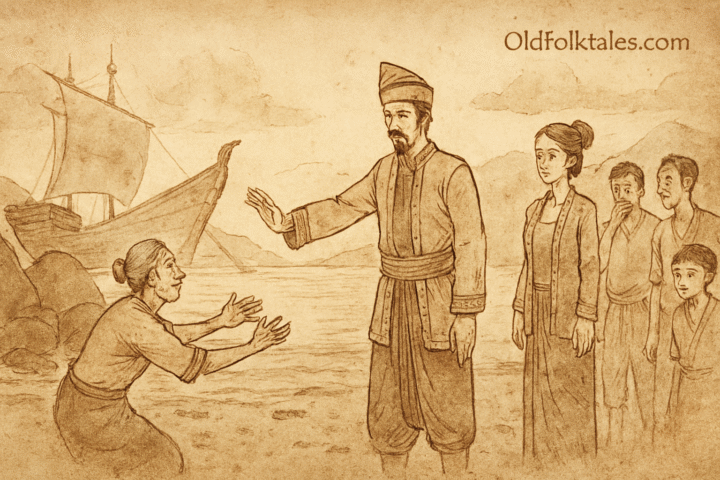
An elderly messenger paddled his canoe out to Bungtao’s flagship. Trembling, he was brought before the fierce Datto. With gestures and broken words, the old man begged for mercy, pointing to the glittering heap of offerings in his canoe. Then, placing the golden image of Captan at Bungtao’s feet and bowing low, he pleaded again for the women and children waiting on the shore.
Bungtao’s response was a scornful laugh. Gold? His island had gold enough to satisfy ten tribes. What he needed was slaves to work his fields, for warriors such as he would never lower themselves to common labor. With a curse, he kicked the messenger aside. Then, grasping the sacred golden image of Captan, he hurled it far over the water in contempt.
The moment the statue struck the waves, the sky turned black. Night fell as suddenly as a dropped curtain. The messenger felt invisible hands seize him and carry him swiftly to shore.
Then the heavens split open. A shower of silver fire rained down upon the Moro fleet. Flames of pure light cascaded from the sky, hemming the ships in on every side. Sailors screamed and dove into the water, but the bay itself boiled with divine fire. Ships burst into flames, their sails becoming towers of burning light. When the darkness finally cleared and dawn broke over the bay, nothing remained. Boats and Moros had vanished completely.
The people rushed to their temple to offer prayers of thanksgiving to Captan. There, in its usual place, stood the golden statue, unharmed, gleaming in the morning light. Around it lay all the rings, bracelets, and offerings they had sent to the Moro chief.
Days later, when the warriors returned victorious from the south, they could scarcely believe the miraculous tale. But that night, when they saw the waters of Manila Bay breaking on the shore in crystals of silvery light—waters that had never glowed before, they knew the truth. Captan had saved their families and homes with divine fire from heaven.
The ancient villages have long since vanished, replaced by the modern city of Manila. But the bay still glows at night. Scientists speak of phosphorus in the water, offering rational explanations. But those who know the old stories understand the truth: they are witnessing the eternal echo of the silver shower, Captan’s gift of protection to his faithful people.
Journey through enchanted forests and islands in our Southeast Asian Folktales collection.
The Moral of the Story
The tale of the Silver Shower teaches us that faith and righteousness are rewarded, even in the darkest hours. When the people of the Pasig villages faced certain destruction, they did not resort to violence or treachery but offered everything they possessed, including their most sacred treasure, to save their families. Though their offerings were rejected and their god insulted, Captan’s divine intervention proved that those who honor the sacred and protect the innocent will never be abandoned. The story reminds us that arrogance and cruelty, embodied by Datto Bungtao’s contempt, will ultimately face judgment, while humility and devotion endure.
Knowledge Check
Q1: Who was Datto Bungtao in this Philippine folktale?
A1: Datto Bungtao was a feared Moro warrior chief who terrorized the eastern seas with his fleet of two hundred ships. He invaded Luzon intending to burn villages and capture people as slaves, believing his army would conquer all resistance.
Q2: Why were only women, children, and elderly people left in the Pasig villages when Bungtao arrived?
A2: All the warriors from the Pasig villages had marched south to fight Bungtao’s invading army. They joined forces with other Filipino tribes, Tagalogs, Macabebes, Igorrotes, and Pangasinanes—to defend Luzon, leaving their homes unprotected.
Q3: What sacred offering did the villagers send to Datto Bungtao?
A3: The villagers sent all their valuables including gold rings, bracelets, bangles, and temple ornaments. Most importantly, they offered the golden statue of the god Captan, which was the tribe’s most precious and sacred possession that people traveled miles to worship.
Q4: How did the god Captan save the Pasig villages from destruction?
A4: When Bungtao threw Captan’s golden statue into the water in contempt, the sky turned black and a shower of silver fire rained down from heaven, destroying all of Bungtao’s ships and sailors. The statue miraculously returned to its place in the temple along with all the offerings.
Q5: What phenomenon in Manila Bay does this Filipino legend explain?
A5: The legend explains why the waters of Manila Bay glow with silvery phosphorescent light at night. When waves break on shore or water is disturbed, it sparkles and flashes like liquid fire the eternal remnant of Captan’s divine silver shower.
Q6: What cultural message does The Silver Shower convey about faith and divine protection?
A6: The story teaches that sincere faith and sacrifice are rewarded with divine protection. The villagers’ willingness to give everything, including their sacred treasures, demonstrated true devotion. Their humility contrasted with Bungtao’s arrogance, showing that those who honor the sacred will be defended by higher powers.
Source: Philippine folktale, Philippines