Along a narrow mountain pass in Edo-period Japan, travelers often faced danger from bandits, wild animals, and sudden storms. One misty evening, a young boy named Sora walked carefully along the path to deliver rice to his grandmother’s house in the village below. He had heard tales of a roadside Jizo statue that sometimes sang in warning to those who approached with respect, but many dismissed the stories as superstition.
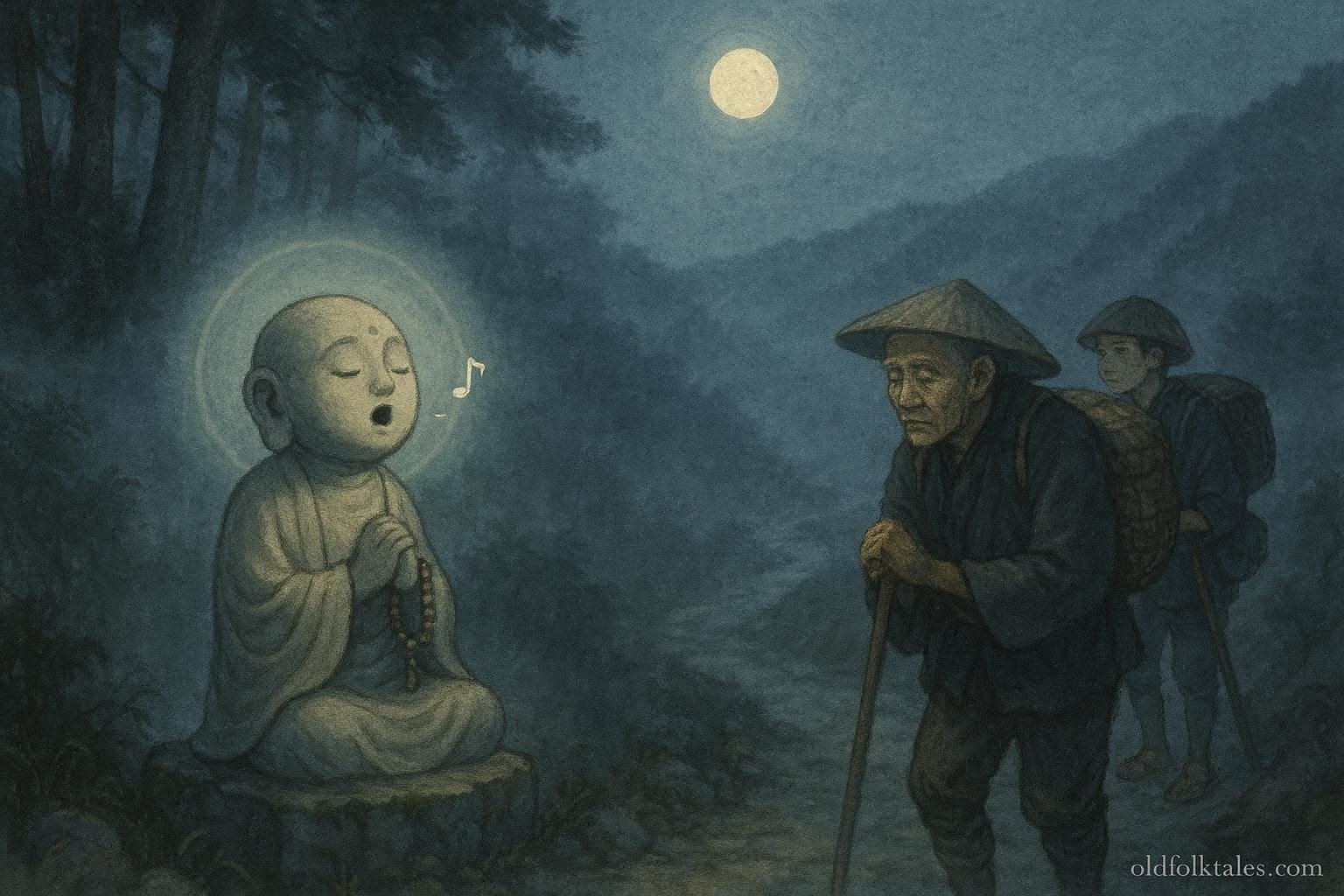
Sora’s steps were measured, and his eyes scanned the path. When the wind whispered through the bamboo, a soft humming arose, like a distant flute. Startled, he looked to the roadside and saw a small stone Jizo statue, its surface worn smooth by years of rain and travelers’ hands. To his amazement, the statue’s mouth moved as though speaking, and the hum grew louder, forming words he could almost understand.
The boy paused, remembering his father’s words: “Respect all things, even those without voice, and they may speak to you in ways you do not expect.” With a bow, Sora approached the statue, keeping a polite distance. The humming swelled into a melodic voice, warning him of a loose bridge further down the path. He thanked the statue quietly and turned back, choosing a safer crossing downstream. That evening, Sora’s grandmother praised him for arriving safely, unaware of the unseen warning that had guided him.
Explore ancient tales from Thailand, Cambodia, and the Philippines in Southeast Asian Folktales.
Several days later, a merchant named Genji hurried along the same path. His mind preoccupied with trade and profit, he barely noticed the Jizo statue. As he rushed past, the hum arose again, louder than before, singing a melodic warning. Genji laughed, dismissing the sound as the wind. He stepped onto the bridge heedlessly. Suddenly, a plank gave way, and he stumbled into the river. Fortunately, the current was shallow here, but he was soaked and humiliated. From that day on, he carried a small offering to the Jizo statue, never again ignoring its warnings.
The legend of the Singing Jizo grew over time. Children traveling to school left little rice balls at its base. Farmers passing through bowed and whispered prayers for safe journeys. Travelers who respected the statue often found their way guided by invisible forces, while those who ignored it faced delays, mishaps, or minor injuries.
One stormy night, a young girl named Hana lost her way on the same mountain path. She was frightened by the howling wind and the shadowy figures of trees bending under the storm. Suddenly, a soft melodic voice rose from the roadside. Hana froze. The Jizo statue was singing. Following the hum, she stumbled upon a faint lantern left by a kind villager and safely made her way to the village.
Generations passed, and the statue remained a symbol of protection. People learned to bow, leave small offerings, and pause in respect. The Jizo’s song was said to carry both guidance and gentle admonishment, teaching humility and awareness to anyone who would listen. Scholars who studied local folk beliefs noted that these guardian statues reinforced moral behavior as much as practical caution.
Through centuries, the Singing Jizo taught a simple yet enduring lesson: attentiveness, respect, and moral consideration open paths to safety and understanding, while arrogance and negligence bring consequence. Travelers continued to sing its praises, and the melody of protection echoed softly along the mountain path, even when the travelers themselves could not see the statue clearly in the misty night.
Moral Lesson
The Singing Jizo Statue teaches that respect, humility, and attentiveness to the unseen forces of the world lead to protection and guidance. Ignoring warnings or acting recklessly brings natural consequence, while acknowledgment of moral and spiritual cues fosters safety, wisdom, and communal harmony.
Knowledge Check
- Why did Sora approach the Jizo statue with respect?
Answer: He remembered his father’s advice that respect toward all things, even silent ones, could bring guidance and safety. - What happened to the merchant Genji when he ignored the statue’s warning?
Answer: Genji stumbled into the river because he dismissed the statue’s melodic warning, illustrating the consequence of arrogance. - How did Hana benefit from the Jizo statue during the stormy night?
Answer: The statue’s song guided her to a lantern and safely down the mountain path, demonstrating protection for those who listen. - What moral behavior did villagers learn from the Singing Jizo?
Answer: They learned humility, attentiveness, and the importance of small offerings and prayers, reinforcing respect and communal safety. - Why did the legend continue through generations?
Answer: The statue’s guidance consistently protected respectful travelers and provided gentle consequences for negligence, making the tale enduring and instructive. - What broader lesson does the Singing Jizo convey about unseen forces?
Answer: That spiritual awareness and moral conduct are intertwined with everyday safety, and listening carefully to subtle signs leads to wisdom and protection.
Source
Adapted from Ritsumeikan University Folk Religion Digital Archive, 2016.
Cultural Origin
Buddhist roadside worship folklore of Japan.