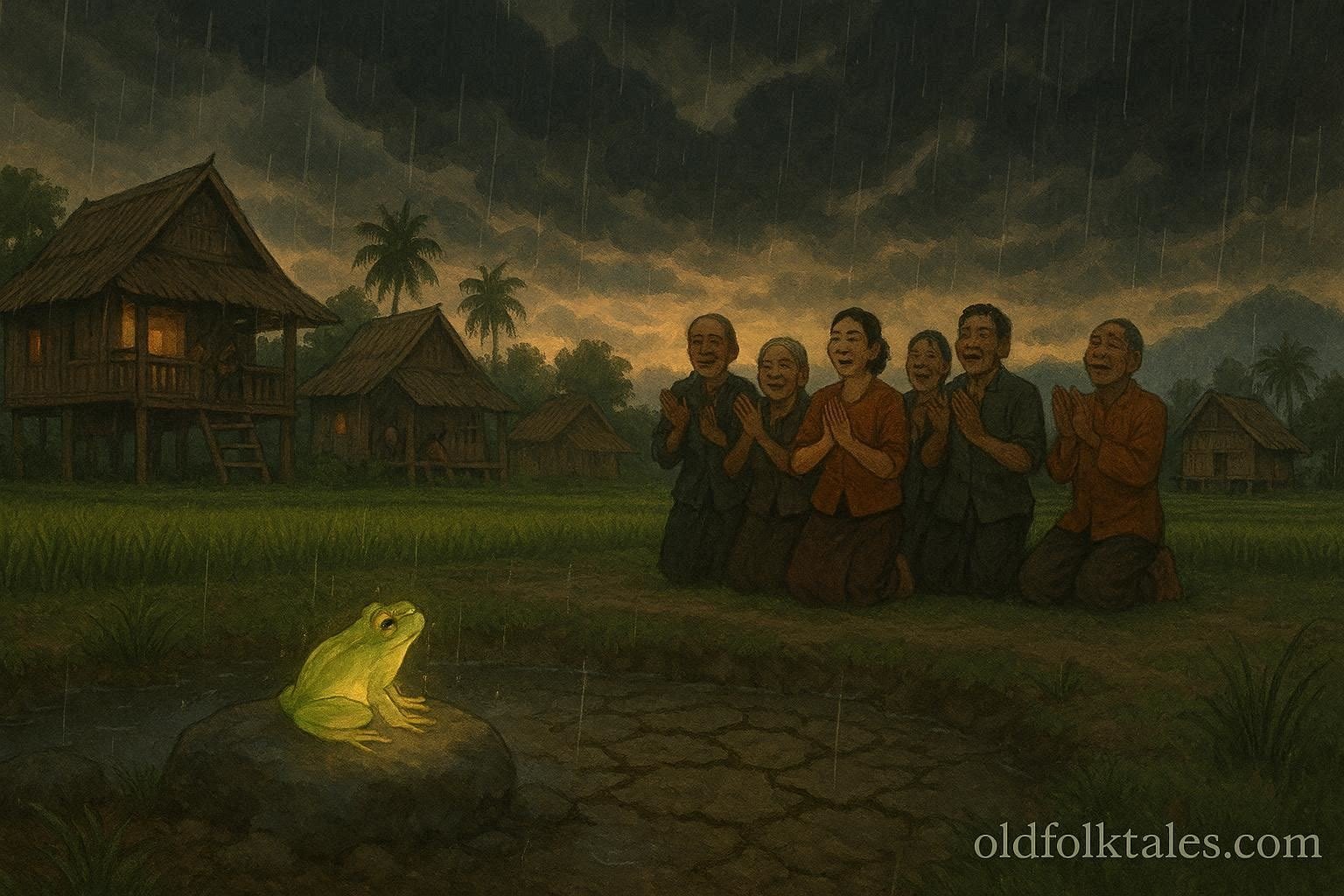
In a small Lao village surrounded by rice fields and low green hills, the people waited anxiously for the coming of the rains. The earth had begun to crack beneath the sun, and the rice shoots bent weakly in the heat. Elders gathered each evening to study the clouds, but the sky remained silent and pale. Without rain, the village faced hunger, and the children felt the tension even as they played.
Among the villagers lived a curious child named Noi. Unlike the others, Noi spent hours watching insects, listening to birds, and speaking softly to the land as though it could answer. When the drought worsened, Noi wandered farther than usual, searching for signs of change.
One afternoon, near a dried pond at the edge of the fields, Noi heard a strange voice singing softly. It was not human and not quite like any animal sound Noi had heard before. Following the sound, Noi discovered a small frog sitting on a warm stone. Its skin shimmered faintly, reflecting the sky rather than the earth.
Discover more East Asian Folktales from the lands of dragons, cherry blossoms, and mountain spirits.
The frog spoke clearly, its voice gentle and calm. It said it had come from the sky, sent down when people forgot how to listen to nature. Noi was not frightened. Instead, Noi bowed politely, as taught by the elders when meeting something unknown.
The frog smiled and asked why the child looked so worried. Noi explained about the drought, the failing crops, and the fear in the village. The frog listened closely, then nodded.
The frog explained that rain does not come when demanded but when invited with respect. Long ago, villagers knew the songs and rhythms that welcomed the clouds. Over time, those rituals were forgotten. The frog offered to teach them again, but only if the village would promise to act together and honor the land.
Noi returned home and told the elders everything. At first, some laughed, saying a frog could not fall from the sky. Others hesitated, remembering old stories passed down by their grandparents. Finally, the eldest woman in the village spoke. She recalled a legend of sky frogs who carried the language of rain. The elders agreed to listen.
That evening, Noi led them to the dried pond. The frog waited patiently, glowing softly as the sun set. It taught them a rhythm made by clapping hands and tapping bamboo. It taught them a song without words, only tones that rose and fell like breath. The frog explained that everyone must join, not for reward, but to show unity.
The next morning, the entire village gathered. Children, elders, farmers, and monks stood together. The frog began the rhythm, and slowly the villagers followed. Their voices blended with the wind. The land seemed to listen. Leaves trembled gently. The air grew heavy.
As the song continued, clouds gathered silently overhead. A low rumble echoed far away. The frog lifted its head toward the sky and sang one final note that seemed to vibrate through the ground itself.
Then the first drop fell.
The villagers gasped as rain followed rain, soft at first, then steady and nourishing. Laughter and tears filled the air. The rice fields drank deeply, and the earth released its heat. The frog hopped into the rain, its form becoming brighter with each drop.
Before disappearing, the frog spoke once more. It reminded the villagers that rain would return when respect returned. It asked them to teach their children not only how to farm, but how to listen. With that, the frog leapt toward the sky and vanished among the clouds.
The rains continued for days, restoring life to the fields. From that year onward, the village renewed the ritual at the beginning of every monsoon season. They sang not to command the sky, but to greet it.
And sometimes, when the first rain falls, children still say they hear a soft frog song echoing from above.
Journey through enchanted forests and islands in our Southeast Asian Folktales collection.
Moral Lesson
Nature responds not to force but to respect and unity. When people listen carefully, act together, and honor the rhythms of the world around them, balance is restored. Even the smallest voice can carry great wisdom when it speaks with sincerity and harmony.
Knowledge Check
- Why was the village suffering at the beginning of the story?
Answer: Because there was a drought and no rain for the crops. - Who discovered the sky frog?
Answer: A curious child named Noi. - What did the frog teach the villagers?
Answer: Songs and rhythms to respectfully invite the rain. - Why did the ritual work?
Answer: Because the villagers acted together with respect and unity. - What happened to the frog after the rain began?
Answer: It returned to the sky among the clouds. - What tradition did the village continue afterward?
Answer: Performing the rain calling ritual each monsoon season.
Source
Adapted from Lao Meteorological Folklore Studies Archive, 2016.
Cultural Origin
Lao monsoon season ritual folklore