In a prosperous kingdom long ago, there lived a King blessed with seven Queens, yet cursed with sorrow, for despite all his wealth and power, he had no heir. The thought of his kingdom passing into stranger’s hands after his death weighed heavily upon his heart, like a stone sinking in deep water.
One fateful day, an old fakir appeared at the palace gates, his eyes twinkling with otherworldly knowledge. “Your prayers have been heard,” he proclaimed. “One of your seven Queens shall bear you a son.” The King’s joy knew no bounds. He ordered celebrations throughout the land, and the seven Queens were pampered beyond measure in their magnificent palace, attended by hundreds of servants and fed the finest sweetmeats.
Click to read all South & Central Asian Folktales — home to stories from India, Nepal, Afghanistan, and Sri Lanka.
But happiness, like morning dew, can vanish swiftly.
The King was passionate about hunting, and one morning, the seven Queens sent him an urgent message: “Beloved husband, we have dreamed troubling dreams. Please, do not hunt toward the north today.” The King promised to honor their wishes and rode south. Yet fortune plays cruel tricks, he found no game in the south, east, or west. His sportsman’s pride refused to let him return empty-handed, and he forgot his promise, turning his horse northward.
There, in the shadowy thickets of the northern forest, a magnificent white hind flashed before him, its horns gleaming gold, its hooves shimmering silver. The creature’s beauty seized his heart like a fever. He commanded his men to surround it, but just as he reached to capture it, the hind leaped impossibly high over his head and fled toward the mountains. Bewitched, the King pursued it alone, galloping until he found himself in a desolate ravine.
Before him stood a miserable hovel. Thirsty and exhausted, he entered to request water. An old woman sat spinning, and when she called her daughter, a maiden emerged, so radiantly beautiful, with golden hair and skin like moonlight, that the King stood transfixed. As she held the water vessel to his lips, he gazed into her eyes and knew the truth: this enchanting girl was the white hind he had chased.
Her magical beauty overwhelmed him completely. He fell to his knees, begging her to become his bride. She laughed mockingly. “Seven Queens are surely enough for any king!” But when he persisted, promising her anything her heart desired, she spoke with chilling cruelty: “Bring me the eyes of your seven Queens. Then perhaps I shall believe you.”
So thoroughly had she bewitched him that the King returned home and committed an unthinkable horror, he had his seven Queens’ eyes torn out and cast the blind, suffering women into a filthy dungeon to die. He brought the fourteen eyes to the white hind, who merely laughed, threading them into a gruesome necklace for her mother before returning with him as his bride. She claimed everything the seven Queens once possessed: their palace, their jewels, their servants, their very lives.
But life finds a way, even in darkness.
Soon after their imprisonment, the youngest Queen gave birth to a handsome baby boy. Though the other Queens initially felt jealous, the child quickly won their hearts. As soon as he could walk, he began scratching at the mud walls, eventually creating a hole large enough to slip through. Each day he ventured out, playing with noble children in the town, performing tricks and amusing everyone. No one knew who this charming boy was, but everyone rewarded him with sweets and grain, which he faithfully brought back to his seven mothers.
As he grew into a strong young man, he learned to hunt. One day, shooting pigeons near the white Queen’s palace, he caught her attention. Through her dark witchcraft, she instantly recognized the King’s son, the child who should have died in the dungeon. Consumed with spite, she summoned him, pretending kindness.
“Would you like to restore your mothers’ sight?” she asked sweetly. “Give me that pigeon, and I shall show you where their eyes are kept.” Overjoyed, the boy agreed. She sent him to her mother with a potsherd bearing a deadly message: “Kill the bearer at once, and sprinkle his blood like water!”
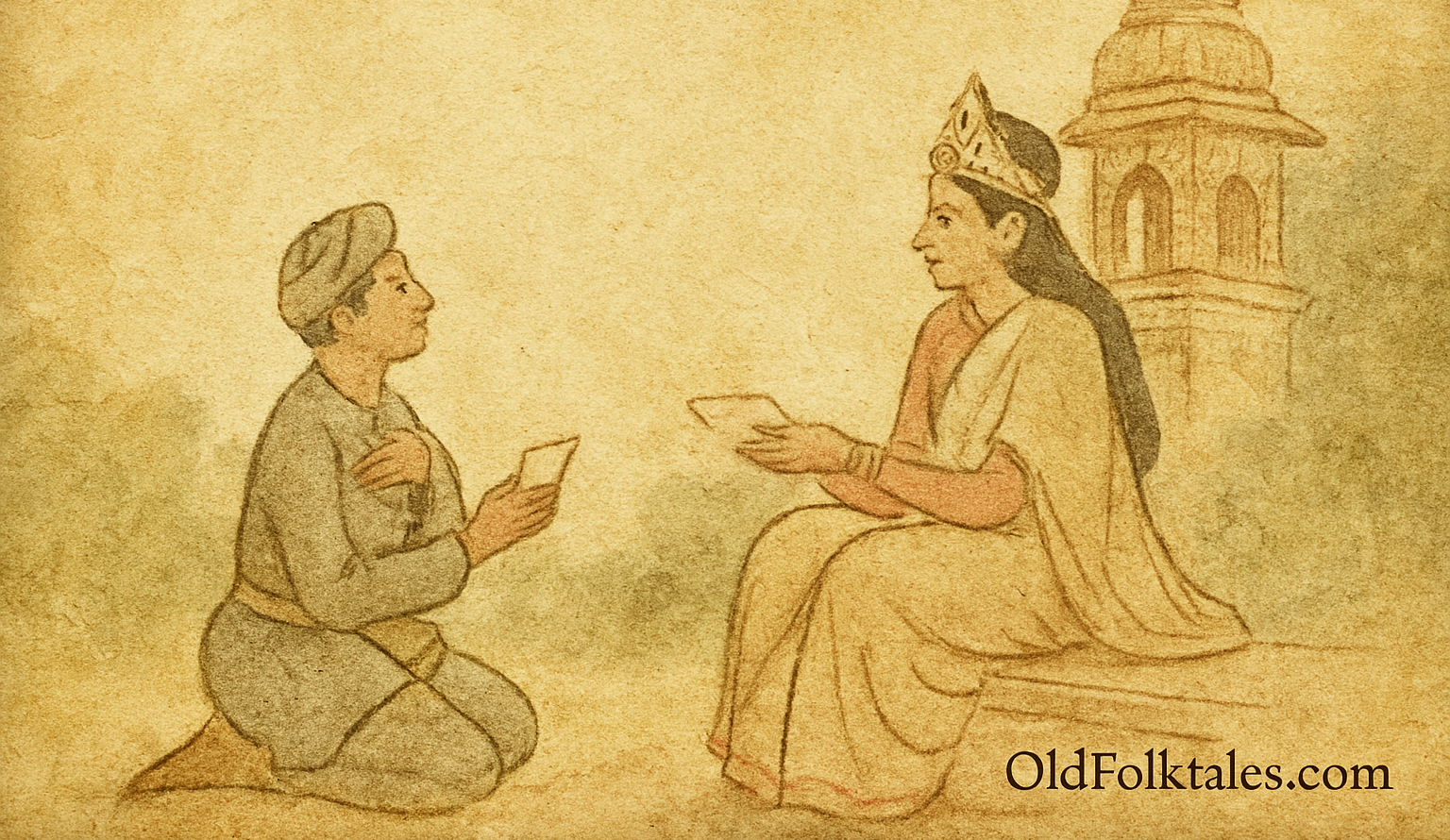
But destiny had other plans. On his journey, the boy passed through a city where a Princess had declared she would only marry the son of seven mothers. When she saw him, she knew he was her destined husband. Being wise and learned, she read the treacherous message and secretly replaced it with one commanding kindness toward the boy.
Thus the old hag, though furious, was forced to surrender the necklace of thirteen eyes (one had been lost). The boy raced home and restored sight to his mothers two eyes each for the six elder Queens, and one for his youngest mother. “Dearest little mother,” he said tenderly, “I will be your other eye always!”
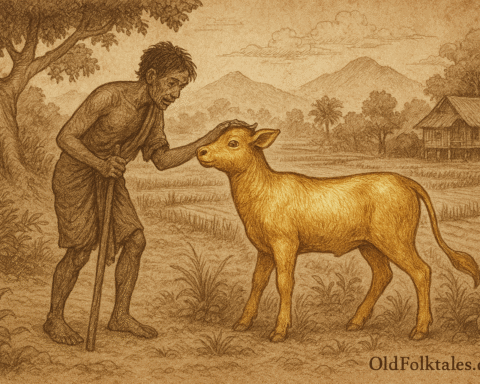
This pattern repeated twice more. The white Queen, seeing him alive, sent him on impossible quests, first for the Jogi’s magical cow whose milk flows endlessly, then for the million-fold rice that ripens overnight. Each time she sent messages commanding his death, and each time the clever Princess substituted messages of protection. The boy successfully obtained both treasures, though the final quest nearly cost his life when he disobeyed warnings and was turned to ash. The old hag, fearing her daughter’s wrath, restored him with her magic.
Now immensely wealthy from the magical gifts, the seven Queens lived in comfort once more. The boy married his clever Princess, who orchestrated a brilliant plan for justice. She had him build a palace identical to the white Queen’s and invited the King to a grand feast. When the King entered and found himself face-to-face with his seven Queens alive, restored, and royal once more, the enchantment shattered like glass.
The Princess revealed the entire wicked tale. The King’s fury toward the white hind burned fierce and righteous. She was executed, her grave ploughed over so no trace of her evil remained. The seven Queens returned to their rightful palace, the King embraced his son, and the kingdom knew peace and happiness once more.
The Moral of the Story
This tale teaches us that evil born of vanity and cruelty will ultimately destroy itself, while courage, filial devotion, and cleverness triumph over dark magic. The son’s unwavering love for his seven mothers, combined with the Princess’s wisdom, broke through the most powerful enchantment. True strength lies not in magic or beauty, but in loyalty, intelligence, and the bonds of love that refuse to break, even in the darkest dungeons.
Knowledge Check
Q1: Who is the main character in “The Son of Seven Queens” and what makes him special?
A1: The main character is the son born to the youngest of seven Queens who were blinded and imprisoned. He is special because he selflessly cares for all seven Queens as his mothers, showing extraordinary courage and devotion by venturing out daily to bring them food and eventually restoring their eyesight.
Q2: What is the symbolism of the white hind in this Indian folktale?
A2: The white hind with golden horns and silver hooves symbolizes dangerous enchantment and deceptive beauty. She represents how greed and bewitchment can lead even wise rulers to commit terrible acts, and how evil disguises itself in beautiful forms to manipulate others.
Q3: What role does the clever Princess play in the story?
A3: The Princess is the hero’s savior and equal partner. Her wisdom and literacy allow her to read the white Queen’s treacherous messages and replace them with protective ones, saving the boy’s life three times. She represents intelligence, loyalty, and the power of education to overcome evil plots.
Q4: What lesson does the story teach about family and devotion?
A4: The story emphasizes that family bonds transcend blood alone, the boy calls all seven Queens his mothers and serves them with equal devotion. It teaches that true filial love means sacrifice, persistence, and never abandoning those who depend on you, even in the darkest circumstances.
Q5: What is the cultural origin of “The Son of Seven Queens”?
A5: “The Son of Seven Queens” is a traditional Indian folktale that reflects themes common in South Asian storytelling, including the fakir (holy man), magical creatures, tests of character, and the triumph of dharma (righteous duty) over adharma (evil). The story’s elements of multiple queens, palace intrigue, and magical quests are typical of Indian folklore.
Q6: Why does the white Queen demand the seven Queens’ eyes?
A6: The white Queen demands the eyes as proof of the King’s devotion to her, but more deeply, it represents the complete destruction of her rivals. By taking their sight and imprisoning them, she attempts to erase them from existence entirely, claiming not just the King’s love but their very identity and place in the kingdom.
Source: Indian folktale, India