The sword was already broken when it was returned to the family altar. Its blade had split cleanly near the middle, not from rust or neglect but from a final strike delivered in absolute resolve. For generations afterward, the sword rested silently in a wooden stand, wrapped in white cloth, its fractured edge hidden from view. Yet within the household, it was never spoken of as useless. It was known as the blade that still watched.
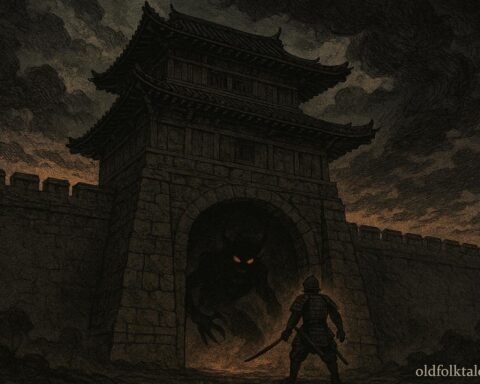
The samurai named Masanori had carried that sword into his last battle. He had not been a famous general nor a warlord sung about in court poetry. He was a provincial retainer whose duty was to protect a small mountain domain and the families who lived under its protection. When rebellion reached the valley, Masanori stood with only a handful of warriors against forces that outnumbered them. During the final clash, as arrows darkened the sky and steel rang against steel, Masanori placed himself between the invaders and a group of fleeing villagers.
His sword shattered when it struck the enemy commander’s armor, breaking not because it was weak but because Masanori poured every remaining breath into that final blow. Though wounded beyond survival, he succeeded in stopping the advance long enough for the villagers to escape. By the time his body was recovered, the blade lay snapped beside him, still clenched in his grasp.
Journey through enchanted forests and islands in our Southeast Asian Folktales collection.
Masanori’s descendants enshrined the broken sword not as a relic of defeat but as proof of fulfilled duty. Each generation was taught the same lesson. A blade does not protect through sharpness alone. It protects through intention.
Years passed, and wars faded into memory. Masanori’s family became farmers, teachers, and scribes. Yet strange events followed them wherever they settled. Fires stopped at the edge of their homes. Bandits lost their way near their fields. Illness lingered everywhere except their household. At night, some claimed to hear the faint sound of steel humming softly in the shrine room, as though the sword remembered its purpose.
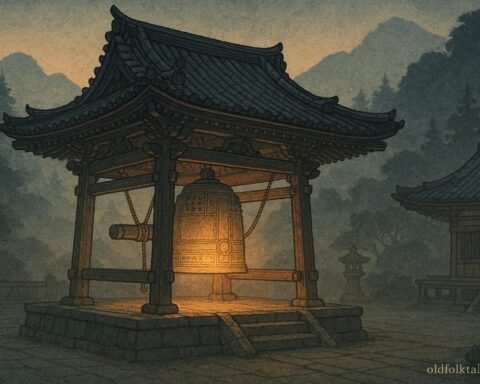
One descendant named Akio was the first to question whether the protection came from coincidence or from something unseen. Akio lived during a time when samurai rule had ended, and swords were no longer carried openly. He had never trained in combat, yet he felt a deep responsibility toward the broken blade. One night, after a violent storm damaged much of the village, Akio dreamed of Masanori standing beneath a pine tree, his armor cracked and his sword broken but his posture unyielding.
In the dream, Masanori spoke without moving his lips. He said that duty does not die with the body. It lingers where promises were kept. When Akio awoke, he found the cloth around the sword slightly loosened, though no one else had entered the room.
Soon after, a group of thieves attempted to raid the village. They avoided many houses but inexplicably refused to approach Akio’s home. Later, one of the captured thieves confessed that when they neared the shrine room, they felt as though someone unseen stood watching with unbearable intensity.
As word spread, villagers came to believe that the sword was inhabited by Masanori’s spirit. However, the family elders rejected the idea of possession. They taught that Masanori did not linger as a ghost but as a vow bound to steel. The sword did not seek revenge or fear. It responded only to threats against the innocent.
During a later generation, when a dispute over land nearly erupted into violence, the broken sword played its quiet role once more. As tempers flared and weapons were raised, a sudden crack echoed across the courtyard. The wooden stand holding the sword split cleanly in two, startling everyone present. The confrontation ended immediately. No blood was spilled. Many believed the sword had intervened, reminding all parties of the cost of violence.
Over time, the family learned that the sword’s protection was strongest when its descendants acted with integrity. During a period when one heir grew arrogant and dishonest, the household suffered repeated misfortune. Crops failed. Illness spread. Only after the heir confessed his wrongdoing before the altar and asked forgiveness did peace return.
The broken sword became a teacher rather than a weapon. It reminded each generation that honor was not inherited automatically. It had to be renewed through action. The blade protected the family not because they owned it but because they upheld the spirit that broke it in the first place.
When modernity arrived and many families abandoned old traditions, Masanori’s descendants refused to discard the sword. They did not display it as an artifact nor sell it as a curiosity. Instead, they continued to clean the shrine, light incense, and tell the story to their children. They taught that protection is born from responsibility and that legacy lives not in strength but in sacrifice.
To this day, the sword remains broken. No one has attempted to repair it. They believe that restoring the blade would weaken its meaning. A sword once broken in service should remain as it is, a reminder that true power is found in what one is willing to give up.
Moral Lesson:
True honor does not end with death. When actions are guided by selfless duty, their influence continues across generations. Protection comes not from force alone but from integrity, sacrifice, and the willingness to stand for others even at great personal cost.
Knowledge Check:
1 Who originally wielded the broken sword?
Answer: A samurai named Masanori
2 Why did Masanori’s sword break?
Answer: It shattered during a final powerful strike made to protect fleeing villagers
3 Where was the broken sword kept after Masanori’s death?
Answer: It was placed on the family altar
4 What signaled that the sword’s protection depended on moral behavior?
Answer: Misfortune occurred when a descendant acted dishonestly
5 Did the sword act as a weapon after Masanori’s death?
Answer: No it acted as a spiritual guardian and moral reminder
6 What lesson did the family believe the broken sword taught?
Answer: That honor and duty must be upheld through actions rather than possession
Source:
Adapted from National Institute of Japanese Literature Folktale Manuscripts, 2012.
Cultural Origin:
Samurai era martial folklore of Japan.