In the highlands of Shan State, where mountains cradle the waters of Inle Lake like protective arms, the Intha people have lived for generations, building their lives upon the very surface of the water. Here, houses rise on stilts above the lake’s rippling expanse, and fishermen balance gracefully on one leg at the sterns of their narrow boats, wrapping the other leg around a single oar to propel themselves through the morning mist. This is a place where water and sky merge in the silver dawn, where the boundary between the earthly realm and the spirit world grows thin as gossamer thread.
The boatmen of Inle Lake are people of few words but many stories. As they paddle through the floating gardens and past the ancient stupas that dot the shoreline, they speak in hushed tones of a particular nat, a spirit who appears when fog rolls across the water like a living thing, turning the familiar lake into a maze of gray mystery. This is the Stilt-Walker Nat, and his story is woven into the very fabric of life on Inle Lake.
Click to read all East Asian Folktales — including beloved stories from China, Japan, Korea, and Mongolia.
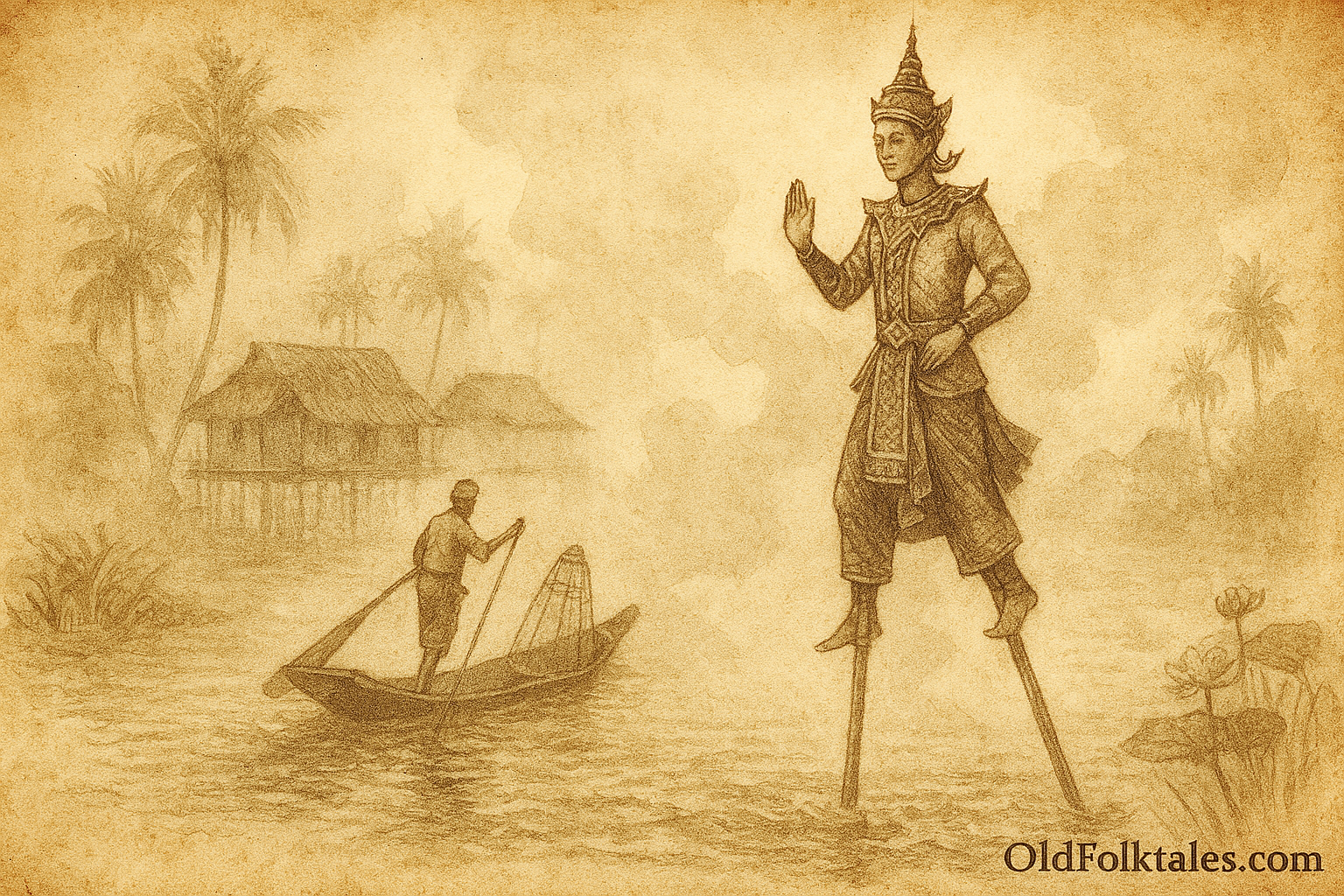
According to the tales passed down through generations of Intha families, the Stilt-Walker Nat appears as a young man of extraordinary grace, dressed in the traditional costume of a ceremonial dancer. His longyi is wrapped perfectly around his waist, its colors vivid even through the thickest fog deep reds and brilliant golds that seem to hold light within their threads. Upon his head sits an ornate headdress adorned with gold leaf and precious stones, the kind worn only by the most skilled performers during the greatest festivals.
But it is his stilts that mark him as something beyond mortal. They are tall impossibly tall carved from dark wood and bound with silver cord. Upon these stilts, he walks across the surface of the lake itself, moving with the fluid certainty of someone who knows every hidden current, every treacherous eddy, every place where the water grows suddenly deep and dangerous.
The nat appears only when fog descends upon the lake, usually in the hours before dawn or as evening darkness gathers. Fishermen who venture out during these times sometimes catch glimpses of him through the gray curtain of mist a tall silhouette moving with deliberate purpose across the water. His stilts make no sound as they touch the lake’s surface, leaving no ripples, no trace of passage. He simply glides through the fog like a figure from a dream.
But the Stilt-Walker Nat does not appear merely to haunt the waters. He comes as a guardian, a protector of those who make their living upon the lake. When fishermen find themselves lost in the disorienting fog, unable to distinguish north from south or home from open water, the nat appears before them. Sometimes he gestures with graceful hands, pointing toward safe passage. Other times he walks ahead of their boats, leading them away from danger with silent authority.
There are places on Inle Lake where the water becomes treacherous areas where hidden whirlpools spin beneath the surface, created by underground springs and strange currents. In winter, when the temperature drops, thin patches of ice can form in the shallows, brittle and deceptive, capable of trapping a boat or causing injury to an unwary fisherman. The Stilt-Walker Nat knows every one of these hazards intimately, and he guides travelers around them with careful precision.
Old U Htun, a fisherman whose hair has turned white from decades on the water, tells the story of the night the nat saved his life. “I was returning home after checking my fish traps,” he says, his weathered hands gesturing as he speaks. “The fog came suddenly, thicker than I had ever seen. I could not see my own hand before my face. I heard the sound of a whirlpool that terrible sucking sound and I knew I was drifting toward it.”
U Htun’s voice drops to a whisper as he continues. “Then I saw him. The young man on stilts, glowing faintly through the fog. He raised his hand, palm facing me, telling me to stop. Then he moved to my left, and I followed. He led me in a wide circle around the whirlpool, and when the fog finally lifted, I found myself at my own dock. I turned to thank him, but he had already vanished.”
But who was this spirit before he became a nat? The elders say he was once a living man a dancer of exceptional talent who performed during the sacred Phaung Daw Oo festival, the most important celebration on Inle Lake. This festival, held each autumn, honors the five ancient Buddha images housed in the Phaung Daw Oo Pagoda. During the festival, these sacred images are paraded around the lake in a magnificent golden barge shaped like a karaweik bird, stopping at different villages over many days.
The young dancer was renowned throughout the region for his grace and skill. He could balance on the tallest stilts while performing intricate movements, his body telling stories of gods and heroes, of creation and devotion. Crowds would gather wherever he performed, watching in breathless silence as he danced on the very edge of possibility.
But during one Phaung Daw Oo festival, tragedy struck. The dancer was performing on stilts at the edge of the lake when he lost his balance. He fell into the deep water, and before anyone could reach him, the current pulled him under. His body was never recovered, claimed by the lake he had performed beside so many times.
The Intha people mourned deeply, for he had brought beauty and joy to their festivals. But they also understood that his spirit remained, unable to leave the water that had taken his life. Rather than becoming a vengeful ghost, however, the dancer’s spirit transformed into something nobler. He became a nat a protector who uses the skills he perfected in life to guide others to safety.
Now, whenever fog shrouds Inle Lake, the fishermen watch for him. Some leave offerings at the water’s edge flowers, candles, and small portions of food thanking the Stilt-Walker Nat for his vigilant protection. They know that as long as he walks the misty waters, they will never be truly lost.
The younger generation sometimes dismisses these stories as superstition, products of imagination and fog-induced illusion. But the old fishermen shake their heads knowingly. They have seen too much, experienced too many impossible rescues, witnessed too many moments when guidance came from nowhere in their times of greatest need.
“The lake remembers those who serve it,” they say. “And the Stilt-Walker Nat serves us still, repaying with eternal vigilance the life that the water took from him. As long as boats sail these waters, he will be here, dancing on his stilts through the fog, leading us home.”
Click to read all Southeast Asian Folktales — featuring legends from Thailand, Indonesia, Vietnam, and the Philippines.
The Moral Lesson
This Myanmar legend teaches us that redemption can come through service to others, even beyond death. The dancer who lost his life in the lake chose to transform his tragedy into eternal protection for those who face the same waters. His story reminds us that true greatness lies not in seeking glory for ourselves, but in using our gifts to guide and protect others. Even in death, compassion and duty can transcend personal loss, turning grief into grace and transforming a spirit into a guardian.
Knowledge Check
Q1: Who is the Stilt-Walker Nat of Inle Lake in Myanmar?
A: The Stilt-Walker Nat is a protective spirit who appears as a young man in traditional dancer’s costume, walking on tall stilts across the foggy waters of Inle Lake to guide and protect fishermen from danger.
Q2: How does the Stilt-Walker Nat protect fishermen on Inle Lake?
A: The nat appears during fog to warn fishermen of dangerous whirlpools and thin ice patches, gesturing to guide them around hazards or walking ahead of their boats to lead them to safety when they’re lost.
Q3: What was the Stilt-Walker Nat’s identity before becoming a spirit?
A: He was a renowned ceremonial dancer of exceptional talent who performed on tall stilts during the sacred Phaung Daw Oo festival, until he tragically fell into the lake and drowned during one performance.
Q4: What is the Phaung Daw Oo festival mentioned in this Myanmar legend?
A: The Phaung Daw Oo festival is the most important celebration on Inle Lake, held each autumn to honor five ancient Buddha images that are paraded around the lake in a golden barge shaped like a karaweik bird.
Q5: When does the Stilt-Walker Nat appear to fishermen?
A: The spirit appears only when thick fog descends upon Inle Lake, typically in the hours before dawn or during evening darkness, when the mist makes navigation treacherous and fishermen are most vulnerable.
Q5: What is the cultural significance of nats in Myanmar tradition?
A: In Myanmar Buddhist culture, nats are spirits that inhabit the natural world and can interact with humans. The Stilt-Walker Nat represents the belief that spirits can choose to protect and serve communities, embodying the values of compassion and redemption that persist beyond death.
Cultural Origin: Intha people, Inle Lake region, Shan State, Myanmar (Burma)