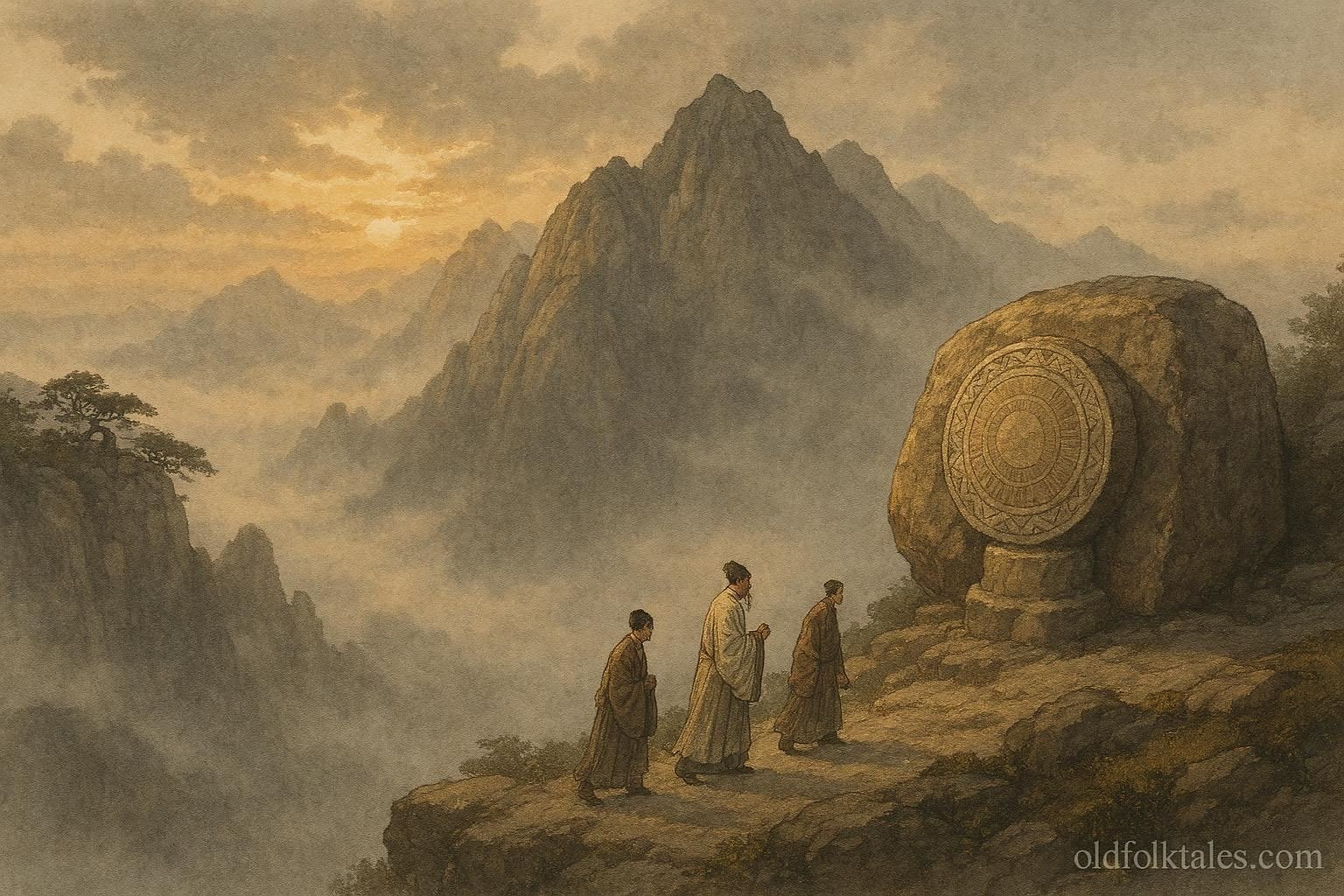
Mist often gathered around Mount Tai at dawn, clinging to its slopes like a living breath. Pilgrims climbed its ancient paths in silence, believing the mountain to be more than stone and soil. It was the meeting place of Heaven and Earth, where emperors once came to affirm their right to rule and where unseen forces were said to watch the conduct of the human world. Among the many shrines and sacred markers scattered across the mountain stood an object few dared to touch and none could explain. It was the Stone Drum.
The drum was not shaped like the instruments used by musicians or armies. It was carved directly from a massive boulder near a cliff that overlooked the plains below. Its surface was smooth and circular, hollowed just enough to resemble the face of a drum, yet there were no carvings of animals or inscriptions of praise. Time had weathered its edges, but the center remained strangely untouched, as if protected by an invisible hand. Local villagers said it had been there longer than memory, older than dynasties, older even than the temples that now surrounded it.
For generations, the Stone Drum lay silent. Shepherds passed it without glancing back. Monks swept fallen leaves from its base. Pilgrims burned incense nearby, bowing not to the drum itself but to the mountain that cradled it. Yet in rare moments of great consequence, the drum made itself known.
Journey through enchanted forests and islands in our Southeast Asian Folktales collection.
The first recorded sounding of the Stone Drum occurred during the late years of a powerful dynasty. The emperor at that time ruled with confidence bordering on arrogance. Taxes were raised to fund grand palaces, and officials who spoke against corruption were dismissed or silenced. Though harvests remained steady, the people whispered of suffering. Still, the court believed Heaven remained favorable, for no rebellion had yet arisen.
One autumn night, as clouds rolled heavily across Mount Tai, a deep resonant sound echoed through the valleys below. It was not thunder. It did not fade quickly. The sound struck once, then again, steady and solemn, as if a giant hand were striking stone with measured intent. Monks rushed from their quarters. Villagers fell to their knees. The Stone Drum had sounded.
By morning, the mountain paths were crowded. Word spread swiftly to the capital, carried by messengers who rode without rest. Court scholars debated the meaning. Some dismissed it as a natural phenomenon, claiming shifting rock or distant storms. Others, steeped in classical texts, grew pale. Ancient commentaries spoke of mountain omens as judgments from Heaven. A sounding drum was not a call to celebration but a warning.
The emperor was informed but chose to ignore it. He ordered sacrifices at Mount Tai, lavish offerings meant to display his power and devotion. Yet the ceremonies were performed without humility. Officials competed to be seen at the forefront, and bribes flowed freely to secure positions near the altar. The mountain received the rituals, but Heaven remained silent.
Within a year, floods ravaged the eastern provinces. Grain stores were hoarded by corrupt officials. Protests erupted, then rebellions. The dynasty fell not in a single moment but through a slow unraveling, as loyalty eroded and armies defected. In the chaos that followed, many remembered the night the Stone Drum spoke and understood too late what it had tried to say.
Centuries later, another dynasty rose, guided by leaders who claimed to have learned from the past. This time, when the Stone Drum sounded, the response was different. The emperor, young and newly enthroned, traveled to Mount Tai himself. He walked the final stretch on foot, dismissed his guards, and bowed before the drum without music or display.
He listened.
No further sound came, but the silence itself carried meaning. The emperor returned to his court and issued reforms. Taxes were reduced. Officials were reviewed. Those known for cruelty were removed, and those of integrity were elevated. The people noticed. Peace followed. The Stone Drum remained quiet for many generations afterward.
Scholars came to believe that the drum did not predict fate but reflected moral imbalance. When rulers drifted too far from humility and responsibility, the mountain responded. Mount Tai, after all, was not merely a landmark. It was the axis of the world, where Heaven observed humanity most closely.
Villagers living near the mountain developed customs around the Stone Drum. Children were taught never to strike stone in play near the site. Elders told stories by firelight, reminding listeners that power carried weight and that arrogance echoed loudly in places where Heaven listened.
One story spoke of an ambitious official who attempted to chip a fragment from the drum, hoping to harness its power. The stone resisted every tool. When the man persisted, he slipped, injuring himself severely. He survived but lost his position soon after, remembered not for his achievements but for his disrespect.
Over time, the Stone Drum became less a source of fear and more a symbol of balance. It reminded rulers that legitimacy was not granted once and forever. It had to be renewed through moral conduct. Just as the mountain endured through ages of change, so too did the standards by which Heaven judged those who governed below.
Even in later eras, when emperors no longer climbed Mount Tai in person, the legend endured. Chroniclers recorded that before major transitions, unusual sounds were heard near the ancient drum. Whether these were echoes of stone, movements of earth, or something beyond human understanding mattered less than the lesson people drew from them.
Power without humility invited collapse. Authority without compassion invited judgment.
Today, Mount Tai still rises above the plains, its paths worn smooth by countless footsteps. The Stone Drum remains where it has always been, silent, weathered, and watchful. Visitors may pass it without hearing a sound, yet those who know its story feel a quiet weight in its presence. It stands as a reminder that even the strongest walls of stone can speak when moral order is threatened and that true warnings are often given not in words but in signs that demand reflection rather than denial.
Moral Lesson
This story teaches that legitimate authority depends on humility, ethical governance, and attentiveness to moral warning signs. Power that ignores responsibility invites downfall, while leaders who listen, reform, and act with restraint preserve harmony between Heaven and humanity.
Knowledge Check
- What is the Stone Drum and where is it located?
It is a sacred drum carved into stone on Mount Tai, believed to sound before major dynastic change. - When does the Stone Drum sound according to the story?
It sounds when moral imbalance arises, particularly when rulers govern with arrogance or neglect. - How did the first emperor respond to the warning of the Stone Drum?
He ignored its meaning and performed hollow rituals without humility. - What were the consequences of ignoring the Stone Drum’s warning?
The dynasty eventually collapsed due to corruption, unrest, and rebellion. - How did a later emperor respond differently to the Stone Drum?
He approached with humility, listened, and implemented moral reforms. - What does the continued silence of the Stone Drum represent?
A state of balance and ethical governance.
Source
Adapted from Shandong Provincial Cultural Relics Folklore Archive, 2012.
Cultural Origin
Mount Tai ritual folklore of China.