At the foot of a sacred mountain in southern Laos stood the ancient temple of Wat Phou. Long before kingdoms rose and fell, the temple was already old, its stones shaped to follow the curve of the land rather than conquer it. Springs flowed nearby, feeding the earth, and the mountain behind the temple was believed to be the dwelling place of powerful spirits. People came not only to pray, but to listen.
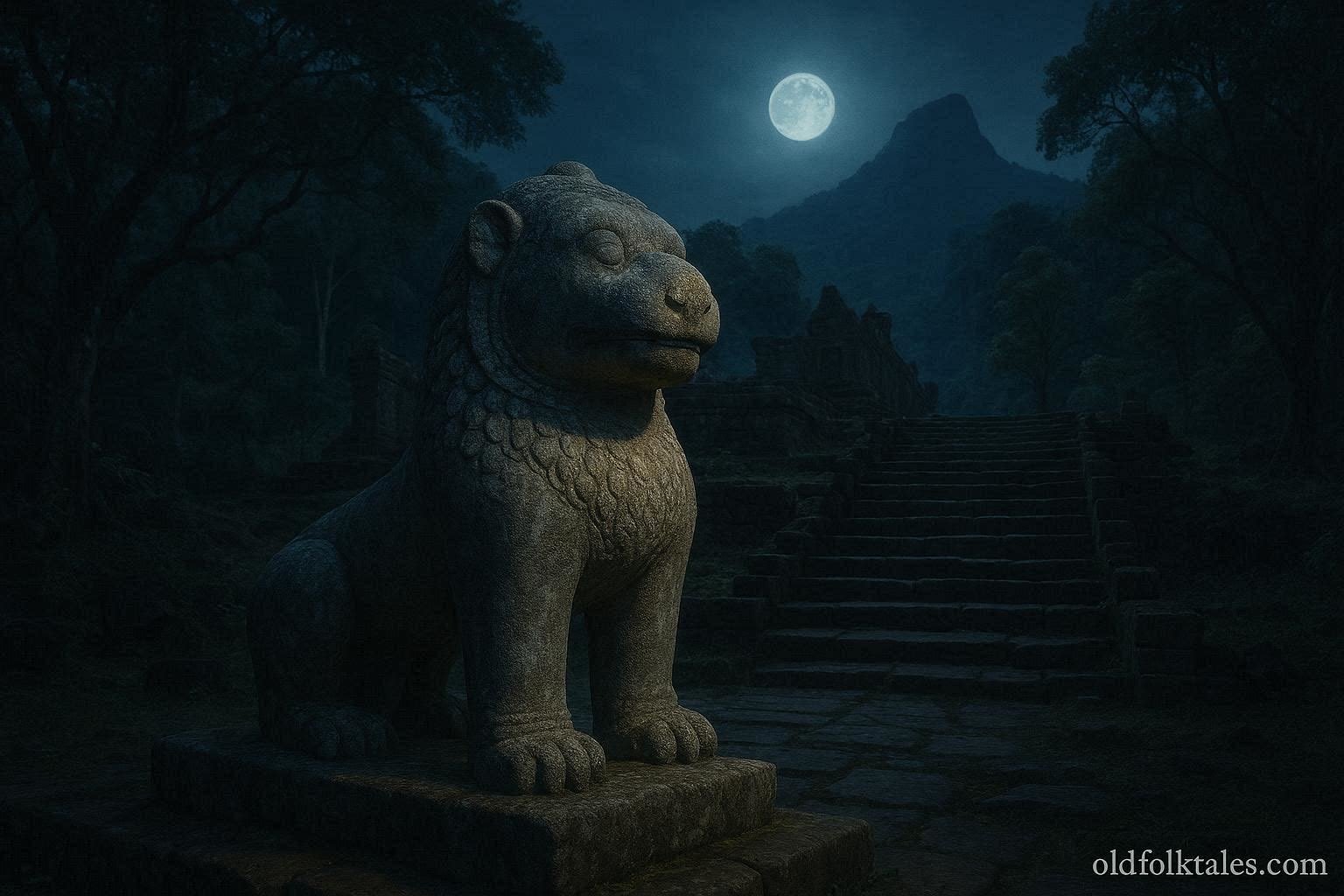
At the entrance of the temple sat a stone lion carved from a single block of rock. Its body was broad and grounded, its head lifted slightly as if alert. Rain had softened its edges, moss traced its back, and yet its presence remained commanding. Elders said the lion had been placed there by the ancestors to watch over the temple and everyone who entered it.
Children were warned not to touch the lion carelessly. Pilgrims bowed before passing. Monks placed incense near its paws every morning. Even travelers unfamiliar with the customs often felt compelled to slow their steps near the gate, as if something unseen requested silence.
Discover more East Asian Folktales from the lands of dragons, cherry blossoms, and mountain spirits.
Among those who lived near Wat Phou was a young caretaker named Kham. His family had lived in the valley for generations, and his grandfather once served the temple before him. Kham believed that tending the grounds was not a task but a duty passed down through blood and spirit. Each morning, he swept the stone paths, cleared fallen leaves, and repaired cracks where grass pushed through ancient tiles.
Every evening, Kham stopped before the stone lion. He never spoke aloud, but he placed flowers at its base and bowed. He believed gratitude should be shown even when no response was visible.
One year, the rains arrived late. Crops struggled, and worry spread among the villagers. At the same time, unsettling stories traveled along the trade routes. Merchants whispered of a man who moved from temple to temple, stealing sacred objects and selling them far away. He mocked local beliefs and boasted that spirits were nothing but stories.
The monks of Wat Phou sensed unease. They increased their prayers and asked villagers to show extra care toward the temple. Kham noticed changes as well. Birds no longer nested near the gate. At night, the air around the stone lion felt warmer, as if the ground held breath.
One evening, while repairing a broken shrine wall after sunset, Kham heard a sound that stopped his hands. It was deep and slow, like stone grinding against stone. He turned toward the gate and felt his heart pound. The lion had not moved, yet its eyes reflected moonlight more sharply than before.
Kham bowed deeply, his forehead touching the ground. He felt no fear, only awareness, as if something ancient had briefly opened its eyes.
Days later, the invader arrived.
He entered the village wearing fine clothes and a polite smile. He claimed to admire old temples and offered coins to children who guided him. Yet he ignored local customs. He laughed when monks reminded him to remove his shoes. He scoffed at offerings, calling them superstition.
That night, when the temple lay quiet beneath a full moon, the man returned alone. He carried tools hidden beneath his cloak and moved quickly toward the inner shrine where the most sacred carvings rested. His footsteps echoed sharply, breaking the calm that usually protected the temple at night.
As he reached the gate, the air thickened. The ground beneath him trembled slightly. The stone lion began to glow faintly, hairline cracks tracing its body. The man froze, staring in disbelief as the lion shifted.
With a sound like thunder held inside stone, the lion stepped forward. Its surface transformed, no longer cold and lifeless but solid with ancient strength. Its eyes burned with steady fire, not rage but judgment.
The man screamed and dropped his tools. He turned and ran, but shadows closed in around him, twisting the path so that every step led him back toward the gate. The lion roared once, a sound that shook the mountain itself. The invader collapsed, overwhelmed by fear, and fled into the forest, never to return.
As dawn broke, the temple stood untouched. The lion sat once more at the gate, silent and still, as if it had never moved.
Kham arrived early that morning and immediately sensed what had happened. He bowed deeply, tears in his eyes, and placed fresh flowers at the lion’s feet. The monks gathered, chanting prayers of thanks. Word spread quickly through the village, and people came with offerings, not out of fear but renewed devotion.
From that day forward, the villagers changed. They repaired damaged shrines, taught children the old stories, and treated the land with greater care. Travelers were welcomed but reminded of proper conduct. Respect became the true offering.
The stone lion never moved again, but no one doubted its presence. They understood that guardians awaken not for stones or gold, but for reverence itself. As long as the people honored what was sacred, Wat Phou would never stand unprotected.
Journey through enchanted forests and islands in our Southeast Asian Folktales collection.
Moral Lesson
Sacred places are guarded not only by spirits, but by the respect of those who care for them. When people honor tradition, land, and community, unseen protectors respond. Disrespect invites danger, but humility awakens protection that endures beyond time.
Knowledge Check
- Where is Wat Phou located
Answer: At the foot of a sacred mountain in southern Laos. - Who cared for the temple grounds
Answer: A young caretaker named Kham. - What sign suggested the guardian was awakening
Answer: Strange sounds and warmth around the stone lion at night. - Who threatened the temple
Answer: A man who stole sacred objects from temples. - How did the stone lion stop the invader
Answer: By awakening and frightening him away with its power. - What lesson did the villagers learn
Answer: That respect and devotion protect sacred heritage.
Source
Adapted from Champasak Historical Folklore Digital Repository, 2015.
Cultural Origin
Southern Lao temple mythology