In the water village of Kampong Ayer, where houses stood on tall stilts above the Brunei River and wooden walkways connected the community like a spider’s web, there lived a poor widow named Dang Ambon and her young son, Nakhoda Manis. Their home was a simple dwelling with weathered planks and a roof that had been patched many times. The river was their highway, their livelihood, and their constant companion, its waters flowing past their door from sunrise to sunset.
Life had not always been so difficult. Dang Ambon’s husband had been a fisherman, an honest man who worked hard to provide for his family. But the sea can be as cruel as it is generous, and one day he sailed out and never returned. Perhaps a sudden storm had capsized his boat, or perhaps he had ventured too far and lost his way. No one knew for certain, and his body was never found. All that remained was the vast emptiness he left behind and the heavy burden of survival that fell upon Dang Ambon’s shoulders.
Click to read all Southeast Asian Folktales — featuring legends from Thailand, Indonesia, Vietnam, and the Philippines.
She did what she could to provide for her son. She took in washing, mended fishing nets for other families, and sold what little vegetables she could grow in pots on their small platform. Her hands grew rough and cracked from constant work, her back bent from labor, but she never complained. Every grain of rice she placed in Nakhoda Manis’s bowl was a sacrifice, every piece of dried fish a treasure she went without so he could eat.
Nakhoda Manis grew into a restless young man with dreams that stretched far beyond the wooden walkways of Kampong Ayer. He would stand at the edge of their platform, watching the merchant ships pass by with their tall masts and billowing sails, their hulls laden with exotic goods from distant lands. His heart burned with ambition and a hunger for something greater than the poverty that surrounded him.
“Mother,” he said one evening as they shared their meager dinner of rice and salt fish, “I cannot stay here. There is no future for me in this village. I want to seek my fortune, to become someone important, to be wealthy.”
Dang Ambon’s heart clenched with fear and sorrow, but she looked into her son’s determined eyes and knew she could not hold him back. “Go then, my child,” she said softly, tears glistening in her eyes. “Follow your dreams. But promise me you will never forget your mother, and that you will return to me one day.”
Nakhoda Manis embraced her tightly. “I promise, Mother. When I am rich, I will come back and take care of you. You will never have to work again.”
The next morning, with a small bundle of clothes and the few coins his mother had saved, Nakhoda Manis boarded a trading vessel bound for the city of Sulu. Dang Ambon stood on their platform, waving until his ship disappeared beyond the river’s bend, then she returned to her empty house and wept.
Years passed long, lonely years for Dang Ambon. She continued her hard life, growing older and more frail with each season. Her hair turned completely white, her face became deeply lined, and her clothes grew more tattered. But she never stopped hoping, never stopped scanning the river for a sign of her son’s return.
Meanwhile, in the bustling port city of Sulu, Nakhoda Manis proved himself clever, ambitious, and ruthless when necessary. He started as a deckhand, worked his way up to navigator, and eventually became a ship’s captain. His keen mind for trade and his willingness to take risks brought him enormous success. Gold and silver filled his coffers. He wore fine silk robes and ate delicacies from porcelain plates. His reputation as a wealthy merchant spread throughout the region.
His success also brought him the attention of noble families. He married a beautiful young woman from an aristocratic house a woman who had never known poverty, never worked with her hands, never experienced anything but privilege and comfort. She was elegant and refined, but her heart was as cold as polished marble, and her pride knew no bounds.
Nakhoda Manis eventually owned his own magnificent ship, a vessel so large and grand that it dominated any harbor it entered. Its sails were of the finest canvas, its hull painted in brilliant colors, and its cargo holds overflowed with valuable goods. He became known throughout the trading routes as a captain of great wealth and influence.
After many years at sea, Nakhoda Manis decided to return to Brunei. His ship would anchor in the Brunei River, and he would finally reunite with his mother. As the journey progressed, he found himself thinking of Dang Ambon more and more her gentle voice, her patient hands, her unconditional love. He felt a mixture of excitement and guilt. He had been gone so long, and he had not sent word or money back to her. But now he would make everything right. He would shower her with gifts, build her a fine house, and introduce her to his wealthy wife.
When word spread through Kampong Ayer that a magnificent ship belonging to Nakhoda Manis was approaching, Dang Ambon could hardly believe it. Her son! Her beloved son was finally coming home! Despite her aged, aching body, she hurried to prepare. She put on her best clothes though they were still worn and patched and climbed into her small wooden boat, a simple craft she had paddled for decades.
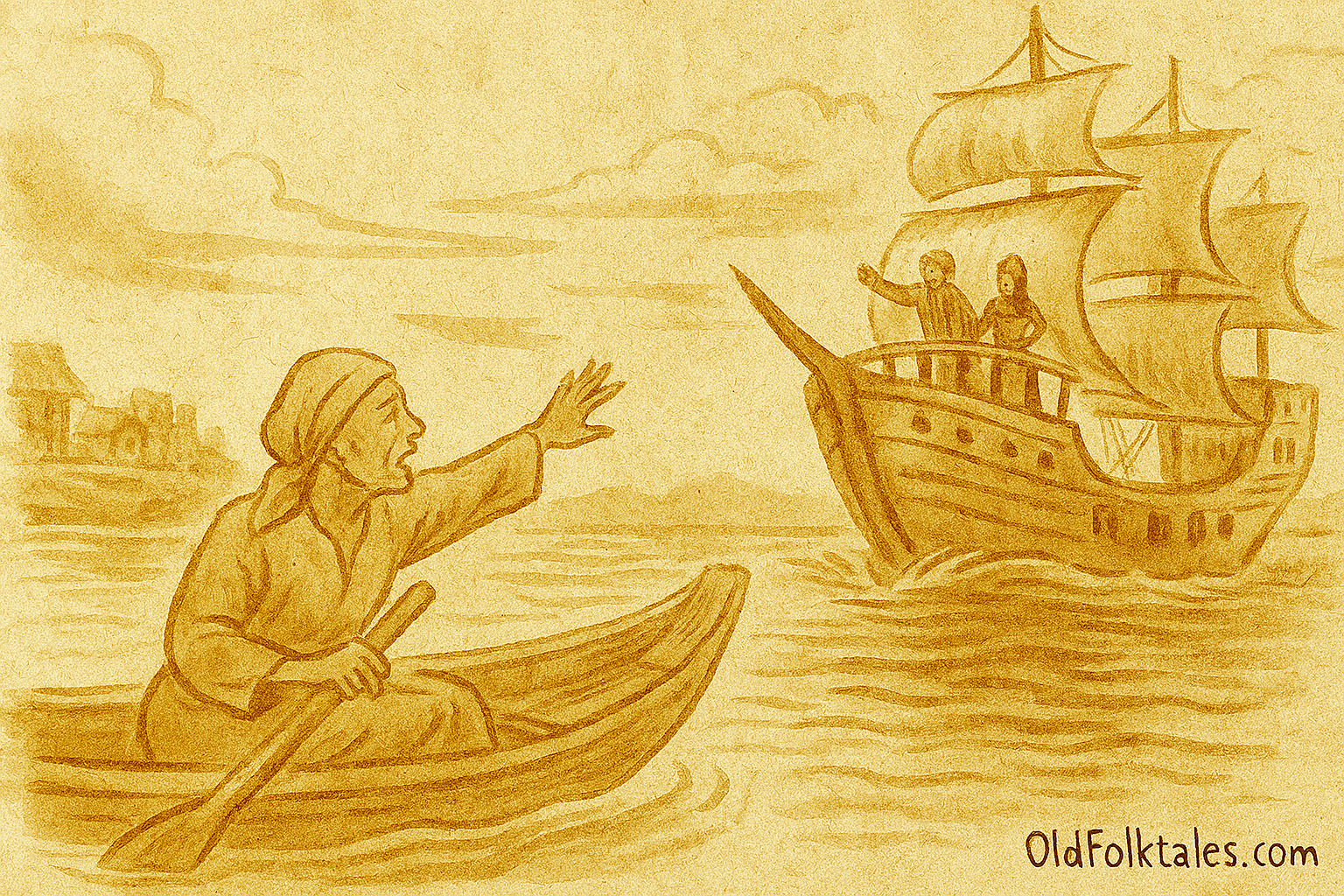
As the grand ship entered the Brunei River, its presence commanding attention from everyone on the shore, Dang Ambon paddled out with all the strength her elderly arms could muster. Her heart pounded with joy and anticipation. Tears streamed down her weathered face.
“Nakhoda Manis! My son! My beloved son!” she called out, her voice cracking with emotion. “It is I, your mother! I have missed you so much!”
On the deck of his magnificent vessel, Nakhoda Manis heard that voice, a voice he had not heard in years but which he recognized instantly. His heart leaped with joy and love. He rushed to the railing, ready to call out to her, ready to have her brought aboard, ready to introduce her to his wife and crew as the woman who had sacrificed everything for him.
But before he could speak, his wife appeared beside him. She looked down at the small boat and the poor old woman paddling it, and her face twisted with disgust and contempt.
“Who is that filthy beggar woman?” she demanded, her voice sharp and cold. “Why is she calling out to you? Send her away immediately! I will not have such poverty-stricken people approaching our ship. What will people think?”
Nakhoda Manis felt his throat constrict. He looked at his proud, beautiful wife, then down at his mother in her humble boat, her face shining with love and hope. He thought of his new life, his reputation, his position in society. He thought of the mockery he might face if his wealthy friends discovered his mother lived in poverty. Shame and cowardice flooded his heart, drowning out the love and gratitude he should have felt.
“I… I do not know this woman,” he said, his voice weak and trembling with the weight of his betrayal.
His wife smiled with satisfaction. “Good. Now have your crew send her away.”
Nakhoda Manis turned to his men and gave the order he would regret for what little remained of his life. “Push that boat away. Do not let her approach.”
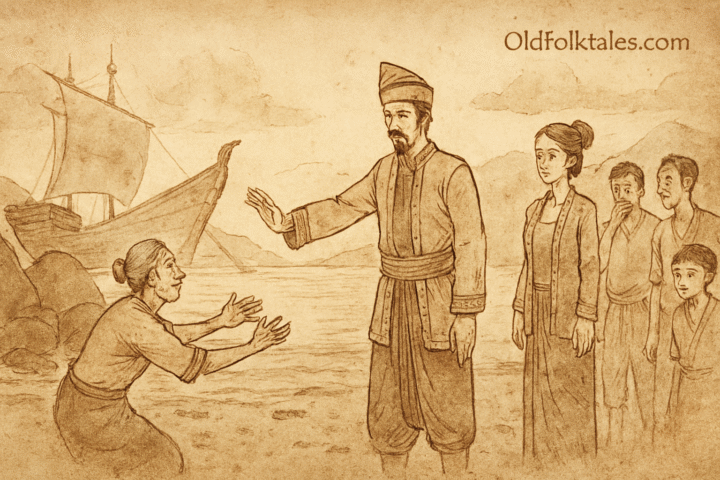
The crew, following their captain’s command, used long poles to push Dang Ambon’s small boat away from the great ship. The old woman stared up at her son in disbelief, her face transforming from joy to confusion to devastating heartbreak.
“Nakhoda Manis,” she called out, her voice breaking. “My son, do you not recognize your own mother? I am the one who gave you life, who raised you, who went hungry so you could eat! How can you deny me?”
But Nakhoda Manis turned his back on her, unable to face what he had done, too proud and too cowardly to admit the truth to his wife.
Dang Ambon felt her heart shatter into a thousand pieces. The pain was worse than any poverty, any hunger, any hardship she had endured. This was the ultimate betrayal, to be denied by the child she had loved more than her own life, the child for whom she had sacrificed everything.
Her grief transformed into righteous fury. She raised her trembling hands toward the sky, and her voice rang out across the river, strong and terrible despite her age.
“Nakhoda Manis! You ungrateful son! I carried you in my body, I raised you with love, I went without food so you could eat, I worked until my hands bled so you could have a better life! And this is how you repay me? You deny your own mother because you are ashamed of where you came from?”
Her voice grew louder, filled with supernatural power. “For your cruelty, your ingratitude, and your shameful betrayal, I curse you! May you and your ship turn to stone! May you remain forever in these waters as a reminder to all who see you that no wealth can excuse the betrayal of a mother’s love!”
The sky, which had been clear and bright, suddenly darkened as if a curtain had been drawn across the sun. Black clouds gathered with unnatural speed, swirling and churning like a living thing. The wind rose to a shriek, whipping the water into whitecaps and tearing at the ship’s sails.
Thunder crashed across the heavens, and lightning split the sky in brilliant, terrifying forks. The river, usually calm and gentle, became a churning maelstrom. Waves rose up like angry fists, battering the great ship from all sides.
Nakhoda Manis felt terror grip his heart. He tried to give orders to his crew, but his voice was lost in the howl of the storm. His wife screamed in fear, clinging to the mast. The ship began to list dangerously, water pouring over its sides.
Then, as the storm reached its terrible peak, Nakhoda Manis felt a strange coldness spreading through his body. He looked down at his hands and saw them turning gray and hard. His skin became stone, his flesh transformed into solid rock. He tried to call out to his mother, to beg for forgiveness, but his lips had already frozen in their final expression of terror and regret.
His wife, his crew, and his magnificent ship, all turned to stone. The transformation was complete in moments. Then the storm pushed the petrified vessel beneath the waves, and it sank to the bottom of the Brunei River.
When the storm finally passed and the sky cleared, the people of Kampong Ayer emerged from their homes. Where the great ship had been, there now stood a massive rock formation rising from the water, its shape vaguely resembling a ship with figures on its deck.
Dang Ambon, her curse fulfilled but her heart broken forever, paddled her small boat back to shore. She had gained justice but lost her son. She lived out her remaining days in quiet sorrow, a reminder to all who knew her story of the terrible price of ingratitude.
To this day, the rock formation remains in the Brunei River, known as “Jong Batu”, the Stone Junk. Locals point it out to their children, telling them the story of Nakhoda Manis, the captain who was so ashamed of his humble origins that he denied his own mother and paid the ultimate price for his betrayal.
Journey through enchanted forests and islands in our Southeast Asian Folktales collection.
The Moral of the Story
The legend of Nakhoda Manis teaches us the sacred importance of filial piety, honoring and remaining faithful to our parents regardless of our circumstances or social status. No amount of wealth, success, or social position can justify denying or being ashamed of our parents and origins. Dang Ambon sacrificed everything for her son, and his betrayal of her love represents the worst form of ingratitude. The story reminds us that our parents’ sacrifices shaped who we are, and that true honor comes not from wealth or status but from loyalty, gratitude, and remembering where we come from. Those who forget their roots and betray their family deserve neither their prosperity nor respect.
Knowledge Check
Q1: Who are the main characters in the Nakhoda Manis folktale from Brunei?
A1: The main characters are Dang Ambon, a poor widow from Kampong Ayer water village, and her son Nakhoda Manis, who leaves home to seek his fortune and becomes a wealthy ship captain in the city of Sulu before returning to Brunei.
Q2: Why does Nakhoda Manis deny his mother in this Bruneian legend?
A2: Nakhoda Manis denies his mother because he is ashamed of her poverty and humble appearance in front of his wealthy, aristocratic wife. His pride and fear of social embarrassment cause him to betray the woman who sacrificed everything for him.
Q3: What curse does Dang Ambon place on her ungrateful son?
A3: In her heartbreak and righteous anger, Dang Ambon curses Nakhoda Manis to turn to stone along with his ship, wife, and crew. A supernatural storm capsizes the vessel, and it transforms into a rock formation that remains in the Brunei River.
Q4: What is Jong Batu and what does it represent?
A4: Jong Batu, meaning “Stone Junk,” is a rock formation in the Brunei River believed to be the petrified remains of Nakhoda Manis’s ship. It serves as a permanent reminder of the consequences of denying one’s parents and forgetting one’s origins.
Q5: What cultural values does the Nakhoda Manis story emphasize?
A5: The story emphasizes filial piety (respect and loyalty to parents), gratitude for parental sacrifice, humility about one’s origins, and the importance of family bonds over material wealth. These are core values in Bruneian and broader Southeast Asian culture.
Q6: What is the significance of Kampong Ayer in this Bruneian folktale?
A6: Kampong Ayer is Brunei’s famous water village on the Brunei River, one of the largest and oldest stilt settlements in the world. In the story, it represents Nakhoda Manis’s humble origins—a place he becomes ashamed of despite it being where his loving mother raised him through great sacrifice.
Source: Bruneian folktale, Brunei Darussalam