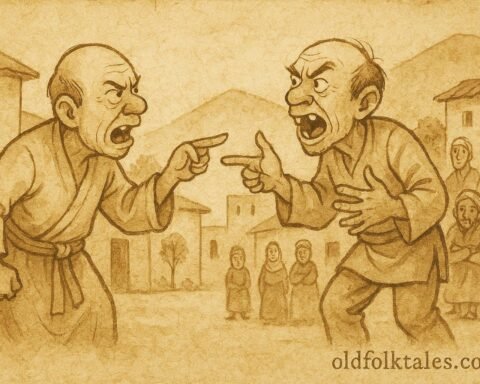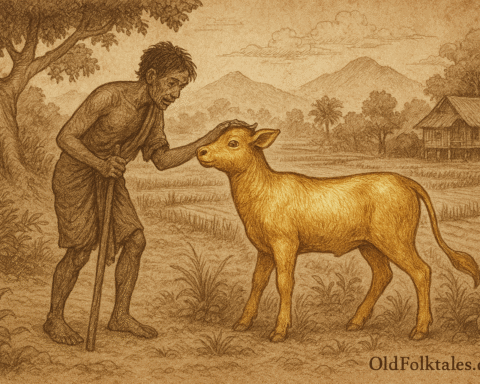
In the ancient forests of Brunei, where the jungle grew so thick that sunlight barely touched the forest floor and the air hung heavy with moisture and mystery, there stood a hill known as Bukit Batu Apoi. The local people would not climb it without proper offerings, would not speak loudly near its base, and would never, under any circumstances, show disrespect within its shadow. They knew what the hill truly was: not just a natural formation of stone and earth, but a monument to pride punished and a warning carved into the very landscape itself.
This is the story of how that hill came to be.
Long ago, before the hill existed, the land was flat and covered with ancient forest. The trees grew tall and strong, their roots reaching deep into the earth, their canopies forming a green ceiling that filtered the tropical sun into dappled patterns on the forest floor. Within this forest dwelled spirits as old as the trees themselves, guardians who had watched over the land since time before memory.
Click to read all East Asian Folktales — including beloved stories from China, Japan, Korea, and Mongolia.
The nearby village was home to a warrior named Apoi. He was tall and powerfully built, with muscles hardened by years of training and arms that could wield a spear with deadly accuracy. Apoi had won every contest of strength in the village, defeated every challenger who dared face him, and earned a reputation that spread to neighboring settlements. Warriors would come from distant places hoping to test themselves against him, and each departed defeated, nursing injuries and wounded pride.
But Apoi’s greatest strength was also his fatal weakness: his pride knew no bounds.
“There is no man in all of Brunei who can match me,” he would boast at village gatherings, his voice carrying across the communal fires. “I am the strongest, the fastest, the most skilled warrior these forests have ever known.”
The village elders would shake their heads at such proclamations. “Strength is a gift,” they would caution, “not an achievement to puff oneself up with. And there are powers in these forests far greater than human muscle and skill.”
But Apoi would laugh at their warnings. “Old men’s tales,” he would scoff. “Spirits and guardians are stories to frighten children. I believe only in what I can see, touch, and defeat.”
His wife, a gentle woman named Dayang, would plead with him to show more humility. “The spirits are real, husband. Our ancestors knew this. Why do you think we make offerings before hunting? Why do we ask permission before clearing land? It is not superstition but respect for powers we do not fully understand.”
Apoi would dismiss her concerns with a wave of his hand. “If these spirits are so powerful, let them show themselves. Let them challenge me as men do. Until then, I acknowledge only my own strength.”
The village bomoh, an elderly woman named Nenek Siti who could read signs in smoke and dreams, tried to counsel Apoi. She invited him to her home, served him tea made from forest herbs, and spoke to him with the authority of one who walked between the seen and unseen worlds.
“The forest guardians are patient,” she said, her voice soft but firm, “but patience is not the same as weakness. They observe, they listen, and they remember every word of pride spoken beneath their trees. You are walking a dangerous path, Apoi. Your strength is impressive among humans, but you are like a child playing with fire when you compare yourself to spiritual forces.”
Apoi listened with barely concealed impatience. “With respect, Nenek, I have fought men twice my size and defeated them. I have wrestled wild boars and emerged victorious. What are spirits compared to such real challenges?”
Nenek Siti’s eyes grew sad. “Then you will learn what many proud men before you have learned: that the greatest defeats come not from equals, but from forces we were foolish enough to challenge.”
The crisis came during the full moon, when the village held its annual ceremony to honor the forest spirits. The entire community gathered at the edge of the great woods, bringing offerings of rice, flowers, fruit, and woven cloth. They would place these gifts at the base of the ancient trees and speak prayers of gratitude and respect.
Apoi attended because social custom demanded it, but his contempt for the proceedings was obvious. He stood apart from the others, arms crossed, a mocking smile playing on his lips as he watched people bow and whisper their prayers.
When his turn came to approach the forest’s edge with offerings, Apoi walked forward carrying only his spear. The crowd gasped. The elders looked at each other with alarm. Nenek Siti closed her eyes in dismay.
Apoi planted his spear in the ground before the forest and spoke in a loud, clear voice that echoed among the trees: “Spirits of the forest! Guardians of the land! I, Apoi, the greatest warrior in Brunei, challenge you! People say you are powerful, that you protect these woods and punish those who show disrespect. I say you are nothing but stories, shadows that have no substance!”
A horrified silence fell over the gathering. Even the insects seemed to stop their chirping, and the night birds ceased their calls. The air itself grew heavy and still, as if the forest were holding its breath.
“Show yourselves!” Apoi continued, his voice growing bolder. “Fight me as men fight! Prove your power, or be revealed as the illusions I know you to be! I claim that human strength is superior to spirit magic, that my arm is mightier than your supposed influence!”
The wind began to rise, gentle at first, then growing stronger. The trees swayed though moments before the air had been still. From deep within the forest came a sound like distant thunder, or perhaps like the groaning of ancient beings roused from eternal rest.
Dayang ran forward, tears streaming down her face. “Husband, please! Take back your words! Apologize before it is too late!”
But pride had sealed Apoi’s tongue. He could not, would not, admit he had been wrong. He stood firm before the forest, his spear in hand, his jaw set with determination.
The sound from the forest grew louder, and now it resolved into something that might have been voices, dozens or hundreds of them, speaking in a language older than human words. The wind whipped the trees into a frenzy, and lightning split the clear night sky.
Then the earth beneath Apoi’s feet began to tremble.
He looked down in confusion as the ground started to rise, lifting him upward. His legs became heavy, impossibly heavy, as if weights had been attached to them. He tried to move but found his feet rooted to the spot. Looking down in growing horror, he saw that his feet were no longer flesh but stone, grey and solid and cold.
“No!” he cried out, finally feeling fear. “I take it back! I apologize!”
But the transformation continued, creeping up his legs, turning muscle and bone into solid rock. The forest spirits’ voices surrounded him, not angry but sad, like parents disappointed by a foolish child.
“You demanded proof of our power,” the voices seemed to say, though they spoke without words, their meaning appearing directly in Apoi’s mind. “You claimed human strength superior to spiritual force. Now you shall stand as eternal testament to the truth: that pride which challenges the sacred will be made into a lesson for all who come after.”
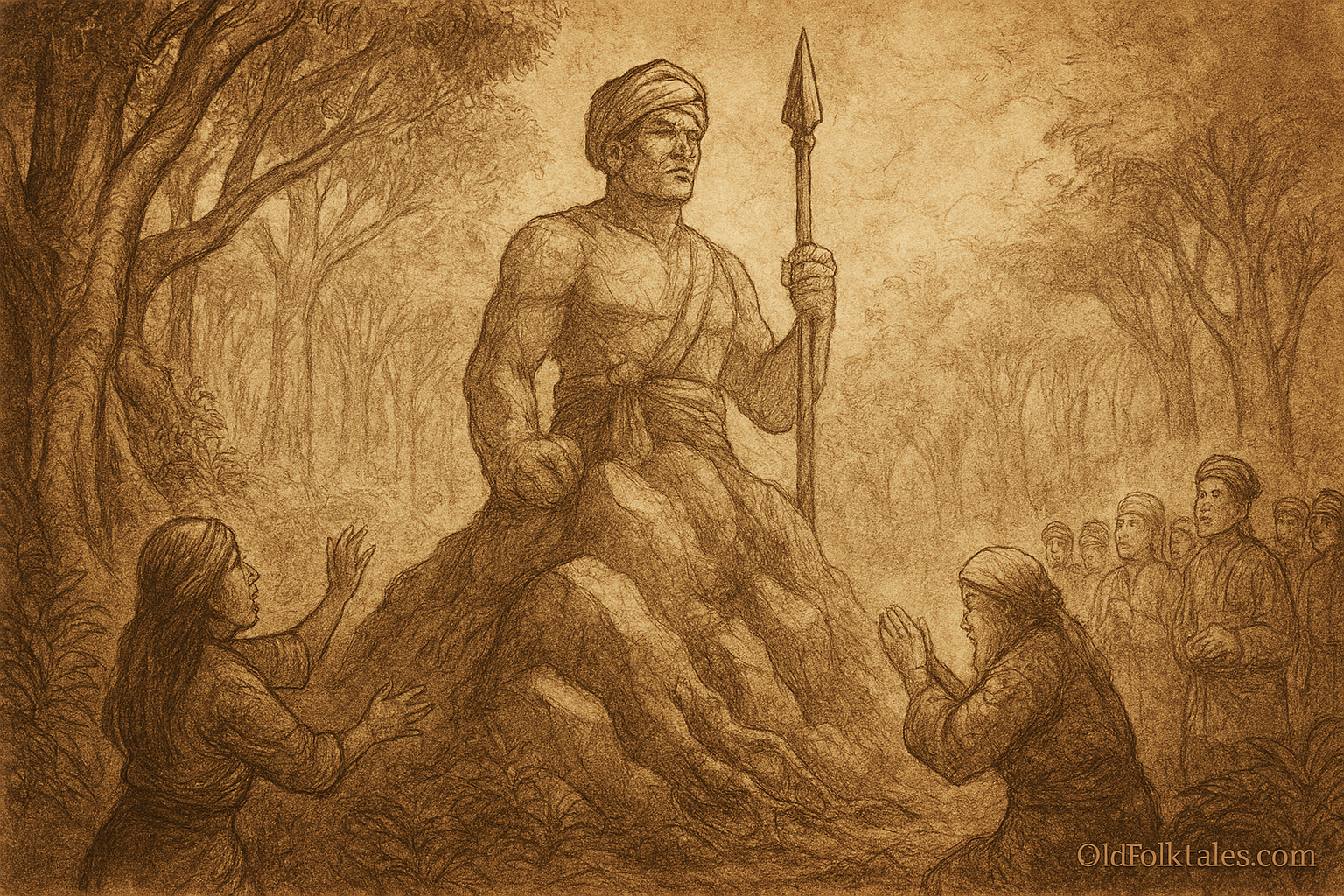
Apoi’s family and the villagers watched in horror as the warrior was transformed, inch by inch, into stone. His body became rock, his features hardened into permanent expression, his spear fused to his stony hand. The ground continued to rise beneath him, forming a hill that grew taller and taller, lifting the stone warrior high above the forest floor.
By the time the transformation was complete, Apoi had become part of the landscape itself. Where he had stood challenging the spirits, there was now a hill of stone, shaped roughly like a warrior in his final moment of realization. The hill rose abruptly from the flat forest floor, unnatural in its sudden elevation, marked forever as a place where the spiritual world had responded to human arrogance.
Dayang wept at the base of the newly formed hill, calling her husband’s name, but stone cannot answer. Nenek Siti laid gentle hands on the grieving woman’s shoulders.
“He lives still,” the bomoh said softly, “but in a form that will last for ages, a reminder to all who see it that there are powers in this world greater than human strength, and that humility is not weakness but wisdom.”
From that night forward, the hill was known as Bukit Batu Apoi, the Hill of Apoi’s Stone. The villagers would bring offerings to its base, not to mock the warrior who had been transformed, but to honor the lesson his fate had taught. Parents would bring their children to see it and tell them the story of the proud warrior who thought himself greater than the spirits.
Over generations, the tale was told and retold. The forest around Bukit Batu Apoi was treated with special reverence. Hunters would ask permission before taking game nearby. Farmers would make offerings before clearing any land in its shadow. And warriors, no matter how skilled or strong, would remember to temper their pride with humility.
The hill itself stood through centuries, weathering storms and time, its unusual shape a permanent reminder carved into the earth itself. Some claimed that on certain nights, when the moon was full and the forest was quiet, you could hear a voice from the hill, not speaking words but conveying a message felt in the heart: that true strength lies not in dominating all things, but in knowing when to bow before powers greater than ourselves.
Click to read all Southeast Asian Folktales — featuring legends from Thailand, Indonesia, Vietnam, and the Philippines.
The Moral Lesson
The legend of Bukit Batu Apoi teaches us that pride which refuses to acknowledge powers greater than human strength leads to devastating consequences. Humility is not weakness but essential wisdom, recognizing that spiritual forces and natural powers deserve respect regardless of whether we fully comprehend them. The story emphasizes that those who boast of their superiority and challenge sacred forces will find themselves made into warnings for others.
Knowledge Check
Q1: Who is Apoi in this Bruneian origin legend? A: Apoi is a proud and powerful warrior who becomes so consumed by his own strength that he challenges the forest spirits, claiming human power is superior to spiritual forces. His character represents the danger of excessive pride and the refusal to acknowledge powers beyond human understanding. His transformation into stone demonstrates how arrogance toward the sacred brings permanent consequences.
Q2: What are the forest spirits or guardians in Bruneian folklore? A: The forest spirits are ancient guardians who have protected Brunei’s forests since time immemorial, representing the spiritual dimension of nature. They are patient beings who observe human behavior and require respect through offerings and proper conduct. They embody the belief that forests and hills are not merely physical spaces but sacred territories inhabited by powerful unseen forces that maintain balance and punish those who violate sacred boundaries.
Q3: What specific act of disrespect does Apoi commit? A: During the village’s annual ceremony to honor forest spirits, Apoi arrives with only his spear instead of proper offerings, then loudly challenges the spirits to fight him, claiming human strength is superior to spiritual power. This public mockery during a sacred ceremony represents the ultimate disrespect, combining pride, blasphemy, and refusal to follow communal spiritual practices that maintain harmony with the land.
Q4: How is Apoi transformed into Bukit Batu Apoi? A: The forest spirits respond to Apoi’s challenge by transforming him from flesh into stone, starting with his feet and gradually turning his entire body into rock. As he becomes stone, the ground beneath him rises, forming a hill that lifts his petrified form high above the forest floor. This transformation is both punishment and permanent lesson, creating a geographical feature that will remind future generations of the consequences of spiritual arrogance.
Q5: What is the significance of the hill remaining in Brunei’s landscape? A: Bukit Batu Apoi serves as a permanent monument to the consequences of pride and disrespect toward spiritual forces. Its unusual shape and sudden elevation from flat forest floor mark it as unnatural, a deliberate creation by spiritual powers. The hill becomes a sacred site where people bring offerings and teach younger generations about humility, respect for nature, and acknowledgment of powers beyond human comprehension.
Q6: What does this story teach about traditional Bruneian beliefs regarding nature? A: This Bruneian legend teaches that forests and hills are inhabited by powerful spiritual guardians who deserve respect and proper ritual acknowledgment. Traditional practices like making offerings before hunting or clearing land are not superstition but essential protocols for maintaining harmony with spiritual forces that share the landscape. The story emphasizes that human strength and achievement should be tempered with humility, and that the natural world contains powers that transcend physical might.
Source: Adapted from Bruneian oral folklore traditions.
Cultural Origin: Brunei Darussalam, Southeast Asia.