Long ago in a quiet village nestled among the green hills of central Vietnam lived an elderly widowed farmer named Lâm. He was gentle and hardworking, but poverty clung to him like the morning mist. His rice fields were small, his hut was old, and with no children to assist him, he worked from sunrise until the stars appeared. Even so, he never complained. The villagers respected him for his honesty and kind heart, but many pitied his loneliness.
One summer morning, after a night of heavy rain, Lâm walked into the nearby bamboo grove to gather shoots for cooking. The grove was thick and lush, with stalks that whispered softly whenever the wind passed through. As he searched for a young bamboo shoot, his eyes caught sight of a single radiant stalk glowing faintly in the sunlight. It was thicker than the rest and strangely warm to the touch. Although puzzled, he gently cut it, planning to split it at home.
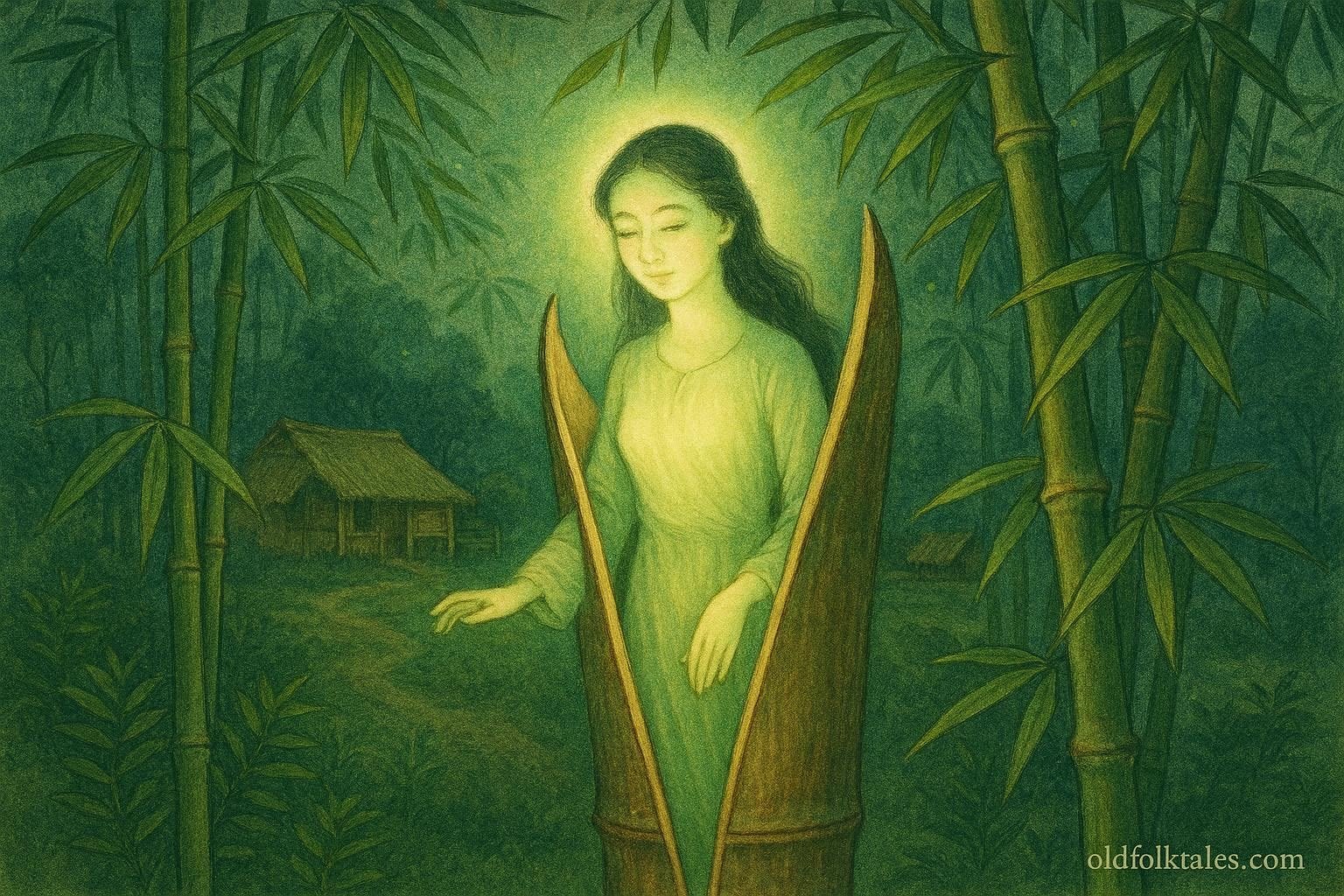
When he opened the bamboo stalk, he gasped and nearly dropped it. Inside lay a tiny girl, no bigger than his forearm, sleeping peacefully as if cradled by the forest itself. Her skin glowed like morning dew, and her hair shimmered like strands of moonlight. Startled but overwhelmed with wonder, Lâm whispered, “A gift from the heavens.” The girl stirred, opened her bright eyes, and smiled. That moment melted every burden in his heart.
Explore timeless legends from China, Japan, and Korea in our East Asian Folktales collection.
Lâm carried the child home and named her Cô Bé Tre, which meant Bamboo Maiden. As days passed, she grew quickly, becoming a kind and graceful young girl. She cleaned the home, cooked meals, sang softly while sweeping, and welcomed every creature that crossed her path. Birds perched near her as if enchanted by her voice, and even shy forest animals ventured close when she gathered water at the stream. The villagers soon noticed that wherever she walked, the air felt lighter and the leaves seemed greener.
Cô Bé Tre became beloved by all who met her. She helped elderly villagers, encouraged children to study, and comforted anyone who felt troubled. When a neighbor injured his leg, she brought herbs and tended his wound. When a mother struggled with her newborn, she prepared warm porridge and soothed the crying infant. Her presence felt like a blessing that touched every corner of the village.
Lâm’s life changed more than anyone’s. With her help, his home became filled with laughter again. For the first time in years, warm meals waited for him at dusk, and soft singing drifted through the bamboo walls. Where loneliness once weighed heavily, joy now bloomed. The villagers often said that Cô Bé Tre shone with purity, as if she carried the gentle spirit of the bamboo grove within her.
One season, the village experienced a long drought. Crops wilted, rivers shrank, and fear spread among the villagers. Many prayed to the mountain and river spirits for relief, but the sky remained cloudless. One evening, Cô Bé Tre asked Lâm, “May I walk into the bamboo grove tonight?” Lâm felt uneasy but trusted her gentle heart. With a soft smile, she added, “I only wish to repay the world for the kindness I have received.”
When she stepped into the grove, the air shifted. Fireflies gathered around her in circles of light. The bamboo swayed even though there was no wind, and the forest seemed to hum with a low, ancient song. She knelt beside a dried stream and touched the cracked earth. A faint glow spread from her fingertips, sinking into the soil. Moments later, the ground trembled gently, and the water began to flow once more. Clear, cool water filled the streambed and trickled out toward the fields. Within hours, clouds gathered above the village, and soft rain began to fall, reviving the land.
The villagers rejoiced, praising the spirits for answering their prayers. They thanked Cô Bé Tre as well, although none understood the full depth of what she had offered. She simply smiled and said, “Blessings grow when shared.” The rains continued for days, restoring life to the fields and granting the villagers hope for a prosperous harvest.
Yet soon after, a subtle change came over Cô Bé Tre. Her glow grew fainter, her voice softer, and her steps lighter as if she were becoming part of the wind. Lâm noticed and asked, his heart tightening, “My child, are you unwell?” She shook her head gently and looked at him with deep affection.
“One day,” she said, “all gifts must return to where they came from. My time here has been full of love. Please do not grieve when I must go.” But Lâm could not bear the thought. She had filled the years of his old age with warmth and companionship. The idea of losing her felt like losing the sun itself.
One dawn, Cô Bé Tre walked into the bamboo grove once more. The grove glowed brightly, as if welcoming her home. Lâm followed as quickly as his tired legs could carry him, calling her name. When he reached the clearing, he saw her standing among the tall bamboo stalks, wrapped in a gentle radiance. She turned toward him, smiling through tender eyes.
“Thank you, Father,” she said softly. “Your kindness gave me life beyond the bamboo. Please remember that blessings shine brightest when shared with an open heart.”
As she spoke, her form shimmered like morning mist. Slowly, she dissolved into a soft glow that drifted upward and disappeared among the leaves. The grove fell silent, leaving behind only the rustle of bamboo swaying in the breeze.
Lâm wept, not out of bitterness but gratitude. He returned home with a renewed understanding of life’s fleeting beauty. Though Cô Bé Tre was gone, her kindness remained in every corner of the village. The children still remembered her songs, the elderly recalled her comforting words, and the fields she had blessed grew abundant that year.
Her story lived on, carried from one generation to the next, reminding all who heard it that purity and gratitude leave lasting traces even when the source of the blessing has passed. Cô Bé Tre had returned to the bamboo, but her spirit continued to guide the hearts of those she touched.
Discover the wisdom of ancient India and the Silk Road in South & Central Asian Folktales
Moral Lesson
The Bamboo Maiden teaches that the purest gifts in life come unexpectedly and must be cherished with gratitude rather than possession. Her story reminds readers that blessings are not meant to be held forever but appreciated while they last. Through her kindness and sacrifice, she shows that generosity brings life and hope, while holding too tightly can blind us to the natural flow of change. Her disappearance emphasizes that life’s most precious moments are temporary, encouraging us to value love, kindness, and gratitude while they are present and to let go with grace when the time comes.
Knowledge Check
- Where did Lâm find Cô Bé Tre?
Inside a glowing bamboo stalk in the forest. - How did the villagers feel about her?
They loved and respected her for her kindness and purity. - How did Cô Bé Tre help during the drought?
She restored a dried stream and brought rain to save the village. - Why did she begin to fade away?
Because she needed to return to the bamboo grove, her spiritual origin. - What lesson does her departure teach?
That blessings are temporary and should be appreciated with gratitude. - What is the main moral lesson of the story?
That blessings are temporary, should be cherished with gratitude, and must be released with grace when their time ends.
Source
Adapted from Hue University Traditional Literature Repository, 2013.
Cultural Origin
Central Vietnamese village folklore.