
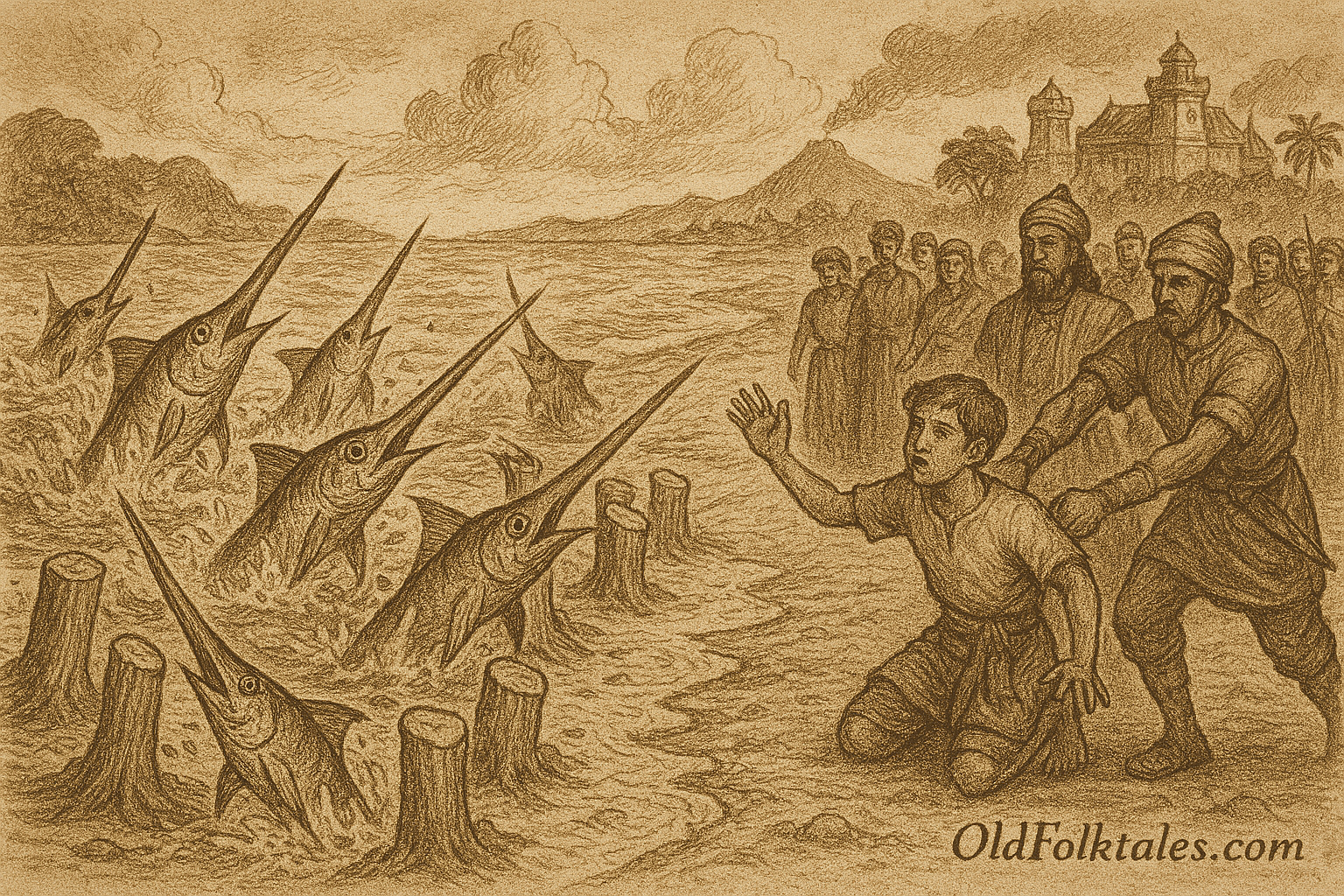
Long ago, when the world was younger and the seas held mysteries beyond counting, there existed a prosperous port city called Temasek. Nestled at the southern tip of the Malay Peninsula, where the great ocean routes converged like rivers meeting at their source, Temasek stood as a jewel of maritime trade. Its beaches stretched golden beneath the tropical sun, and its waters sparkled with such clarity that fishermen could see the coral gardens far below the surface. The city thrived under the rule of a Sultan whose palace rose above the settlement like a crown of carved wood and gilded towers.
The people of Temasek lived in harmony with the sea. Fishermen cast their nets at dawn, their boats dancing across gentle waves, while merchants from distant lands filled the harbor with vessels bearing silk, spices, and precious stones. Children played along the shoreline, their laughter mixing with the cry of seabirds, and the elderly shared tales of the ocean’s bounty beneath the shade of coconut palms.
Click to read all East Asian Folktales — including beloved stories from China, Japan, Korea, and Mongolia.
But one fateful morning, as the sun climbed above the eastern horizon painting the sky in shades of gold and crimson, the tranquility shattered like glass against stone.
A fisherman’s scream pierced the peaceful air. From the depths of the turquoise waters, creatures began to emerge, leaping from the waves with terrible purpose. They were swordfish, but unlike any the villagers had seen before. Their bodies gleamed like polished metal, and their snouts extended into razor-sharp blades as long as a man’s arm. These were not the gentle creatures that occasionally graced fishermen’s nets, these were instruments of destruction, driven by some unknown fury.
The first attack came without warning. A swordfish launched itself from the water with incredible force, its deadly snout piercing straight through a fisherman’s chest before he could even cry out. His boat capsized, staining the crystalline waters crimson. Then another leaped, and another, and soon the entire coastline erupted into chaos.
Villagers fled from the beach, screaming in terror as the swordfish pursued them even into the shallow waters. The creatures attacked with relentless ferocity, their sharp bills stabbing through wooden boats, fishing nets, and any person unfortunate enough to be caught near the shore. Bodies fell upon the sand, and the once-peaceful harbor became a scene of unimaginable horror. Parents clutched their children, elders stumbled in panic, and the strong tried desperately to pull the injured to safety.
Day after day, the attacks continued. The Sultan summoned his advisors, his warriors, and his wisest counselors to the palace. They debated long into the night, their voices echoing through the great hall as incense smoke curled toward the carved ceiling. Warriors proposed forming lines of spearmen along the beach, but the swordfish moved too quickly and struck from underwater. Priests suggested offerings to appease whatever spirit had angered the creatures, but the attacks only intensified. Fishermen dared not venture out, trade ships refused to dock, and the city that had once thrived on the ocean’s generosity now cowered from its wrath.
The Sultan grew desperate. His kingdom was dying, and no solution presented itself. Fear gripped Temasek like a tightening fist, and whispers spread that the city was cursed, that the gods themselves had turned against them.
It was then that a young boy, no more than ten years old, approached the palace guards. His name has been lost to time, but his courage and cleverness would be remembered forever. The child was the son of a humble fisherman, his clothes worn and patched, his feet bare and calloused from walking the beach. Yet his eyes held a brightness that spoke of keen observation and quick thinking.
The guards initially dismissed him, but the boy persisted with such determination that word eventually reached the Sultan himself. Intrigued, and having exhausted all other options, the Sultan granted the child an audience.
Standing before the throne, small and seemingly insignificant beneath the palace’s grandeur, the boy spoke with clarity and confidence that belied his youth. “Your Majesty,” he said, his voice steady despite the weight of countless eyes upon him, “I have watched the swordfish attack our shores. They leap from the water with such speed and force that their snouts pierce everything they strike. But what if we gave them something softer to pierce, something that would trap their weapons instead of being pierced by them?”
The Sultan leaned forward, curiosity replacing despair. “Speak, child. What do you propose?”
“Banana trees, Your Majesty. We should cut down banana trees and place their stems along the shoreline, creating a barrier. The stems are thick and soft. When the swordfish leap and stab their snouts into them, they will become trapped, unable to pull themselves free. We can then capture or kill them while they struggle.”
Silence filled the great hall. The advisors looked at one another, some with skepticism, others with dawning hope. The solution was so simple, so elegant, that it seemed almost foolish, yet the more they considered it, the more sense it made.
The Sultan ordered it done immediately. Hundreds of banana trees were felled, their thick, fibrous stems cut into sections and planted along the entire coastline. The people worked through the night, driven by desperate hope, creating a living barrier between the sea and their homes.
When dawn broke and the swordfish came again, leaping from the waves with their characteristic fury, they struck the banana stems with tremendous force. But instead of piercing through as they had with flesh and wood, their sharp snouts became embedded deep in the soft, spongy material. They thrashed and twisted, but the fibrous stems held them fast, trapping them as surely as a hunter’s snare.
Warriors rushed forward with spears and nets, dispatching the helpless creatures. By the day’s end, the beach was littered with the bodies of swordfish, and not a single villager had been harmed. The attacks ceased. The crisis was over.
Temasek erupted in celebration. People danced in the streets, offerings were made at temples, and the harbor slowly returned to life. But in the palace, something dark stirred in the Sultan’s heart.
As he sat upon his throne, receiving praise for the victory, a poisonous thought took root in his mind. This boy, this mere child of a fisherman, had solved a problem that had defeated the Sultan’s greatest warriors, wisest advisors, and most learned priests. What if others began to see the boy as superior to their ruler? What if this child’s intelligence threatened the Sultan’s authority? What if, one day, this clever boy grew into a man who could challenge the throne itself?
Fear and jealousy twisted the Sultan’s thoughts until they became indistinguishable from reason. He convinced himself that the boy posed a danger to the kingdom, that such extraordinary intelligence in one so young and lowborn was unnatural, perhaps even evidence of witchcraft or supernatural influence.
Without warning or trial, without gratitude or mercy, the Sultan ordered the boy executed.
The child was dragged from his home, his protests unheard, his parents’ cries ignored. On the very beach he had saved, surrounded by the banana stems that stood as monuments to his brilliance, the boy’s life was ended by the ruler he had served.
The people of Temasek wept, but none dared speak against the Sultan’s decree. The boy’s blood soaked into the sand, and according to legend, the earth itself mourned the injustice. Over time, the place where the innocent child fell began to rise, the ground swelling and lifting until it formed a hill, a permanent reminder of the terrible price of a ruler’s jealousy and fear.
That hill, so the storytellers say, still stands today, a silent witness to the day when wisdom was repaid with death, and a kingdom saved by a child’s cleverness lost something far more precious than it had gained.
Click to read all Southeast Asian Folktales — featuring legends from Thailand, Indonesia, Vietnam, and the Philippines.
The Moral Lesson
The tale of the Swordfish Attack on Temasek carries a profound and tragic moral lesson about the destructive nature of jealousy, insecurity, and the abuse of power. It teaches us that true leadership requires not only strength but also the humility to recognize and reward wisdom regardless of its source. The Sultan’s inability to accept that a child possessed greater insight than his advisors led him to commit an irreversible injustice. The story reminds us that intelligence and goodness should be celebrated and nurtured, not feared and destroyed. It also warns against allowing pride and insecurity to corrupt judgment, for such corruption not only harms the innocent but also damages the soul of the wrongdoer and the society that tolerates such injustice.
Knowledge Check
Q1: What was Temasek and where was it located?
A: Temasek was an ancient prosperous port city located at the southern tip of the Malay Peninsula, in what is now modern-day Singapore. It was an important maritime trading center where ocean routes converged, and the city thrived under the rule of a Sultan before the swordfish attacks began.
Q2: How did the swordfish attack the people of Temasek?
A: The swordfish emerged from the ocean waters and leaped onto the shore with tremendous force, using their long, razor-sharp snouts as weapons to stab through fishermen, villagers, boats, and nets. The attacks were relentless and deadly, killing many people and bringing the coastal city to a standstill as no one dared approach the water.
Q3: What solution did the young boy propose to stop the swordfish attacks?
A: The boy suggested cutting down banana trees and placing their thick, soft stems along the shoreline as a barrier. When the swordfish leaped and stabbed their snouts into the banana stems, they would become trapped in the fibrous material, unable to pull themselves free, allowing warriors to easily capture or kill them.
Q4: Why did the Sultan execute the boy who saved Temasek?
A: The Sultan executed the boy out of jealousy and insecurity. He feared that the child’s extraordinary intelligence, which had solved a problem his advisors and warriors could not, might threaten his authority and position. The Sultan worried that people would see the boy as superior and that he might one day challenge the throne, so he ordered the child killed despite his heroism.
Q5: What is the cultural significance of this story in Malaysian and Singaporean history?
A: This tale from the Sejarah Melayu (Malay Annals) is a foundational narrative in classical Malay literature that explores themes of leadership, wisdom, and justice. It serves as a cautionary tale about the abuse of power and the tragic consequences of jealousy. The story is particularly significant as it relates to the early history of Singapore and forms part of the shared cultural heritage of Malaysia and Singapore.
Q6: What happened to the place where the boy was executed according to legend?
A: According to legend, the ground where the innocent boy was executed began to rise over time, the earth swelling and lifting until it formed a hill. This hill stands as a permanent memorial to the injustice committed, symbolizing how the land itself mourned the wrongful death of the child who had saved the kingdom.
Source: Adapted from Sejarah Melayu (Malay Annals)
Cultural Origin: Ancient Temasek (Singapore), Malaysia








