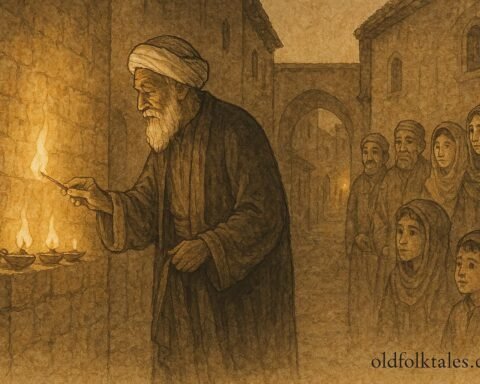
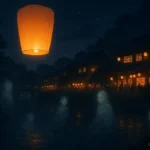
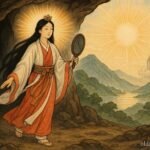
Long ago, during the graceful age of the Heian court, there lived an old bamboo cutter named Taketori no Okina and his gentle wife. They lived quietly at the edge of a bamboo grove, earning their living by cutting and crafting bamboo into simple objects. Their days were peaceful but tinged with sadness, for they had no child to brighten their home with laughter.
One morning, as the old man walked through the forest, he noticed a strange light glowing among the bamboo stalks. It shimmered softly like moonlight resting on water. Curious, he stepped closer and saw that the light came from a single stalk. When he carefully cut it open, he found a tiny, radiant girl sitting inside, no bigger than his thumb, shining with heavenly beauty.
Amazed and trembling, he lifted the little being into his hands. “Surely you are a gift from heaven,” he murmured. He carried her home to his wife, who was filled with joy and wonder. Together they decided to care for her as their own daughter. They placed her in a basket and watched over her tenderly, calling her Princess Kaguya, meaning “Radiant Shining One.”
Explore desert legends and palace tales in our Western Asian Folktales archive.
From that moment, blessings seemed to follow them. Whenever the old man cut bamboo, gold coins spilled from the stalks. Their small house soon became warm and beautiful, filled with comfort they had never known before. They thanked the heavens for their precious child.
Princess Kaguya grew at an astonishing rate. Within only a few months, she became a young woman of unmatched grace and beauty. Her skin glowed softly as if touched by the moon, and her eyes shone with quiet sorrow that no one could understand. Word of her beauty spread throughout the land. Noblemen, poets, and princes came to seek her hand in marriage, bringing gifts and promises of devotion.
Yet Kaguya remained gentle but distant. To each suitor she gave impossible tasks, asking them to find treasures that could never be obtained. One was to bring her the jeweled branch from the island of Horai, another the Buddha’s stone bowl, another the fire-rat’s robe, another the dragon’s jewel, and another the swallow’s shell. Though all tried, none succeeded, and all went away in despair.
Even the Emperor of Japan heard of her beauty and longed to see her. When he finally visited her home, he was overcome by her presence. Her light seemed to fill the entire room, soft and calm, like a reflection of the moon on still water. The Emperor begged her to come to his palace, but Kaguya lowered her gaze and said softly, “My lord, though I honor you, I cannot go with you. I do not belong to this world.”
From that day, she grew more sorrowful. On clear nights she would look up at the moon and weep silently, her tears shining like pearls. Her parents grew frightened and begged her to tell them what troubled her. At last, Kaguya revealed the truth. “I am not of this earth,” she said. “I came from the Moon as punishment, but the time has come for me to return. On the night of the next full moon, my people will come for me.”
Her parents clung to her, crying bitterly. The Emperor, when he heard the news, sent guards to surround her house and protect her. But when the moon rose full and bright, a radiant chariot descended from the sky. The guards were blinded by its light and fell to their knees. Heavenly beings stepped forward, their robes glimmering like silver mist.
Kaguya turned to her parents one last time. “Though I must leave, I will never forget your love,” she said, placing a small vial of the Elixir of Immortality before them. “Drink this, and you will live forever.” But they refused, saying, “Without you, eternity would be sorrow.”
Kaguya smiled sadly as tears fell upon her glowing robe. She looked toward the Emperor’s palace in the distance and whispered a final farewell. Then she ascended into the sky, surrounded by light, until she disappeared into the moon.
The Emperor, heartbroken, ordered his soldiers to climb the highest mountain and burn the Elixir of Immortality, so that no one would live forever apart from her. The smoke rose high into the heavens, and from that time, people called that mountain Fuji, meaning “immortal.” To this day, it is said that the mountain’s smoke is the memory of the Emperor’s grief for Princess Kaguya, who returned to the moon.
Explore timeless legends from China, Japan, and Korea in our East Asian Folktales collection.
Moral Lesson
The Tale of Princess Kaguya teaches that beauty, love, and life are all fleeting. No matter how strong our love may be, everything in this world passes away. True peace comes from accepting the impermanence of all things.
Knowledge Check
1. Who discovered Princess Kaguya and where was she found?
An old bamboo cutter named Taketori no Okina found her glowing inside a bamboo stalk in the forest.
2. What blessing followed Kaguya’s arrival?
Whenever the bamboo cutter worked, gold coins appeared inside the bamboo, bringing prosperity to the family.
3. Why did Kaguya refuse her suitors?
She gave them impossible tasks, showing that her heart could not belong to anyone on earth.
4. What truth did Kaguya reveal to her parents?
She confessed that she was a being from the Moon who had to return to her celestial home.
5. What did she leave behind before ascending to the Moon?
She left her parents a vial of the Elixir of Immortality, which they refused to drink.
6. What lasting symbol remains from this story in Japan?
Mount Fuji, whose rising smoke is said to carry the Emperor’s grief for Princess Kaguya.
Source:
Adapted from Taketori Monogatari (The Tale of the Bamboo Cutter), Japan’s earliest narrative prose work, dating to the 10th century during the Heian period.
Cultural Origin: Japan (Heian-era folklore)