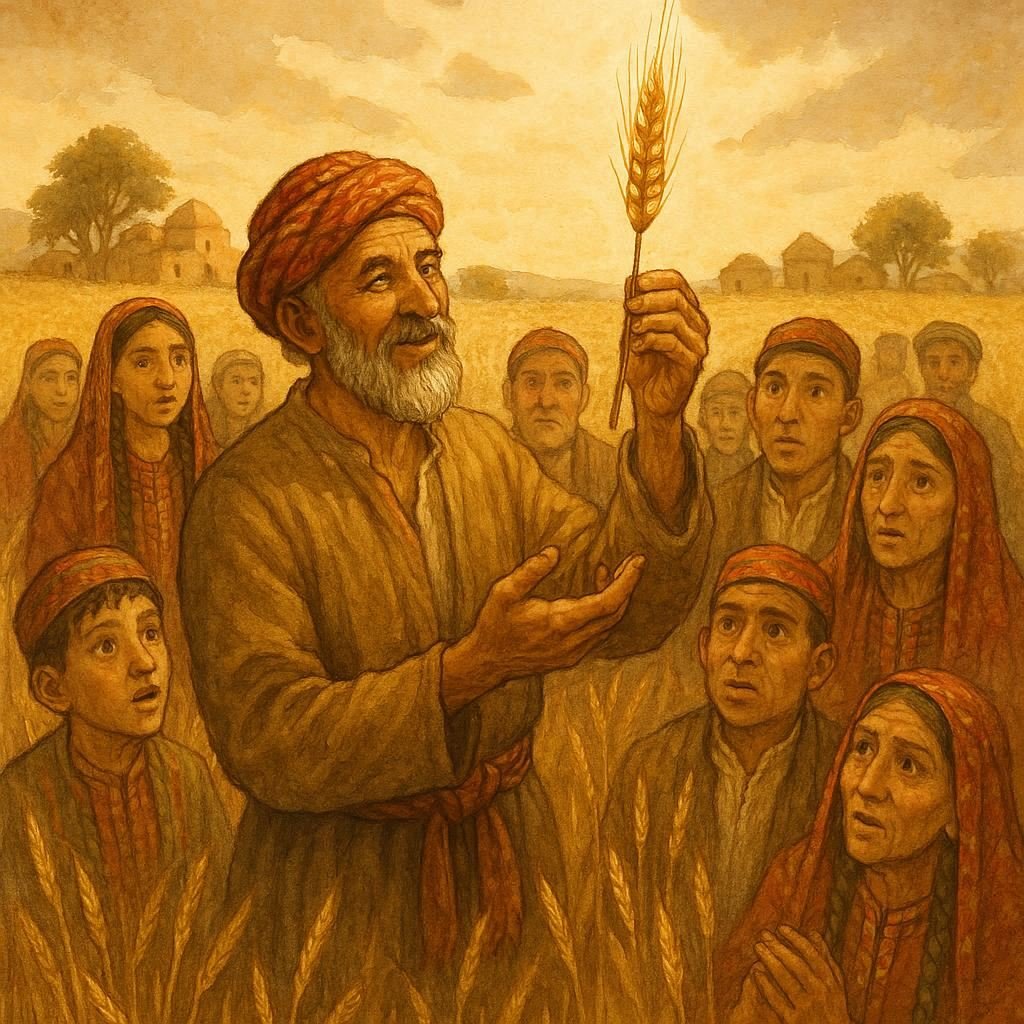
Once upon a time, in a quiet Turkmen village surrounded by rolling plains and golden fields, there lived a humble farmer named Murad. One crisp morning, as he tended his modest plot of land, he noticed something extraordinary: a single stalk of wheat glimmering in the sunlight, its kernels shining like liquid gold. Murad rubbed his eyes, certain it was a trick of the light, yet the golden grains remained, glowing as if the sun itself had blessed them.
Murad’s heart swelled with wonder and a hint of fear. Such a miraculous gift, he realized, must be handled with care. He decided, at first, to keep it secret. Each day, he harvested a few golden grains, storing them carefully in a small wooden chest hidden beneath his roof. The rest of the villagers continued their daily labors, unaware of the miracle growing silently in Murad’s field.
Explore timeless legends from China, Japan, and Korea in our East Asian Folktales collection.
But news, like wind through the steppe, travels quickly. Soon, whispers of golden wheat reached the ears of neighbors and traders who passed through the village. Curiosity turned to envy, and envy to desire. One by one, villagers came to Murad’s modest home, asking, pleading, and even bargaining to obtain the golden grains.
Murad was torn. On one hand, the grain was a blessing meant for careful stewardship; on the other, the greed and longing in the villagers’ eyes troubled him. He pondered deeply, walking through his fields at dawn and dusk, feeling the cool breeze and listening to the whispers of the wind among ordinary wheat stalks. In those quiet moments, Murad realized that wealth kept secret was wealth wasted. True prosperity, he thought, must be shared.
Gathering his courage, Murad called the villagers to his yard. With hands steady but voice humble, he shared the story of the golden stalk and offered a single grain to each family. The villagers, initially hesitant, received the gift with awe and gratitude. Murad instructed them to plant the grains, care for them diligently, and share the harvest once it ripened.
The magic of the golden wheat, it turned out, was not only in its radiant kernels but in the spirit of generosity that nourished it. Season after season, the fields of Murad’s village thrived. Each household’s crop flourished, and the village, once modest, became renowned for its abundant harvests. Sharing had transformed envy into cooperation, greed into gratitude, and secrecy into trust.
Murad, now older and wiser, often walked through the golden fields, smiling as children played and elders worked side by side. He understood that the golden grain was a lesson, not merely a gift: prosperity is sweetest when it lifts not one, but all.
Moral Lesson
Generosity and sharing enrich entire communities, while secrecy and greed lead only to isolation. True wealth comes from unity and collective well-being.
Knowledge Check
-
Who discovered the golden grain in the story?
-
Murad, a humble Turkmen farmer, found the miraculous stalk.
-
-
What lesson does the golden grain teach?
-
Generosity and sharing bring prosperity and communal well-being.
-
-
How did the villagers initially react to the golden grain?
-
They became curious, then envious, and finally sought to possess it.
-
-
What changed the villagers’ behavior?
-
Murad’s act of sharing inspired gratitude, cooperation, and trust.
-
-
What cultural values are highlighted in this Turkmen folktale?
-
Community spirit, generosity, and the dangers of greed.
-
-
Where does the story originate from?
-
Turkmen folklore, often told to teach moral lessons in village gatherings.
-
Source & Origin: Adapted from Turkmen oral folklore, Turkmenistan; traditionally shared in village gatherings to impart moral lessons.