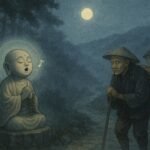
In the old royal city of Luang Prabang, where wooden houses stood on stilts and monks walked barefoot at dawn, people believed that every living thing carried a message. The river spoke through its currents, trees whispered through their leaves, and even the smallest animals were thought to hold signs meant for those willing to listen.
Among these creatures, none was more closely watched than the gecko.
At night, when oil lamps flickered and families gathered for their final meal, the sharp call of a gecko on the wall could bring sudden silence. Elders would pause and listen carefully. Some calls were believed to promise good fortune, others warned of illness, loss, or conflict. In Luang Prabang, the gecko was not merely an animal but a messenger between the unseen and the human world.
In one neighborhood near the Mekong River lived a wealthy landlord named Phai. His house was larger than most, built with polished wood and decorated with carvings meant to impress visitors. Yet despite his wealth, Phai was known throughout the quarter for his laziness and dishonesty. He overcharged his tenants, avoided temple duties, and mocked old customs, claiming that money was more powerful than spirits or signs.
Explore timeless legends from China, Japan, and Korea in our East Asian Folktales collection.
Phai often laughed when neighbors spoke of omens. He called them fears invented by the poor. When monks passed his house collecting alms, he closed his doors. When village meetings were called, he sent excuses. He believed that as long as his rice barns were full and his silver locked away, nothing could touch him.
One evening, as rain clouds gathered over the mountains and the city settled into darkness, Phai lay on his wooden bed counting coins. The oil lamp beside him cast long shadows on the walls. Suddenly, a clear sharp sound echoed through the room.
Tokay. Tokay.
Phai frowned and looked up. A large gecko clung to the beam above him, its eyes shining in the lamplight. Geckos were common in Luang Prabang homes, but something about this one made the air feel heavier.
The gecko called again, slower this time.
Tokay. Tokay.
Then, to Phai’s astonishment, the sound shifted into words.
Landlord Phai, the gecko said, its voice dry yet steady. You sit on wealth built from crooked hands. Listen now, or loss will walk through your door.
Phai leapt to his feet, heart pounding. He stared at the gecko, convinced that fatigue or wine had tricked his senses.
Spirits and tricks, he muttered. You are nothing but a wall lizard.
The gecko did not move. Its eyes remained fixed on him.
Three days remain, it said. Return what you have taken unfairly. Feed the hungry. Clean your house of deceit. If you do not, the river will take what you value most.
Anger replaced fear in Phai’s chest. He grabbed a broom and swung it toward the beam. The gecko vanished into the shadows, its final call echoing softly.
Tokay.
Phai laughed loudly to convince himself of his courage. He poured another drink and slept without offering incense or prayer.
The next morning, he told no one of what he had heard. When his tenants came to complain about leaking roofs and unfair rents, he chased them away. When a neighbor mentioned strange dreams of flooding, Phai scoffed. He believed warnings were meant to control fools.
On the second night, the gecko returned.
This time, its voice was clearer, echoing through the house.
Two days remain, Phai. The path is still open.
Phai shouted curses and threw a clay cup, shattering it against the wall. The gecko disappeared once more.
By the third day, dark clouds crowded the sky. The Mekong swelled with rainwater from distant hills. Villagers tied their boats carefully and moved valuables to higher ground. Monks chanted protective sutras, and families burned incense at their doorways.
Phai ignored it all.
That night, as thunder rolled over the city, the gecko appeared for the final time. Its voice was no longer calm.
The door is closing, it said. What is built on greed cannot stand.
Phai screamed and slammed the door, locking it tightly. He stayed awake, clutching his coin box, listening to the storm rage outside.
Before dawn, the river overflowed.
Water rushed through the streets like a living force. Wooden posts groaned, boats broke loose, and cries filled the darkness. Phai’s house, built close to the river for convenience, took the full force of the flood. Water surged beneath the stilts, tearing at weakened beams neglected for years.
Phai ran through the house in panic, trying to save his silver and rice. But the floor cracked, and the water rose too fast. His storehouse collapsed into the current, carrying away the wealth he had guarded so fiercely.
At sunrise, the flood receded. Phai’s house stood broken and empty. His tenants, whose homes he had neglected, had already been helped by neighbors and monks. Phai stood alone in the mud, shaking and silent.
That evening, villagers saw him kneeling at the temple for the first time, offering what little he had left. He apologized publicly, returning land deeds and forgiving debts. He worked beside others repairing homes, his pride washed away by the river.
Late one night, as Phai slept in a small borrowed room, he heard a familiar sound.
Tokay.
The gecko sat quietly on the wall.
You have learned, it said. Remember, not all warnings come with thunder.
When the gecko vanished, Phai bowed deeply. From that day forward, he listened not only to people, but to the quiet voices of nature itself.
Moral Lesson
Nature speaks in subtle ways, offering warnings before harm arrives. Pride and greed blind people to guidance that could save them. True wisdom lies in humility, listening carefully, and acting before consequences become unavoidable.
Knowledge Check
- Where does the story take place
Answer: In Luang Prabang, Laos. - What animal delivers the warning
Answer: A gecko. - What kind of man was Phai at the beginning
Answer: A lazy and dishonest landlord. - How many warnings did the gecko give
Answer: Three warnings over three days. - What disaster struck Phai
Answer: A flood that destroyed his wealth and house. - What lesson did Phai learn
Answer: To listen to warnings from nature and act with humility.
Source
Adapted from Luang Prabang Heritage Folklore Manuscripts, 2013.
Cultural Origin
Traditional household superstition folklore of Luang Prabang