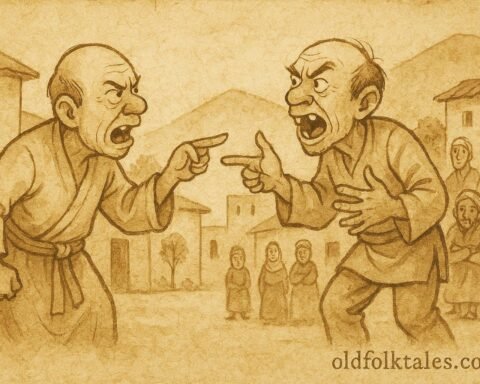
In a quiet village along the fertile plains of Samarkand, an aged Uzbek father prepared his three sons for the journey that would define their lives. Each had grown strong and eager, yet their spirits differed. The eldest, Kamil, prided himself on his unmatched strength. The middle son, Timur, boasted of wit and cleverness. The youngest, Rahim, carried no grand illusions, only a heart gentle and true.
Before dawn, the father blessed them and sent them forth: “Go, my sons, and seek your fortunes. Let your deeds reveal your true character, for wealth alone will not measure a man.” The three departed, each walking a separate path through valleys dotted with rivers and tamarisk trees, their futures uncertain yet promising.
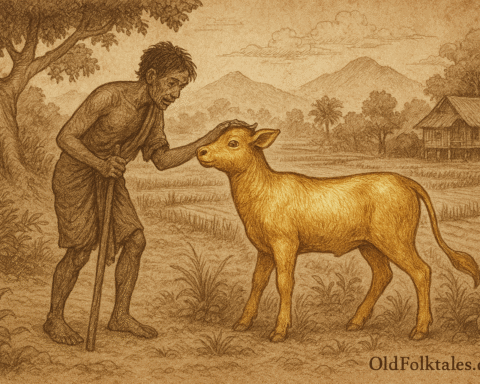
As they traveled, the eldest encountered a great stone bridge spanning a chasm. A beggar struggled to carry a heavy bundle across. Kamil sneered, thinking the task beneath him, and pushed the old man aside. Timur, ever calculating, pretended to help but asked for a reward in return, leaving the beggar burdened. Rahim, in contrast, offered his hand freely, lifting the bundle and guiding the beggar across. The old man smiled warmly, whispering, “Kindness opens doors the proud cannot see,” before vanishing as mysteriously as he had appeared.
Days later, news of a dragon reached each brother. The beast had taken residence in a mountain cave, terrorizing nearby villages and holding a princess captive. Each brother sought to face the dragon and claim the promised reward, riches and royal favor. Kamil, relying on his might, charged boldly into the cave, swinging his sword with brute force. Timur tried clever tricks and traps, hoping to outsmart the creature. Both returned battered and defeated, their pride shattered.
Rahim, humble and patient, approached the cave alone. As he neared the mouth, the beggar he had aided earlier reappeared, revealing his true form as a saintly spirit. He handed Rahim a talisman and whispered, “Trust not in strength or cunning alone. Let your heart guide you, and fear shall not bind you.”
Inside the dark cavern, the dragon roared like thunder, flames licking the walls. Rahim stepped forward, staff in hand, invoking courage and compassion. He spoke to the creature gently, not with anger, and thrust the talisman toward it. Light radiated from the charm, blinding the dragon and softening its fury. In a final surge of faith, Rahim confronted the beast, piercing its heart with the staff. The dragon collapsed, leaving the princess unharmed. The cave, once oppressive and dark, now glimmered with sunlight reflecting on golden scales scattered across the stone floor.
The princess, radiant and grateful, led Rahim back to the palace. News of the dragon’s defeat and Rahim’s courage spread quickly. The king, impressed not only by the young man’s heroism but also by his humility and kindness, rewarded him with half the kingdom and the princess’s hand in marriage. Kamil and Timur, humbled and ashamed, realized their pride had been their undoing. Rahim’s success affirmed that true strength arises from virtue and compassion, not from arrogance or cleverness alone.
In the years that followed, Rahim ruled wisely, always mindful of the old man’s words. The villages prospered, and the tale of the youngest brother’s courage, humility, and kindness endured through generations.
Moral Lesson
The story teaches that humility, compassion, and respect for others outweigh mere strength or cleverness. True fortune comes to those who act with kindness and integrity.
Knowledge Check
-
Who is the hero of “The Three Brothers” and what defines him?
Rahim, the youngest brother, is defined by humility, kindness, and compassion. -
What role does the beggar play in the story?
The beggar is a disguised saint who rewards Rahim’s kindness and aids him in defeating the dragon. -
What moral is illustrated by the failure of Kamil and Timur?
Pride and self-interest prevent success; virtue and humility are true strengths. -
How does the story reflect Uzbek cultural values?
It emphasizes filial respect, hospitality, divine justice, and the importance of moral virtue. -
What symbolic act allows Rahim to defeat the dragon?
Rahim’s use of the talisman given by the beggar symbolizes faith, kindness, and the triumph of good over evil. -
What rewards does Rahim receive for his heroism?
He marries the princess and receives half the kingdom, showing that virtue is recognized and honored.
Source & Cultural Origin
Source: Folk Tales from the Soviet Union: Central Asia and Kazakhstan (Raduga Publishers, 1983).
Origin: Uzbek oral storytelling tradition; Samarkand, Tashkent regions.