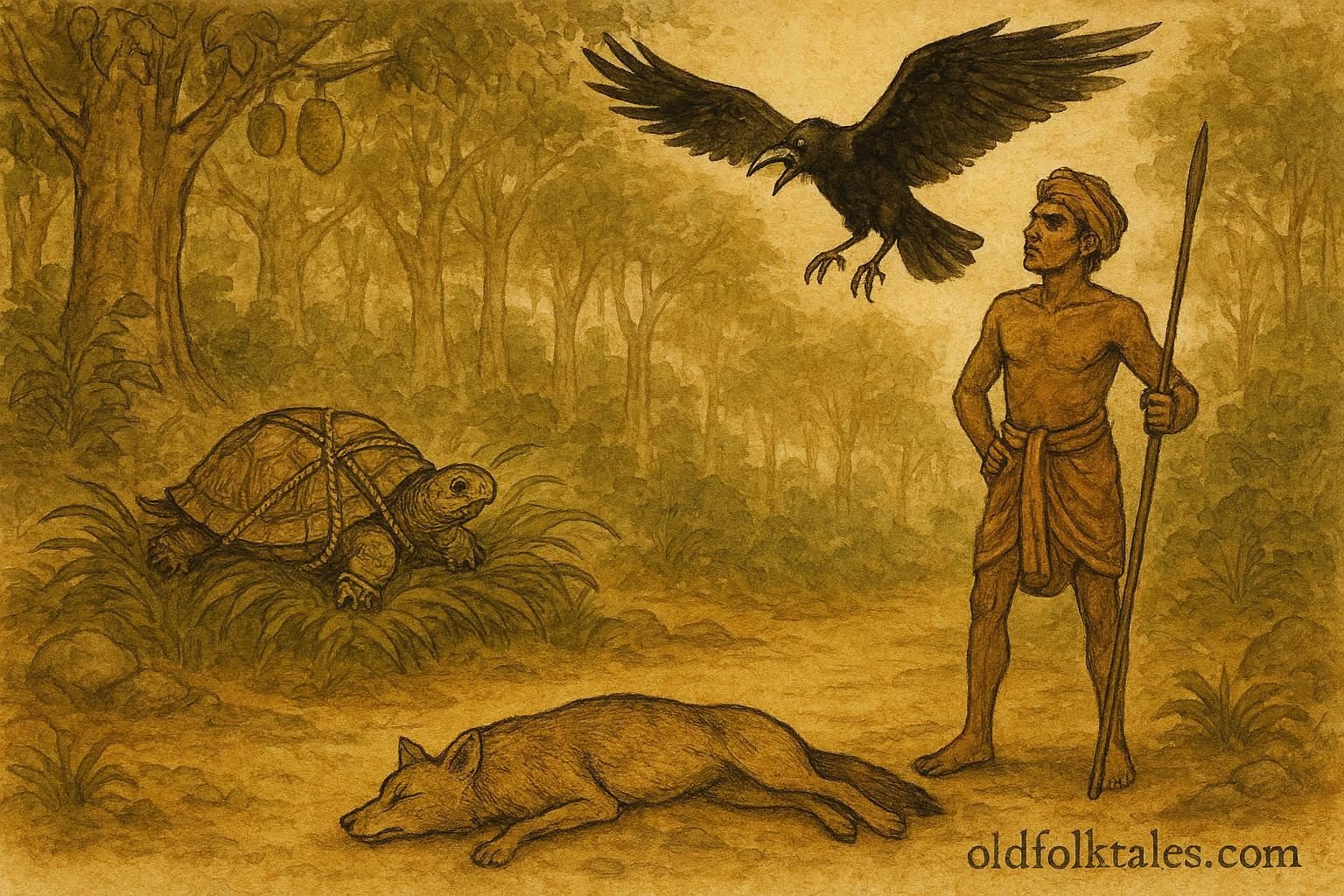
In the warm forests of Sri Lanka, where sunlight filtered through tall jak trees and the air carried the sweet scent of ripening fruit, three unlikely friends lived in harmony: a Jackal with bright, watchful eyes; a Crow whose wings shimmered like polished ebony; and a slow but thoughtful Tortoise with a shell weathered by many seasons.
Despite their differences, the three were inseparable. They ate together, wandered the forest trails together, and watched over one another with the quiet loyalty that only true friendship creates. One day, when the jak trees were heavy with golden, honey-scented fruit, the trio decided to enjoy a feast beneath one of the tall trees that grew near a cluster of rocks.
Explore desert legends and palace tales in our Western Asian Folktales archive.
The Jackal and the Crow easily climbed the branches, hopping from one limb to another as they plucked the ripe jaks. Below them, the Tortoise waited patiently at the foot of the tree, gazing upward with quiet amusement as his friends chattered and dropped bits of fruit down to him.
But as the forest fluttered with birdsong and the friends enjoyed their harvest, the peaceful moment was suddenly broken. Through the trees, a man approached, carrying a sharp billhook. The glitter of its metal edge flashed dangerously in the dappled light.
The Tortoise, ever observant, saw him first.
He asked slowly, “Why are you sharpening that billhook?”
The man, gripping the tool firmly, replied, “To cut down this tree.”
The Tortoise blinked. “Why are you going to cut it down?”
“Because,” the man said with irritation, “the fruit is being eaten by these animals.”
Up in the branches, the Jackal froze mid-bite, and the Crow paused with a fruit in its beak. The Tortoise understood the danger immediately. If the tree fell, not only would their feast be lost—the man might catch them as well.
Thinking quickly, the Tortoise spoke again, his voice calm and reassuring.
“Don’t cut it down. Leave the fruit on the tree. Instead, I will show you a place where the jaks are far larger than these.”
The man hesitated, curiosity flickering across his face.
“Where is that?”
“Come with me,” the Tortoise said. “I will show you.”
Trusting the slow creature, the man followed. As soon as they were out of sight, the Jackal and the Crow scrambled down the tree with great urgency. They gathered as much fruit as they could carry and hurried away into the forest, leaving the tree, and danger, behind them.
Meanwhile, the Tortoise trudged forward in steady determination, leading the man through a winding path between trees and rocks. He moved slowly, of course, but he never stopped. The man, slightly annoyed but hopeful for bigger fruit, continued after him.
Eventually they reached a barren stretch of land, open ground with rocks, dry shrubs, and not a single tree bearing fruit. The man frowned.
“Where is the jak tree?” he demanded.
“It is near here,” the Tortoise replied. “Come along.”
With great seriousness, the Tortoise led him toward a deep, dark hole nestled between large rocks. Pointing at it with his heavy foot, he said, “The jak tree is in there.”
The man leaned forward carefully and peered into the darkness. He saw nothing, no branches, no leaves, not even a shrub.
“There is no jak tree here,” he snapped.
The Tortoise insisted, “It is inside.”
That was the man’s breaking point. His patience vanished.
“You are deceiving me!” he roared.
Before the Tortoise could withdraw his head into his shell, the man grabbed him by the neck, lifted him with frustration, and hurled him away.
But the forest itself seemed to protect the loyal friend. The Tortoise landed in a thick heap of soft puppa grass, light, springy, and harmless. His shell absorbed the impact, and he was not hurt at all. After recovering from the tumble, he slowly pushed himself upright and began his long walk home.
When he finally rejoined the Jackal and the Crow, his friends rushed to greet him. The Jackal sniffed him all over with concern, and the Crow fluttered around him anxiously, scolding the absent man in loud caws. But the Tortoise only smiled his gentle, patient smile.
Their danger had passed, and once again their friendship had carried them safely through.
Discover the wisdom of ancient India and the Silk Road in South & Central Asian Folktales.
Moral Lesson
This Sri Lankan folktale teaches that true friendship thrives on loyalty, trust, and quick thinking. Even the smallest or slowest among us can protect their friends through calm wisdom and clever action. Together, friends can face dangers that would overwhelm them alone.
Knowledge Check
1. Who are the main characters in “The Three Friends” folktale?
A jackal, a crow, and a tortoise form the trio at the heart of this Sri Lankan story.
2. What cultural symbolism does the tortoise represent in the tale?
The tortoise symbolizes patience, wisdom, and the power of steady thinking in difficult situations.
3. Why does the man want to cut down the jak tree?
He believes the animals are stealing the fruit and wants to remove their source of food.
4. How do the friends escape danger in the story?
The tortoise distracts the man while the jackal and crow escape with the fruit and avoid being caught.
5. What is the main moral lesson of this Sri Lankan folktale?
The story teaches that loyalty and clever cooperation help friends overcome challenges.
6. What cultural origin does “The Three Friends” belong to?
The tale is part of traditional Sinhalese folklore from Sri Lanka, preserved in Henry Parker’s collection.
Source: Adapted from the Sinhalese folktale “The Three Friends” in Village Folk-Tales of Ceylon, Vol. I, collected by H. Parker (1910), London: Luzac & Co.
Cultural Origin: Sri Lanka (Sinhalese folklore)