In a small village at the edge of the Burmese countryside, where rice paddies stretched like green mirrors reflecting the sky and the golden spires of distant pagodas rose above the morning mist, there stood a modest teak wood house. This home belonged to three sisters who had inherited it from their parents, along with a small plot of land that provided just enough to sustain them if they worked together and shared equally.
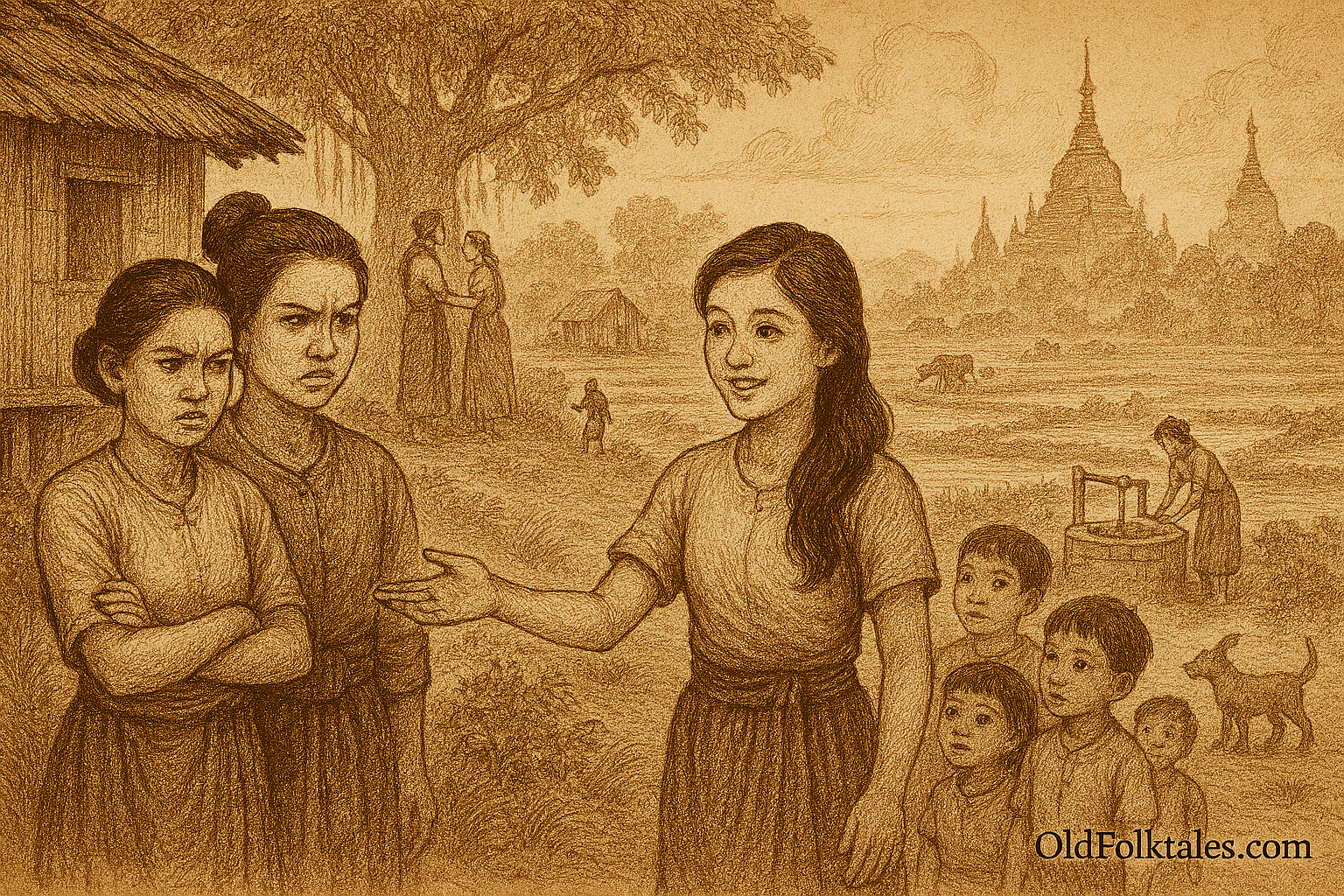
The eldest sister was sharp-featured and sharp-tongued, her face often set in lines of discontent. The middle sister followed the eldest in all things, echoing her opinions and sharing her moods like a shadow follows its source. But the youngest sister was different entirely. She possessed a gentle spirit that seemed to radiate warmth like sunlight through clouds. Her face carried a natural sweetness, not from any extraordinary beauty but from the kindness that lived in her heart and showed itself in every expression and gesture.
Click to read all East Asian Folktales — including beloved stories from China, Japan, Korea, and Mongolia.
When the youngest sister walked through the village, children would run to greet her, knowing she always had a kind word or a small treat saved in her pocket. Elderly neighbors would smile and call out blessings as she passed, remembering countless small acts of thoughtfulness water fetched without being asked, weeds pulled from their gardens, a listening ear offered freely. Even the animals seemed drawn to her: birds would land near her feet without fear, stray dogs would follow her home hoping for scraps, and the family’s water buffalo would low softly whenever she approached.
For a time, the three sisters lived together in relative peace. They divided the household tasks, worked their small plot of land, and took turns cooking meals over the clay stove. But peace built on unequal hearts cannot last forever, and slowly, like poison seeping through cracks, envy began to corrupt the eldest sister’s feelings toward the youngest.
It started with small irritations. “Why does everyone always smile at her and not at us?” the eldest would mutter as they returned from market, watching villagers wave warmly at their youngest sister. “We work just as hard. We’re just as deserving of affection.”
The middle sister, hearing these complaints, began to echo them. “You’re right,” she would agree, her own resentment growing to match her elder sister’s. “It’s not fair. What makes her so special?”
The truth, though neither wanted to acknowledge it, was simple: the youngest sister gave freely of her kindness without expectation of return, while her older sisters measured every interaction as a transaction, always calculating what they should receive. The youngest helped neighbors because helping brought her joy; the eldest helped only when she calculated there would be benefit. The youngest shared food with strays because she couldn’t bear to see hunger; the eldest saw only wasted resources that could have filled their own bowls.
As months passed, the eldest sister’s envy grew from irritation into consuming bitterness. She began to find fault with everything the youngest did. “You’re too slow with your work,” she would snap. “You give away too much to beggars. You waste time talking to old women who have nothing to offer us.”
The middle sister joined in these criticisms, her voice a cruel echo: “Yes, you think you’re better than us with all your kindness, don’t you? You want everyone to think we’re heartless while you’re the precious one.”
The youngest sister tried to defend herself gently. “Sisters, I don’t think I’m better than anyone. I only try to be kind because kindness was what our mother taught us before she passed. Don’t you remember? She always said that a generous heart brings more joy than a full rice pot.”
But her words only inflamed her sisters’ anger further. They saw her gentle response as smugness, her reference to their mother’s teachings as an accusation of their own failures to live up to those ideals.
One evening, as the three sisters sat around their low table eating the simple dinner the youngest had prepared, the eldest sister made her decision. Her eyes, glittering with malice in the lamplight, met the middle sister’s gaze, and a silent understanding passed between them.
“We’ve been thinking,” the eldest announced, her voice cold as winter rain, “that this house is too small for three. You should leave.”
The youngest sister looked up from her bowl, confusion and hurt flooding her face. “Leave? But this is our home. Our parents left it to all three of us. Where would I go?”
“That’s not our concern,” the middle sister said, her voice hard despite the slight tremor that betrayed her uncertainty. “You’re always so beloved by everyone in the village. Surely someone will take you in. You don’t need us.”
The youngest sister’s eyes filled with tears. “But you’re my sisters. You’re my family. I don’t want to leave. Have I done something to offend you? Please, tell me what I’ve done wrong, and I’ll try to make it right.”
Her pleading only disgusted the eldest sister more. “Everything about you offends us,” she spat. “Your false sweetness, your pretended kindness, the way everyone fawns over you. We’re tired of living in your shadow. Take your things and go. You’re no longer welcome here.”
The youngest sister wept openly now, her heart breaking not from fear of homelessness but from the realization that her sisters’ hearts had turned so completely against her. Still, she tried one more time: “I love you both. You’re my family. Please don’t send me away.”
But her sisters’ faces remained hard as temple stones. The eldest stood and opened the door, gesturing impatiently toward the darkness outside. “Go. Now. Before we throw you out by force.”
With trembling hands, the youngest sister gathered her few possessions, a spare longyi, a wooden comb their mother had given her, and a small cloth bundle containing a bit of rice and dried fish. She cast one last pleading look at her sisters, hoping to see some softening in their expressions, some hint of the bond they had once shared. But she found only cold satisfaction in the eldest’s eyes and carefully maintained indifference in the middle sister’s averted gaze.
She stepped out into the night, and the door slammed shut behind her with a finality that echoed through her heart.
The youngest sister walked through the darkness, tears streaming down her face, with no destination in mind. She followed the dirt path that led away from the village, away from everything familiar, into the unknown. The night was moonless, the darkness complete except for the faint starlight that barely illuminated her way. Strange sounds came from the forest on either side of the path rustling leaves, animal calls, the whisper of wind through bamboo groves.
She walked until exhaustion overtook her, finally collapsing beneath a large banyan tree whose spreading roots created natural shelters. She curled up in one of these spaces, using her bundle as a pillow, and cried herself to sleep while wondering what would become of her now.
She woke to sunlight filtering through the banyan leaves and the sound of chirping birds. As she sat up, rubbing her swollen eyes, she noticed a small monkey sitting nearby, watching her with curious, intelligent eyes. The monkey held a ripe mango in its paws.
“Hello, little one,” she said softly, her voice hoarse from crying. The monkey chittered and, to her surprise, rolled the mango toward her before scampering up into the branches.
The youngest sister picked up the fruit, overwhelmed by this small kindness. “Thank you,” she called up to the monkey, who peered down at her through the leaves as if acknowledging her gratitude.
She ate the mango slowly, its sweet juice reviving her spirits slightly, and then continued walking, still with no clear destination but feeling somehow that she should keep moving forward.
Over the following days and weeks, the youngest sister wandered from village to village, always treating others with the same kindness that had characterized her entire life. When she encountered an old woman struggling to carry water, she took the heavy jug and carried it to the woman’s home. When she found an injured bird on the path, she carefully set its wing with small sticks and soft cloth, then fed it until it could fly again. When she met a hungry child begging by the roadside, she shared her meager portion of rice without hesitation.
These acts of kindness, performed without thought of reward, began to create ripples that spread outward like circles on still water. The old woman whose water she had carried told her friends about the helpful stranger. The child’s mother, grateful for the shared meal, offered the youngest sister shelter for the night. Word traveled through the network of villages about a gentle-hearted young woman who helped anyone in need.
One particularly hot afternoon, the youngest sister came upon a well where a crowd had gathered. A young boy had somehow managed to knock the well bucket down into the water, and it had sunk too deep for anyone to retrieve with the rope. The village desperately needed that bucket it was their only one, and without it, they would struggle to draw water.
The youngest sister studied the problem carefully. Then she removed her longyi, tied it securely to the rope, and created a makeshift net. After several attempts, she managed to snag the bucket and pull it up, much to the village’s joy and relief.
The village headman, impressed by her cleverness and kindness, offered her work and a place to stay in his household, helping his elderly mother with daily tasks. The youngest sister accepted gratefully, and for the first time since being cast out by her sisters, she felt the beginning of peace settling over her wounded heart.
Months passed. The youngest sister thrived in her new situation, beloved by the headman’s family and the entire village for her tireless helpfulness and unfailing kindness. She had learned to find joy even in her reduced circumstances, discovering that home is not a place but a feeling we carry within ourselves.
Then one day, two women arrived in the village, looking haggard and desperate. The youngest sister was drawing water from the well when she heard familiar voices asking for directions to the headman’s house. She turned and saw her two sisters, barely recognizable from the proud women who had cast her out. Their clothes were worn and patched, their faces thin, their eyes carrying the hollow look of those who have suffered greatly.
The youngest sister’s heart clenched with conflicting emotions hurt, anger, concern, and despite everything, love. She set down her water jug and approached them slowly.
“Sisters?” she said softly.
Both women turned, and their faces transformed with shock, shame, and desperate hope. The eldest sister, all her former pride gone, fell to her knees. “Youngest sister, please forgive us,” she said, her voice breaking. “We’ve come to beg your forgiveness. We were wrong so terribly wrong to treat you as we did.”
The middle sister knelt beside her, tears already streaming down her face. “After you left, everything went wrong. Our crops failed. We fell ill. We lost the house because we couldn’t pay the land taxes without your share of work. But worse than all of that was the guilt. The shame of what we did to you haunted us every day. We realized too late that your kindness wasn’t false or pretended it was real, and we threw away the most precious thing we had: a sister who truly loved us.”
The youngest sister looked at them both, seeing their genuine remorse and suffering. She thought about how her own experiences had taught her that hardship can either harden hearts or open them, and clearly, her sisters’ hearts had finally opened.
“Stand up,” she said gently. “Both of you, please stand up.”
They rose shakily, unable to meet her eyes, expecting rejection or at best, cold tolerance.
Instead, the youngest sister embraced them both, holding them as they wept. “I forgive you,” she said simply. “You’re my sisters. I never stopped loving you, even when you sent me away. Envy and jealousy poisoned your hearts for a time, but suffering has cleansed you. Welcome back to my life.”
She brought her sisters to the headman’s house and explained the situation. The kind headman, moved by the youngest sister’s forgiveness and impressed by her sisters’ genuine remorse, offered them all work in his household.
The three sisters began to rebuild their relationship, this time on a foundation of honesty and mutual respect. The eldest and middle sisters watched their youngest sister carefully now, not with envy but with genuine desire to learn from her example. They began to practice kindness themselves, discovering that giving to others truly did bring more joy than they had ever found in selfishness.
The youngest sister, for her part, taught them patiently, never throwing their past cruelty in their faces, never claiming moral superiority, simply living as she had always lived and allowing them to see that this path led to genuine contentment.
Time passed, and the bond between the three sisters grew stronger than it had ever been before. They eventually saved enough to build their own small house near the headman’s property, where they lived together in true harmony, their past mistakes transformed into lessons that made their present understanding deeper and their love for each other more profound.
And when villagers would comment on how close the three sisters had become, the eldest would say with quiet humility, “We learned that envy destroys everything good, but forgiveness can heal even the deepest wounds. Our youngest sister taught us that lesson at a cost we should never have made her pay.”
Click to read all Southeast Asian Folktales — featuring legends from Thailand, Indonesia, Vietnam, and the Philippines.
The Moral Lesson
This Burmese folktale teaches that envy poisons relationships and destroys families, while forgiveness possesses the power to heal even the deepest wounds. The eldest sisters’ jealousy led them to commit a terrible cruelty against someone who loved them, demonstrating how comparison and resentment corrupt our judgment and make us harm the very people we should cherish most. The youngest sister’s unwavering kindness and eventual forgiveness show that true strength lies not in vengeance but in compassion. Her example teaches that responding to cruelty with continued goodness can transform hearts more effectively than punishment ever could.
Knowledge Check
Q1: What caused the eldest sisters to turn against the youngest?
A: The eldest sisters became consumed with envy and jealousy because everyone in the village loved and admired the youngest sister for her genuine kindness. Rather than examining why their sister received such affection, they blamed her for their own lack of warmth and generosity, allowing resentment to poison their feelings until they cast her out.
Q2: How did the youngest sister survive after being forced from her home?
A: The youngest sister survived through the same kindness that had characterized her entire life. She helped strangers, cared for injured animals, and showed compassion wherever she went. These acts of goodness created a network of grateful people who offered her shelter, food, and eventually permanent work in a village headman’s household.
Q3: What happened to the eldest sisters after they drove the youngest away?
A: After casting out their youngest sister, the eldest sisters suffered multiple misfortunes including failed crops, illness, and the loss of their family home because they couldn’t manage without their sister’s contribution. More painfully, they were haunted by guilt and shame for their cruelty, which eventually drove them to seek forgiveness.
Q4: Why did the youngest sister forgive her sisters despite their cruelty?
A: The youngest sister forgave her sisters because she recognized their genuine remorse and understood that suffering had opened their hearts and taught them the value of what they had lost. Her forgiveness stemmed from her inherent compassionate nature and her continued love for them as family, demonstrating that true kindness extends even to those who have harmed us.
Q5: What transformation occurred in the eldest and middle sisters?
A: Through suffering the consequences of their envy and witnessing their youngest sister’s continued kindness even after their betrayal, the eldest and middle sisters underwent a profound transformation. They learned humility, developed genuine compassion for others, and began practicing the kindness they had once scorned, discovering it brought true contentment.
Q6: What cultural values does this Burmese folktale emphasize?
A: The story emphasizes core Buddhist and Burmese cultural values including the importance of compassion (metta), the destructive nature of envy and jealousy, the power of forgiveness to heal relationships, the concept that kindness creates positive karma that returns to us, and the understanding that family bonds, though tested, can be restored through genuine remorse and forgiveness.
Source: Adapted from Folklore and Fairy Tales from Burma, a collection preserving the oral storytelling traditions and moral teachings of Myanmar’s diverse cultural heritage.
Cultural Origin: Burmese folklore, Myanmar (Burma), Southeast Asia