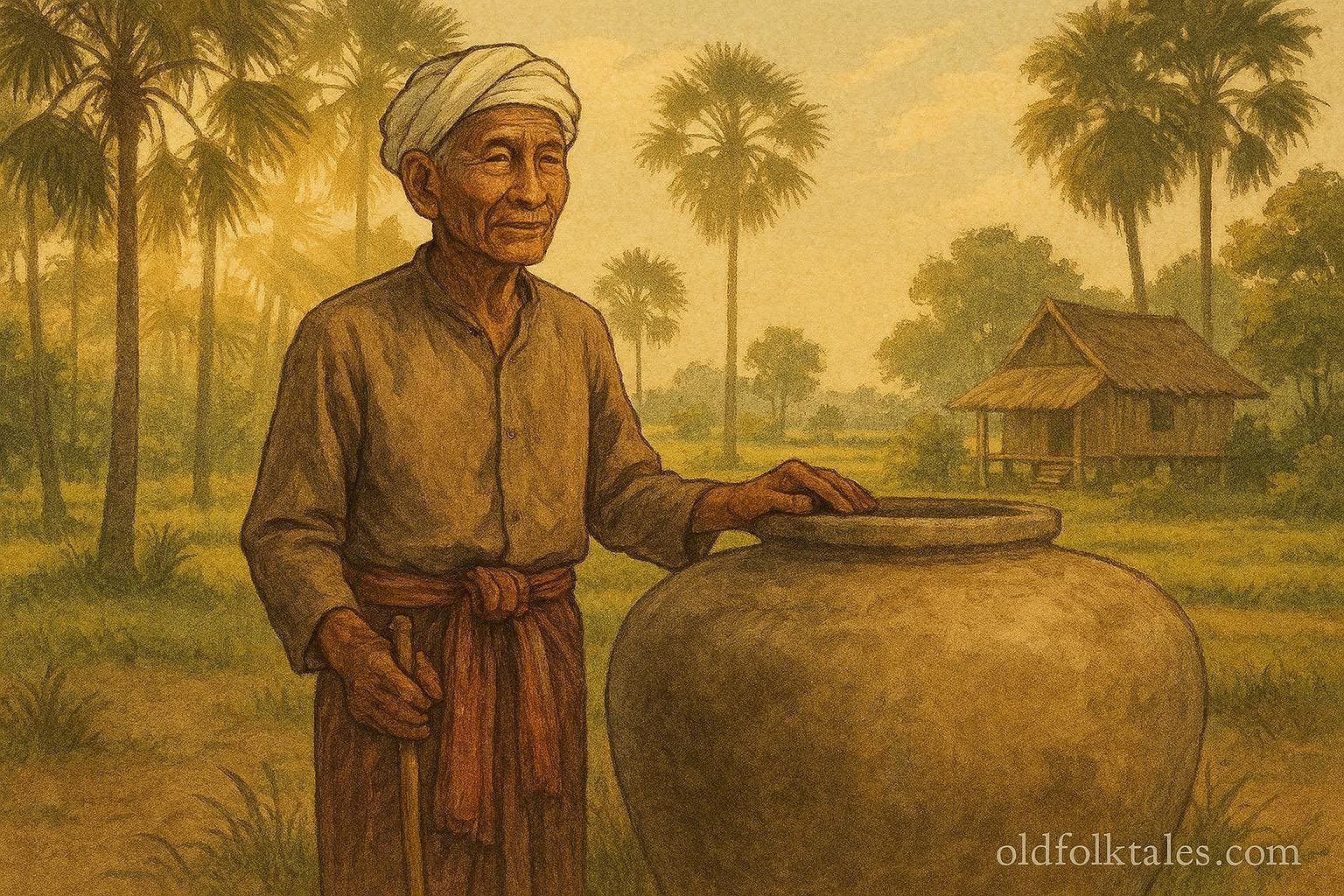
In the heart of central Cambodia, where the rice fields shimmer beneath the sun and tall sugar palms cast long shadows over village paths, there lived a humble farmer named Dara. He was known throughout the countryside not for great wealth or physical strength but for his sharp mind and thoughtful nature. Dara understood the rhythms of the land, the moods of the weather, and the silent language of animals. This knowledge had kept him safe and kept his family fed for many years, even when seasons grew harsh.
One year, the rains came late, and food became scarce for both people and animals who depended on the fields. As desperation grew in the jungle nearby, a tiger began prowling closer to the village. This tiger was feared by all. It was large, fierce, and cunning, and it had already attacked livestock belonging to several villagers. Stories traveled quickly: the tiger could leap silently from shadows, its eyes glowing like burning coals. Farmers became fearful of tending their fields early in the morning or returning late in the evening.
Dara, however, continued his daily work at dawn, just as he always had. He believed that fear clouded judgment, and he trusted in his ability to think clearly even when danger lurked near. But fate has a way of testing even the wisest, and one misty morning, his moment came.
While carrying a basket of newly harvested vegetables toward his home, Dara heard a low, rumbling growl behind him. He froze. He recognized the sound instantly. Turning slowly, he saw the tiger emerging from the tall grass, its huge body moving fluidly, as quiet as smoke. Its golden fur was streaked with black shadows, and its eyes fixed upon him with unmistakable intention.
Explore timeless legends from China, Japan, and Korea in our East Asian Folktales collection.
Dara knew he could not outrun the tiger. He also knew that showing fear or making sudden movements would seal his fate. Instead, he forced himself to breathe slowly as an idea began forming in his mind. Speaking clearly, he addressed the tiger, hoping it could be reasoned with or at least delayed by curiosity.
“You are strong and powerful,” Dara said, keeping his voice steady. “But eating me will not bring you pride or lasting satisfaction. I am only a modest farmer. There is someone much more valuable you could eat, someone who claims to be far wiser than me.”
The tiger stopped, surprised by the human’s calmness. It tilted its head slightly, listening. Most prey either ran or screamed. This one spoke as though holding a secret. The tiger took another step forward but did not pounce.
“Wiser than you?” the tiger growled. “Who is this creature?”
Dara nodded, pretending to whisper a forbidden truth. “He lives near the village. His name is the Judge. Everyone fears him. He prides himself on his knowledge and thinks himself greater than all. If you eat him, you will surely gain his power.”
The tiger’s ears twitched. The idea appealed to its pride. Few creatures dared speak of gaining more power than they already had. That alone intrigued the great beast.
“Take me to him,” the tiger demanded. “If I am to eat, I will eat the most valuable prey.”
Dara bowed respectfully, still pretending to be cooperative while his mind worked quickly. “Of course. Follow me, and I will show you where he is kept.”
As they walked, Dara rehearsed his plan in his head. The Judge he referred to was not a person at all but an enormous clay jar used to store rice. It was old, cracked, and empty after the poor harvest season. But to the tiger, who knew nothing of human tools or storage containers, it could be anything Dara said it was.
Dara led the tiger to the clearing behind his house. There, beneath the shade of a large tamarind tree, stood the massive clay jar. It was taller than a grown man and wide enough for two people to hide inside. The tiger narrowed its eyes, uncertain.
“This,” Dara whispered, “is where the villagers keep the Judge. It is said he holds great wisdom and can judge any creature who approaches. But he is very dangerous. If you get too close, he may try to trap you first.”
The tiger snorted. “I fear nothing. If he is inside, I will eat him.”
“Very well,” Dara said. “But approach carefully.”
The tiger circled the jar, sniffing suspiciously. The jar did not move, did not growl, did not show signs of life. It sat silently in the dust. The tiger grew frustrated.
“This is no Judge,” the tiger snarled. “It is only a strange dead thing.”
Dara clicked his tongue disapprovingly. “Ah, but that is what makes him powerful. He can hide his presence completely. If you want to defeat him, you must show courage. Climb inside and confront him directly, or he will forever escape you.”
The tiger hesitated. It did not like the thought of climbing into something so dark and narrow. But its pride sparked once more. It would not let a mere human suggest that it lacked bravery. With a growl, the tiger leaped inside the jar.
As soon as the tiger’s body disappeared into the opening, Dara acted. He shoved the heavy lid over the jar and used a thick wooden beam to pin it securely in place. The tiger roared furiously, hurling itself against the inside walls, but the jar was solid and built for long storage seasons.
Dara stepped back, relief washing over him like cool rain. He called for the villagers, who arrived with ropes and tools. Together, they secured the jar and carried it far from the village, deep into the forest, where the tiger could do no more harm. Eventually, it broke free and disappeared into the wilderness, never returning to trouble the villagers again.
From that day forward, Dara was celebrated not as a warrior but as a man whose wisdom had saved the entire community. His story was told to children for generations as a reminder that intelligence often triumphs over strength, and calm thinking can protect even the most vulnerable.
Moral Lesson
True strength does not lie in physical power but in clear thinking, patience, and wise decision-making. Courage guided by wisdom can overcome dangers that force alone cannot defeat. Respect for the balance between humans and animals ensures harmony, but cleverness is essential when survival is at stake.
Knowledge Check
1. Why did the tiger come close to the village?
Answer: Because food was scarce, and it was desperate during a difficult season.
2. How did Dara stay safe when he first saw the tiger?
Answer: He remained calm and used his intelligence instead of panicking.
3. What did Dara tell the tiger to delay it?
Answer: He claimed there was someone wiser and more valuable to eat, called “the Judge.”
4. What was “the Judge” actually?
Answer: A large, empty clay rice-storage jar.
5. How did Dara trap the tiger?
Answer: He convinced it to jump inside the jar and then sealed it shut.
6. What is the main message of the story?
Answer: Wisdom and calm thinking are more powerful than physical strength.
Source
Adapted from Cambodia Folk Literature Preservation Project, 2014
Cultural Origin
Central Cambodian animal fables