Once upon a time, in a quiet Cambodian village surrounded by rice fields and palm trees, there lived a kind couple blessed with twelve beautiful daughters. The sisters were gentle, hardworking, and devoted to their parents. They sang while fetching water, tended the fields together, and shared every meal with laughter and love. But when famine struck the land, food became scarce, and hardship crept into their home like a shadow.
The parents, desperate and ashamed, could no longer feed their many children. One sorrowful night, the father led his daughters deep into the forest under the pretense of gathering fruits. When they fell asleep beneath a large fig tree, he quietly slipped away, leaving them behind.
When the sisters awoke and discovered they were abandoned, they wept bitterly. Yet their eldest sister, Neang Pov, wiped her tears and said, “We are all we have now. We must stay together.” Encouraged by her courage, they began to search for food and shelter.
Discover the wisdom of ancient India and the Silk Road in South & Central Asian Folktales
By the river, the sisters caught fish to survive. As they prepared their meal, a tiny fish spoke in a soft voice, “Spare me, and I will remember your kindness.” Eleven sisters ignored the plea, but Neang Pov gently placed the fish back into the water. Before swimming away, it whispered, “Your mercy will not be forgotten.”
The sisters built a small hut and lived together, depending on the forest for their needs. But peace did not last long. A powerful ogress who ruled that part of the forest discovered them. Disguising herself as a kindly old woman, she visited their hut and tricked them into serving her. Soon, they realized her true form a hideous giantess who craved human flesh.
One by one, the sisters were captured. When the ogress turned her attention to Neang Pov, she cried out for help. Suddenly, the same little fish appeared in the river, now transformed into a radiant spirit. “Fear not, kind sister,” it said, “your compassion has saved you.” The spirit summoned divine beings who struck down the ogress and freed the sisters.
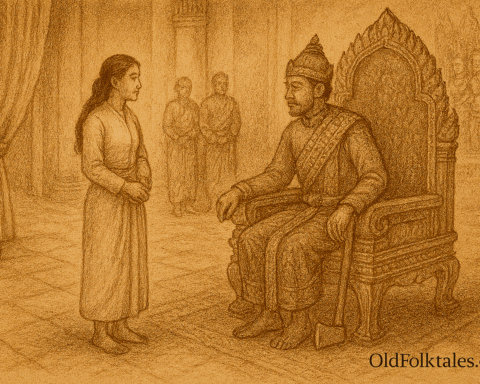
Years passed, and the twelve sisters found refuge in a nearby kingdom. Their virtues and wisdom became known to the king, who welcomed them into his palace. But jealousy and injustice still haunted their lives. False accusations and betrayal separated the sisters once more, testing their endurance and faith.
Despite all their suffering, they remained loyal to each other and true to virtue. In the end, truth triumphed, and the king restored their honor. Yet the youngest sister, Neang KongRei, whose heart had carried the pain of all her sisters, vanished into the mountains. It is said that her spirit transformed into the mountain Phnom Kong Rei, where her form still lies her body turned to stone, forever facing the sky in quiet sorrow.
Even today, villagers believe that Neang KongRei’s spirit watches over those who visit her mountain. They speak softly and avoid bringing food into her resting place, out of respect for her eternal fasting and compassion.
Moral Lesson
The story of The Twelve Sisters (Neang KongRei) teaches that compassion, endurance, and faith will triumph over cruelty and misfortune. Acts of kindness, even the smallest ones, carry power beyond measure, and family love endures even through great suffering.
Knowledge Check
-
Why did the parents abandon their twelve daughters?
Because famine left them unable to feed the children. -
How did the sisters survive in the forest?
By working together, finding food, and helping one another. -
What did Neang Pov do differently from her sisters with the fish?
She spared its life, showing compassion and mercy. -
Who was the ogress in the story?
A powerful forest spirit disguised as an old woman who sought to harm the sisters. -
How were the sisters finally saved?
A divine fish spirit helped them because of Neang Pov’s earlier act of kindness. -
What does Phnom Kong Rei represent?
It is said to be the stone form of the youngest sister, mourning eternally for her family. -
What moral does this story teach?
Compassion, loyalty, and endurance bring spiritual victory over suffering and injustice.
Source
Adapted from The Twelve Sisters (Puthisen Neang KongRei), a traditional Cambodian folk tale derived from the Paññāsa Jātaka tradition and widely told across Cambodia.
Cultural Origin
Cambodia (Khmer folklore, children’s tales, oral storytelling tradition)