In a prosperous kingdom, there lived a prince and a minister’s son whose friendship was legendary. They were inseparable companions, sharing every moment from dawn to dusk. They sat together, walked together, ate from the same plate, and slept side by side. Their bond was stronger than brotherhood, forged through years of unwavering loyalty.
One day, restless with youth and curiosity, they decided to venture beyond their palace walls. Though born to wealth and privilege, they traveled alone on magnificent pakshirajes, horses as swift as birds, their manes flowing like silk in the wind. They rode through endless paddy fields swaying green and gold, through bustling cities and quiet villages, across barren deserts where no tree offered shade, and into dense forests prowled by tigers and bears.
Click to read all Southeast Asian Folktales — featuring legends from Thailand, Indonesia, Vietnam, and the Philippines.
One evening, as darkness descended like a curtain, they found themselves in a desolate region devoid of human habitation. Near a vast tank with water clear as crystal, they dismounted beneath a towering tree. Tying their horses to its trunk, they climbed into its thick canopy for safety, preparing to spend the night among the leaves.
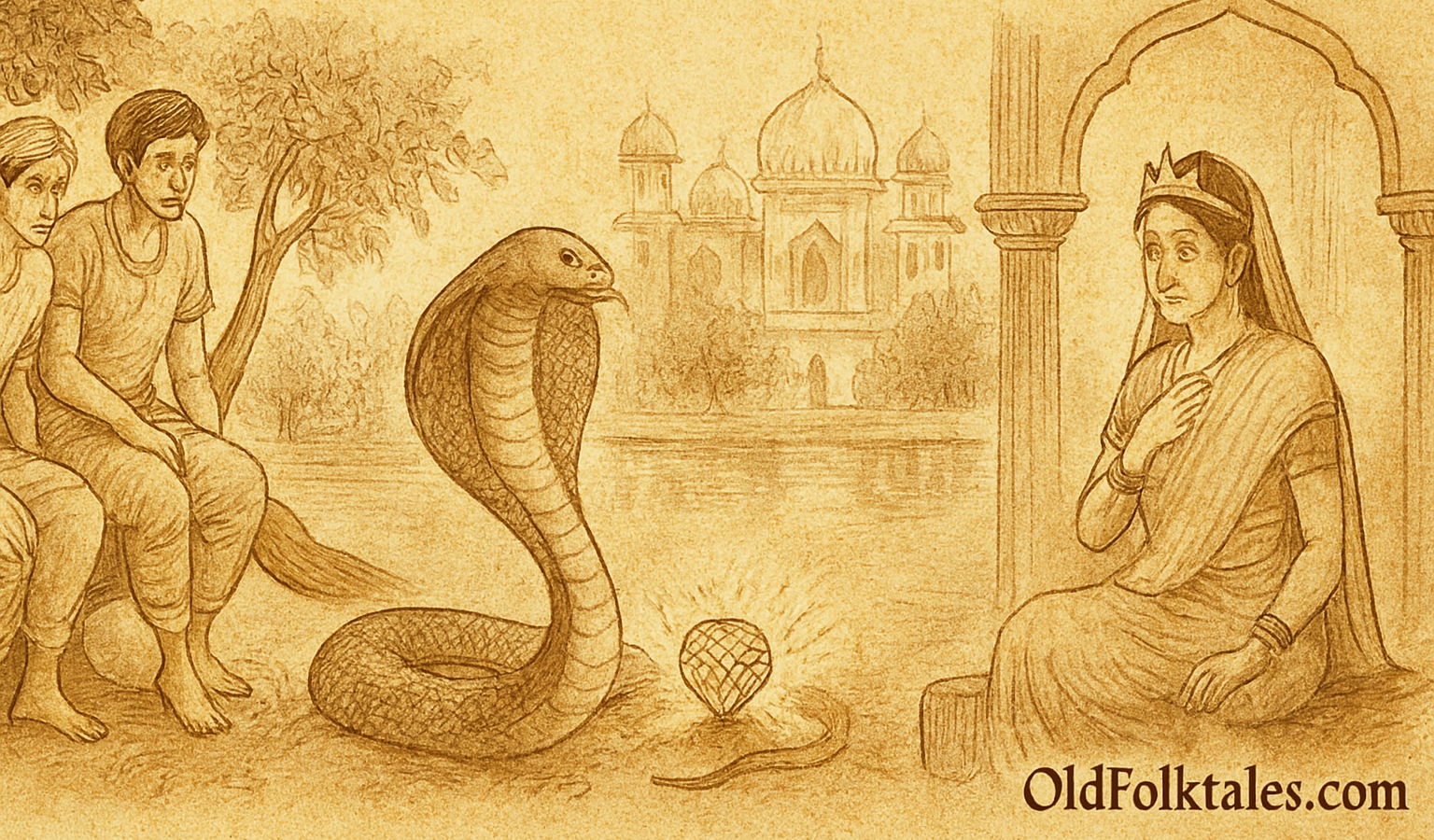
As midnight approached, the water’s surface suddenly erupted. A monstrous serpent burst forth, its hood spreading wide as a shield. Upon its crest gleamed a jewel so brilliant it illuminated everything around like a thousand diamonds ablaze. The serpent removed the precious manikya from its head, placed it carefully on the ground, and slithered away in search of prey.
Terror seized the young men when the serpent approached their tree and devoured their horses, one after another. But fortune favored them when the creature moved away. The minister’s son, remembering tales of serpent jewels, descended quietly and covered the glowing stone with horse dung to hide its light. When the serpent returned and found its jewel darkened, it thrashed in fury, hissing and convulsing until it breathed its last.
At dawn, they retrieved the jewel and washed it in the tank. Its radiance penetrated the water’s depths, revealing an astonishing sight: a magnificent palace stood on the tank’s floor. Without hesitation, the adventurous friends dove beneath the surface, the jewel lighting their way.
They emerged in an enchanted garden surrounding a fairy palace with walls of burnished gold studded with dazzling diamonds. Flowers of every variety perfumed the air with intoxicating sweetness. Inside the silent palace, they discovered a beautiful princess sleeping on a golden bed. She was perhaps sixteen, with skin like milk and roses blended, and eyes that sparkled like a gazelle’s.
Awakening, she warned them frantically to flee. The serpent that dwelt there had devoured her entire family, sparing only her. When they revealed they had slain the monster, gratitude flooded her face. The prince, captivated by her beauty and grace, married her in the Gandharva tradition, exchanging flower garlands in the absence of priests.
Time passed blissfully in the underwater realm. Eventually, the prince decided to return home with his bride. The minister’s son surfaced first to arrange a royal procession, setting a date to retrieve the couple. But destiny had other plans.
One afternoon, while the prince slept, the curious princess took the jewel and ventured into the upper world. She reveled in sunlight and fresh air, scrubbing herself on the tank’s steps. By her third visit, the local rajah’s son spotted her briefly before she vanished beneath the waves. That single glimpse drove him mad with longing. He wandered repeating only, “Now here, now gone!”
The rajah proclaimed that whoever cured his son would receive his daughter’s hand and half the kingdom. An old woman called Phakir’s mother, who had seen the princess, captured her using the jewel as bait. The rajah’s son recovered instantly, but the princess, separated from her underwater husband, vowed not to look at another man for one year.
When the minister’s son arrived at the appointed time and his friend failed to appear, he investigated. Learning the whole story, he devised a daring plan. He disguised himself as Phakir’s mother’s mad son, Phakir Chand, rubbing his body with ashes, wearing only a small cloth, and dancing wildly while chanting “dhoop! dhoop! dhoop!”
The old woman, believing her absent son had returned, showed him the jewel. That night, he entered the rajah’s palace with his “mother,” then waited until the guards slept. Carrying the princess on his back, he escaped to the tank and dove below to reunite the couple.
Their joy was immeasurable, but greater challenges awaited. As they journeyed home on foot, the minister’s son kept watch one night beneath a tree where two prophetic birds, Bihangama and Bihangami, nested. He overheard their conversation foretelling four deadly perils awaiting the prince: a poisoned elephant, a cursed lion gate, a fatal fish head, and a venomous cobra. The birds warned that revealing these prophecies would turn the teller to stone, reversible only by washing the marble statue with a newborn’s blood.
Silently absorbing this terrible knowledge, the minister’s son prepared to save his friend. When the king sent an elephant for the prince, the minister’s son insisted on riding it himself. When they reached the palace, he demanded the ornate lion gate be destroyed. At the feast, he snatched the fish head from the prince’s plate. Each act alienated his friend, who saw only inexplicable rudeness.
That night, hidden beneath the royal bed, the minister’s son killed the serpent prophesied to strike. But when the princess awoke to find him bending over her, the prince accused him of betrayal. Forced to explain, the minister’s son revealed the prophecy piece by piece. With each revelation, more of his body turned to stone until he stood frozen, a marble monument to friendship.
Months later, when the princess bore a son, the grieving couple fulfilled their vow. They killed their beautiful infant and washed the statue with its blood. The minister’s son revived instantly but wept over the dead child. He traveled to his wife, a devoted worshipper of goddess Kali, who through fervent prayer persuaded the goddess to restore the infant to life.
The minister’s son returned triumphantly with the living child. The prince, princess, and their faithful friend lived together in harmony, their bond unbreakable, enriched by sacrifice and tested by fire.
Journey through enchanted forests and islands in our Southeast Asian Folktales collection.
The Moral of the Story
This profound tale teaches us that true friendship requires sacrifice without expectation of recognition or reward. The minister’s son risked his life repeatedly, endured his friend’s anger and suspicion, and even accepted transformation into stone rather than abandon his duty. The story also illustrates that trust and faith are essential in relationships, as the prince’s doubt nearly destroyed both his friend and himself. Finally, it reminds us that divine intervention rewards sincere devotion and selfless love, as seen when goddess Kali restored the innocent child to life. Genuine friendship transcends pride, misunderstanding, and even death itself.
Knowledge Check
Q1: Who is Phakir Chand in this Bangladeshi folktale and why is the story named after him?
A1: Phakir Chand is the mad, half-witted son of an old woman who captured the princess. Though he never appears in the story, the minister’s son impersonates him to rescue the princess, making his identity crucial to the plot. The title honors the clever disguise that enabled the rescue.
Q2: What is the significance of the serpent’s jewel (manikya) in this Bengali legend?
A2: The serpent’s crest jewel represents power over different realms and the key to crossing between worlds. It illuminates hidden truths (revealing the underwater palace), grants passage between the upper and lower worlds, and becomes the instrument of both the princess’s capture and her rescue. It symbolizes how knowledge and magical objects can be used for good or evil.
Q3: What role do the prophetic birds Bihangama and Bihangami play in the story?
A3: These immortal birds possess the power of human speech and can see into the future. Their midnight conversation reveals the four deadly perils awaiting the prince, giving the minister’s son knowledge to save his friend. They represent fate and destiny, showing that while future events are predetermined, human courage and sacrifice can alter outcomes.
Q4: Why does the minister’s son turn to stone and how is he restored?
A4: The minister’s son turns to stone because revealing the prophetic birds’ conversation was forbidden by destiny. Each prophecy revealed transforms more of his body to marble. He is restored to life only when the prince and princess sacrifice their newborn son, washing the statue with the infant’s blood, demonstrating that breaking supernatural curses requires extraordinary sacrifice.
Q5: What is the cultural significance of Gandharva marriage mentioned in this folktale?
A5: Gandharva marriage is an ancient form of union in Hindu-Bengali tradition where couples marry by mutual consent through exchanging garlands, without elaborate ceremonies or priests. In this story, it represents love transcending conventional boundaries and the validity of sincere commitment even in extraordinary circumstances like an underwater palace.
Q6: How does goddess Kali’s role reflect Bangladeshi religious traditions?
A6: Goddess Kali, a powerful deity in Bengali Hindu tradition, represents both destruction and protection. Her appearance in the story reflects the cultural belief that sincere devotion and worship can move divine powers to intervene in human affairs. The minister’s wife’s nightly prayers and Kali’s response demonstrate the intimate relationship between devotees and deity in Bengali spiritual practice.
Source: Bangladeshi folktale, Bangladesh (Bengali tradition)