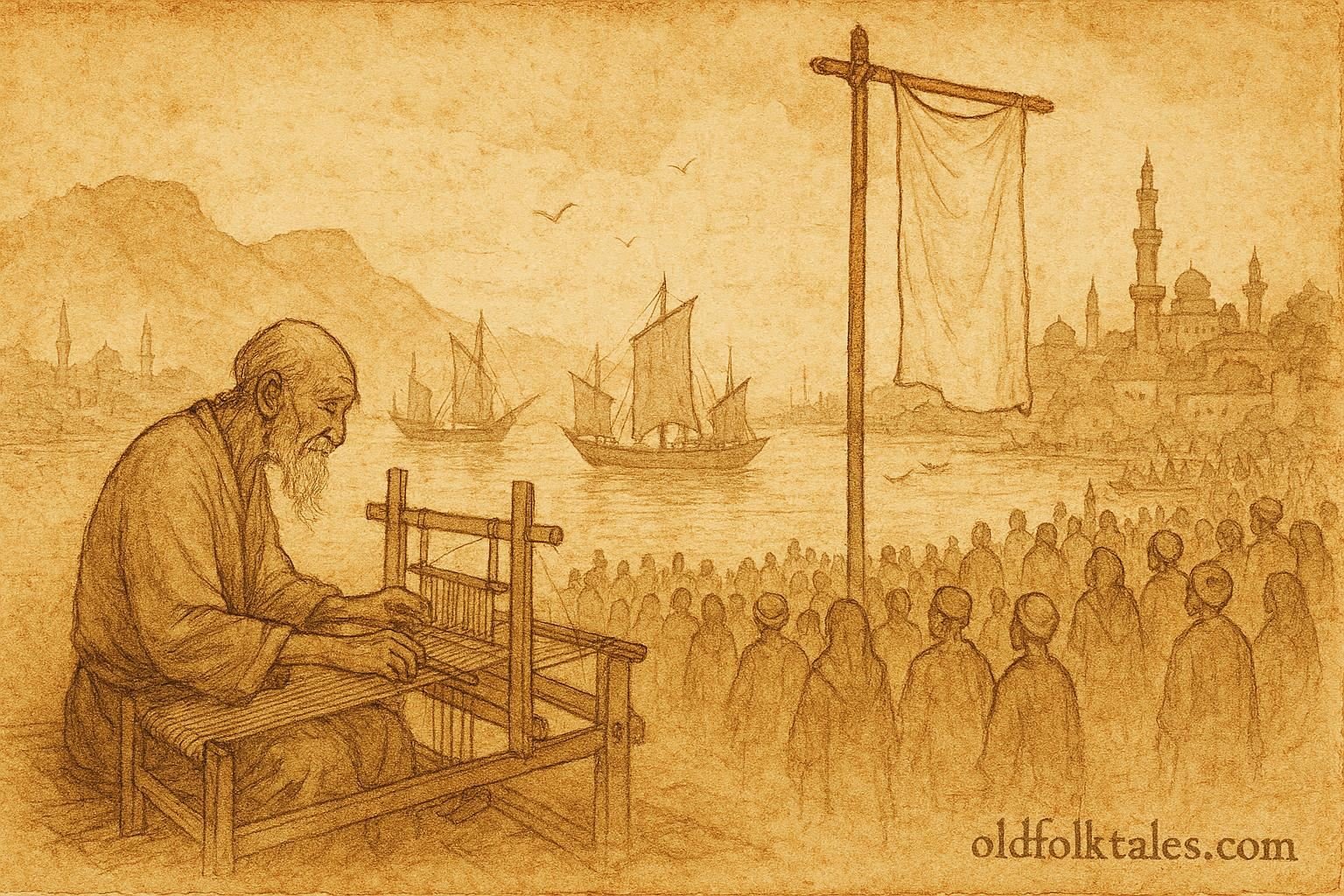
In the era when Aden stood as one of the most important ports of the Arabian Sea, the city was alive with the movement of ships and the mingling of peoples. Sailors from distant coasts unloaded spices, cloth, and stories, while local merchants watched the tides with practiced eyes. Yet beneath this prosperity lay a growing unrest. Rival factions within Aden argued endlessly, each claiming loyalty to the city while seeking victory over the others. The harbor, once a place of shared labor and purpose, echoed with division.
The Sultan of Aden watched this discord with concern. He knew that force alone could not heal what pride and resentment had broken. Seeking a way to remind the people of their shared home, he declared that a new flag would be created, one that could rise above faction and bloodline. This banner, he proclaimed, must be so meaningful that it would call the city back to unity. Messengers were sent throughout Aden to summon the finest weaver.
They found him near the docks, an old man whose eyes had dimmed with age but whose hands remained steady and sure. Though nearly blind, he was known for weaving cloth of rare depth and balance. When brought before the Sultan, the weaver bowed low and accepted the task without argument or praise.
For many days, he worked alone at his loom. He selected threads of indigo like the deep sea, saffron bright as dawn, and silver fine as moonlight on water. His fingers moved slowly, guided by memory and intention rather than sight. Those who passed his workshop heard only the quiet rhythm of the loom and the soft murmur of prayer.
When the flag was finished, it was carried to the palace and unfurled before the Sultan and his court. A silence followed. To most eyes, the cloth appeared pale and empty, bearing no pattern or emblem. The Sultan’s anger rose quickly. He accused the weaver of deception and mockery, of wasting precious time while the city remained divided.
The weaver listened without protest. When permitted to speak, he said calmly, “This flag is woven with the thread of intention, niyyah. Only those who truly desire peace for Aden, not victory over their rivals, will see what it holds.”
Though furious, the Sultan hesitated. Something in the old man’s words stayed his hand. Instead of punishment, he ordered the flag to be hung at the harbor where all of Aden could see it.
The next morning, crowds gathered beneath the banner as it moved gently in the sea wind. Many laughed openly, pointing at the empty cloth and mocking the Sultan’s decision. These were the ones whose hearts still burned with anger and ambition.
But among the crowd stood others, men and women weary of conflict. As they gazed upward, their faces softened, and tears filled their eyes. They began to speak quietly, describing what they saw. Some spoke of the Mina harbor restored in harmony. Others described water tanks full and families seated together sharing food. Though their visions differed, the feeling was the same.
The laughter faded. Those who saw nothing felt exposed, shamed not by force but by reflection. The flag was never seen by all, yet it changed the city. It remained at the harbor, not as decoration, but as a measure of the heart.
The Sultan spared the weaver and honored him. From that day forward, the people of Aden remembered the lesson the flag carried, spoken not in command, but in truth.
Moral Lesson
This Yemeni folktale teaches that peace is not a symbol imposed from above, but a choice revealed through intention. What we see depends on what we seek.
Knowledge Check
1. Why did the Sultan commission a new flag for Aden?
To unite the city’s rival factions during a time of internal conflict.
2. Who was chosen to weave the flag?
An elderly, nearly blind master weaver known for wisdom and skill.
3. Why did many people see the flag as blank?
Because it could only be seen by those who truly desired peace.
4. What did peaceful viewers see on the flag?
Scenes of harmony such as Aden’s harbor, shared meals, and restored unity.
5. Where was the flag displayed?
At the harbor of Aden, Yemen.
6. What cultural value does the story emphasize?
That peace begins with intention rather than victory.
Source and Cultural Origin
Source: ASIATIC Archive, text titled “Adeni Port Stories.”
Cultural Origin: Historic port of Aden, Yemen.