In the northern emirates, where the land shifts from mountain foothills to open desert and the nights are bright with stars, women gathered to weave stories into cloth. Among them lived a master weaver known throughout Ras Al Khaimah and Sharjah for her skill in Al Sadu, the traditional Bedouin weaving passed from mother to daughter. Her hands were steady, her eye precise, and her understanding of patterns deeper than most could imagine.
Al Sadu was not merely craft. It was memory, rhythm, and meaning. Each thread carried a decision, each color a purpose. The weaver learned to read the land and the sky, drawing inspiration from the geometry of dunes shaped by wind and the steady order of stars above the desert. Her woven bands spoke of journeys, shelters, seasons, and endurance.
One year, word reached the weaver that the wife of a respected sheikh wished to commission a tent divider unlike any seen before. It was to be displayed within the family’s majlis tent, separating spaces with beauty and dignity. The request carried honor and expectation. Only the finest work would be accepted.
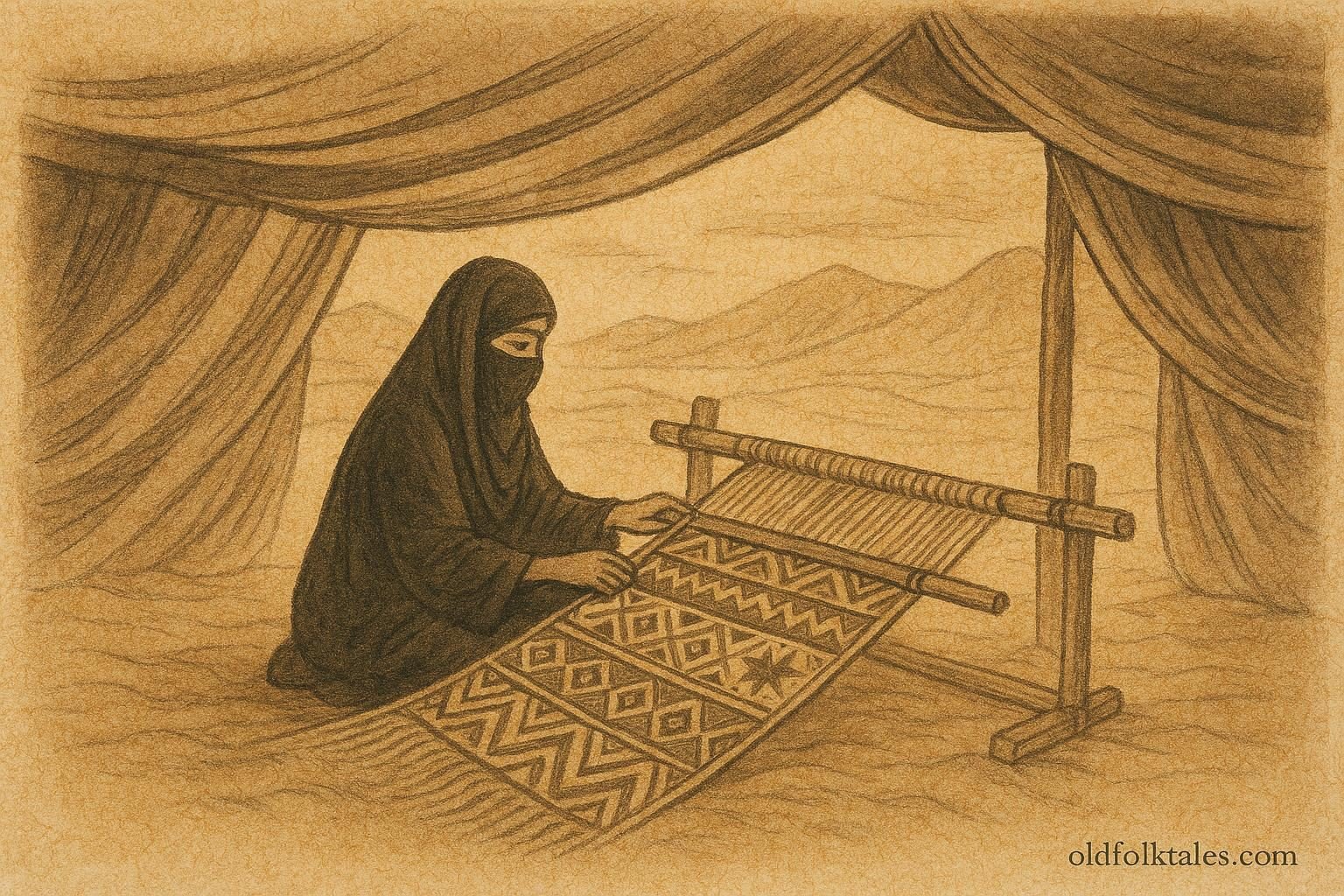
The weaver agreed, understanding the responsibility placed upon her. She selected her wool carefully, spinning and dyeing it in traditional hues of deep red, black, white, and earth tones. As she prepared her loom, she studied the desert around her. She traced the curves of distant dunes at dawn and counted the stars that appeared each night, steady and silent.
As the weaving began, the patterns grew complex and balanced. Bold geometric shapes formed paths across the fabric, echoing the movement of caravans and the rise and fall of sand. To the untrained eye, the design appeared flawless and complete. Yet within the structure, the weaver made choices known only to her.
Hidden among the repeating forms, she wove a quiet story. It was a tale of love lost to time and circumstance, of separation carried by the desert winds. The story was not shown through images or figures, but through subtle shifts in symmetry, deliberate interruptions in pattern, and color sequences that spoke of longing and absence. Only one deeply familiar with Al Sadu could read this silent language.
The weaver worked alone, often late into the night. Her expression remained calm, but her heart moved with the rhythm of the loom. Each thread tightened memories she never spoke aloud. In this way, the cloth became both commission and confession.
When the tent divider was completed, it was carried with care to the sheikh’s household. The fabric was hung within the tent, and those present admired its beauty. The sheikh’s wife praised the balance of colors and the strength of the design. Guests commented on how the patterns seemed to shift with the light, revealing depth beyond decoration.
Most saw only craftsmanship. But among the women of the household, one elder paused before the cloth. Her eyes traced the lines slowly. She recognized the subtle changes, the deliberate breaks, the story folded into the design. She said nothing, but her expression softened with understanding.
The weaver was rewarded generously and returned to her home. Her work remained in the tent, serving its purpose while holding its secret. The hidden story did not seek recognition. It existed as many stories did among the women of the desert, preserved within craft, shared only with those who knew how to listen with their eyes.
In time, the tale of the tent divider spread quietly among weaving circles. It was remembered not for scandal or sorrow, but for the reminder that Al Sadu was more than ornament. It was a language, capable of holding joy and grief alike, woven into patterns that endured longer than spoken words.
Moral Lesson
This folktale teaches that art can carry hidden truths and personal histories, reminding us that craftsmanship is also a form of storytelling and emotional expression.
Knowledge Check
-
What craft is central to the story?
Al Sadu, traditional Bedouin weaving. -
Who commissions the tent divider?
The wife of a sheikh. -
What inspires the weaver’s patterns?
Desert dunes, stars, and natural geometry. -
What secret does the weaver include in the cloth?
A hidden story of lost love. -
Who is able to recognize the hidden narrative?
Only those deeply familiar with Al Sadu patterns. -
What cultural role does weaving serve in the story?
A means of preserving memory and storytelling among women.
Cultural Source
Source: Collected by the UAE National Archives as part of documentation on intangible cultural heritage related to traditional crafts in Ras Al Khaimah and Sharjah.