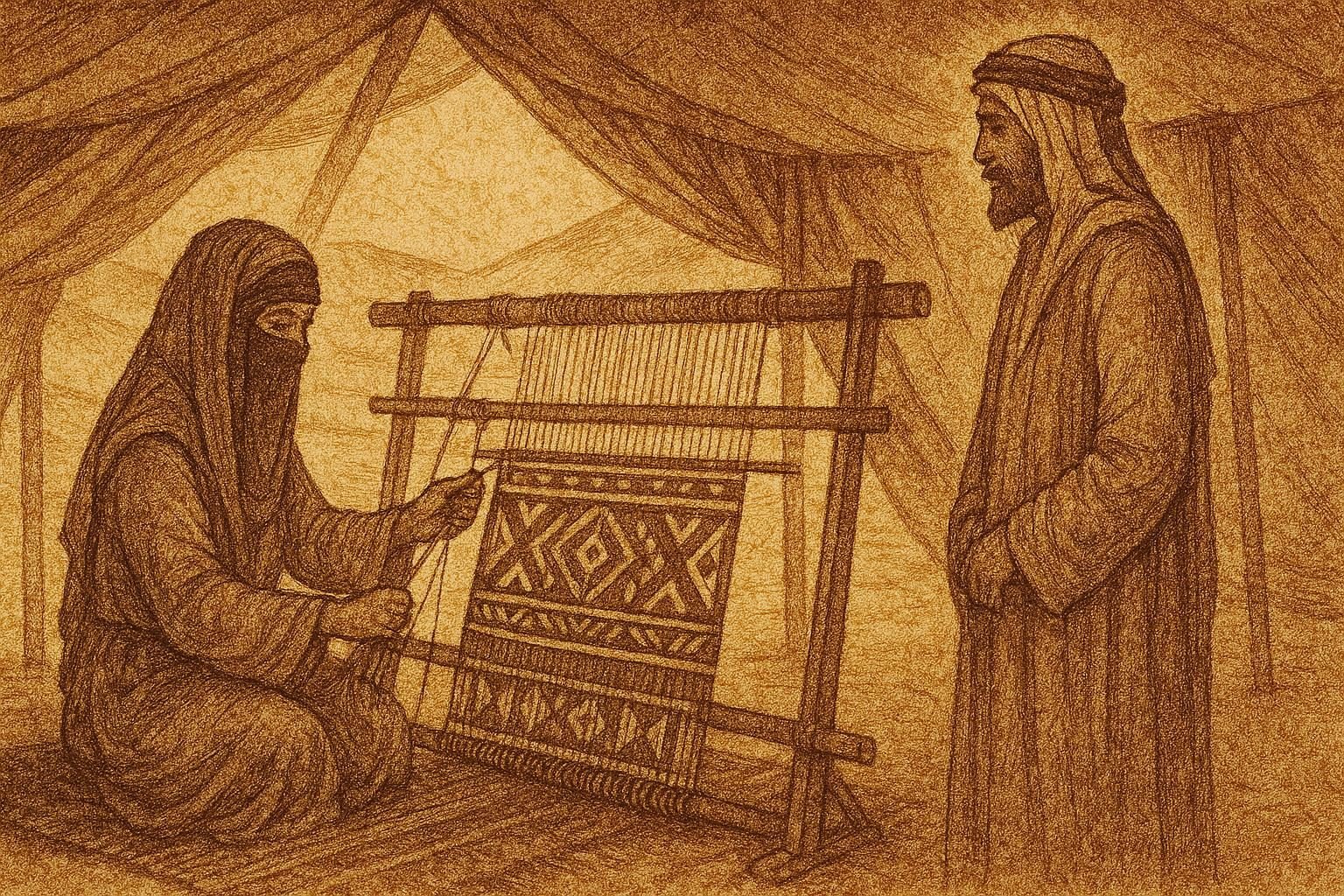
In the heart of the Qassim region, where the golden sands meet clusters of date palms and bustling marketplaces, Fatima was renowned across Buraidah for her skill in Sadu, the traditional Bedouin weaving. Her hands moved with practiced grace, threading brightly dyed wool into intricate geometric designs. Each pattern, each stitch, was a story, a reflection of life, resilience, and the bonds that held the community together.
One morning, a wealthy merchant arrived from a distant town. He had traveled across the desert, drawn by tales of Fatima’s unmatched craftsmanship. His request was unusual: he wanted a tent partition that would capture “the essence of Qassim.” He envisioned palm trees swaying, camels resting beneath the sun, and scenes that outsiders would immediately recognize as the desert’s charm.
Explore ancient tales from Thailand, Cambodia, and the Philippines in Southeast Asian Folktales.
Fatima listened carefully, nodding politely. She understood the merchant’s desire for recognizable symbols, but she also felt the weight of truth in the task. To her, the essence of Qassim was not in superficial images, it was in the people, the connections, and the invisible ties that sustained them. She agreed to take the commission and set to work.
For a month, Fatima labored from dawn until the sun dipped behind the distant dunes. Her loom clicked rhythmically, a song of patience and devotion. The final piece was unlike anything the merchant expected. Instead of trees or camels, the partition displayed a network of interconnected diamonds and triangles. Lines intersected, overlapping and weaving together, forming a tapestry that pulsed with harmony and order. Each shape carried meaning: a diamond symbolized a shared well where families drew water, a triangle represented a dune that sheltered travelers from sandstorms, and the interlacing lines reflected the bonds between neighbors, friends, and kin.
When the merchant returned, he gasped. “Where are the palm trees? The camels? The recognizable symbols of Qassim?” he demanded, disappointment etched across his face.
Fatima smiled gently, her eyes calm and steady. “You asked for the essence of Qassim,” she said. “Look closely. The patterns you see are our life together. Each line is a connection, each diamond a shared resource, each triangle a protective shield against the desert. Our strength lies not in isolated images, but in the ties that bind us and support one another.”
The merchant studied the tapestry in silence. Slowly, understanding dawned. He realized that the partition was not just decorative, it was a lesson, a living story of a community’s interdependence and resilience. The wealth he had offered now seemed modest in comparison to the wisdom woven into each thread. Overcome with respect, he not only paid Fatima the original price but doubled it, acknowledging the insight and artistry she had gifted him.
News of Fatima’s work spread quickly. Travelers, merchants, and villagers came to see the tapestry, marveling at how the essence of Qassim had been captured in abstract geometry rather than literal images. They recognized in its patterns the lifeblood of their community, the shared wells, the communal tents, the protective bonds, and the quiet strength of collaboration. Fatima’s weaving had transformed perception, reminding all who saw it that the soul of a place is often found in the invisible structures that sustain it, not merely in its outward appearance.
Through her craft, Fatima taught a timeless lesson: understanding the heart of a people requires more than a glance at what is visible. It requires attention, care, and recognition of the bonds that unite them. In this way, the essence of Qassim was preserved not on paper or in images but in the very fabric of daily life, immortalized in a tapestry of lines, diamonds, and triangles.
Discover the wisdom of Persian poets and Arabian storytellers in Western Asian Folktales.
Moral Lesson
True understanding comes from looking beyond surface appearances. The essence of a community, place, or culture lies in the relationships, bonds, and shared experiences that sustain it, not in isolated symbols or images.
Knowledge Check
1. Who is Fatima in the story?
A skilled weaver from Buraidah, known for her Sadu weaving.
2. What did the merchant request?
A tent partition depicting “the essence of Qassim.”
3. What symbols did Fatima weave instead of palm trees or camels?
Interconnected diamonds, triangles, and lines representing community bonds and resources.
4. What does each diamond symbolize?
A shared well where families draw water.
5. How did the merchant react to the finished tapestry?
Initially disappointed, but ultimately humbled and paid double the original price.
6. What cultural lesson does the story convey?
The true essence of a place is found in its people, social bonds, and communal resilience, not just in literal symbols.
Source and Cultural Origin
Source: Adapted from “Folktales from the Arabian Peninsula” by Nadia Jameel Taibah.
Origin: Qassim Region, Central Saudi Arabia, reflecting Bedouin Sadu weaving and social values.