In the heart of Al Ain’s green oasis, where date palms swayed in the desert wind and the call of doves echoed through the wadi, lived a man of honour and prosperity. He had once been happily married and blessed with a son and a daughter, children as bright and kind as the morning sun. But fate took his wife too soon, leaving the household heavy with silence. After years of loneliness, the man remarried, hoping to restore warmth to his home.
The new wife, however, was not as gentle as she first appeared. Beneath her graceful speech and modest smiles, envy brewed like a desert storm. She despised her husband’s children, whose beauty and good manners reminded her of their late mother. Each day, she searched for ways to drive a wedge between them and their father.
Explore timeless legends from China, Japan, and Korea in our East Asian Folktales collection.
At first, her wickedness showed in small ways, whispered lies and feigned tears. “Your son disrespects me,” she told her husband. “Your daughter mocks me behind your back.” The father, weary from work and blinded by trust, began to doubt his children. When he scolded them unjustly, the stepmother’s eyes glimmered with secret delight.
But deceit rarely rests content. The wife’s jealousy deepened until mere slander no longer satisfied her. One evening, she feigned illness and lay in bed, her voice weak and trembling. When her husband asked what troubled her, she said, “A cure exists only in the rare herb that grows beyond the dunes of Jebel Hafeet. If I do not have it, I will surely die.”
Her husband, distressed, promised to send for the herb. But she shook her head and added with false innocence, “Only the girl can fetch it. She has a pure heart, and the spirits of the desert will not harm her.”
The girl, hearing this, understood the deceit but bowed respectfully. “I will go, Father,” she said. “May God guide my steps.” She set out at dawn, her face veiled against the burning wind, her small bundle of food tied with care. The journey was long and cruel; the sun scorched the sand, and the hills shimmered like fire. But the girl walked on, praying quietly.
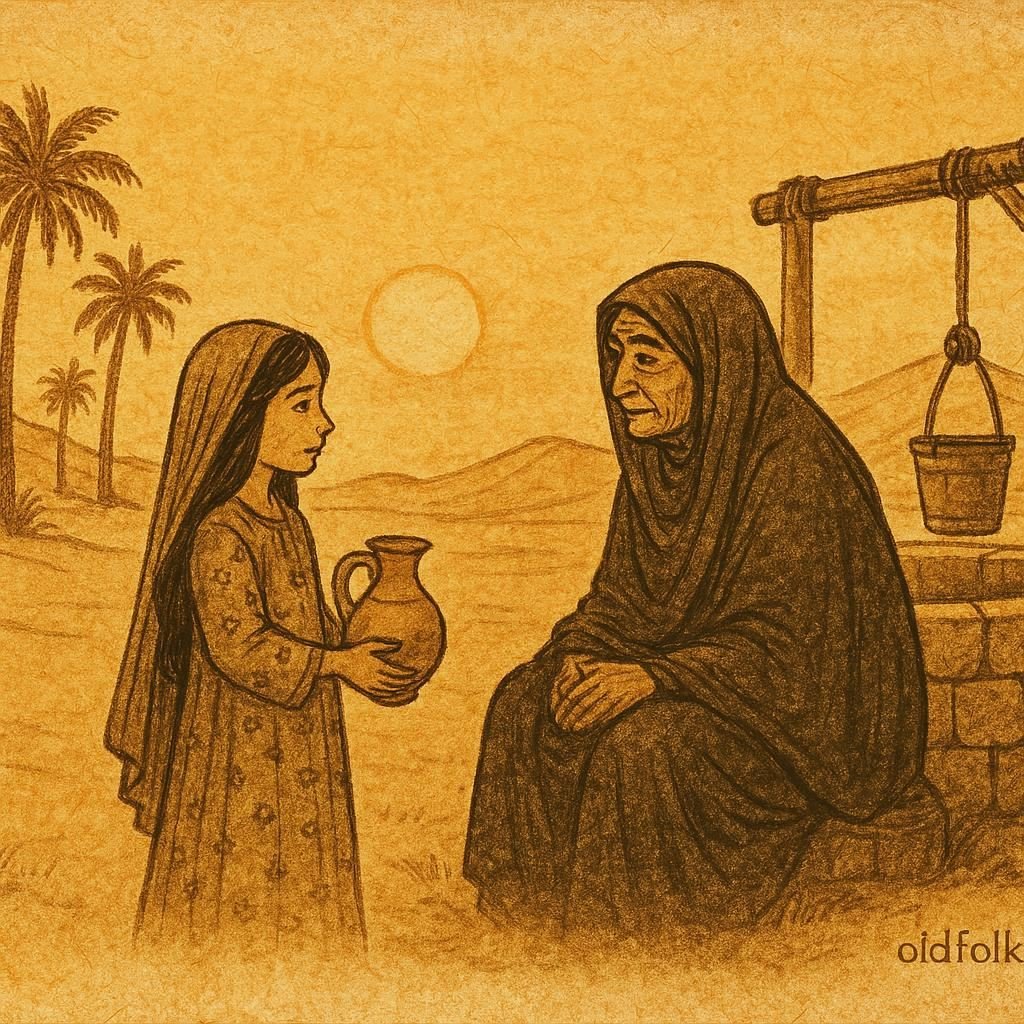
At sunset, as shadows lengthened, she came upon an old woman sitting beside a well. The woman’s eyes were gentle, her voice wise. “Child,” she said, “you travel alone through the desert. What brings you so far?”
The girl told her story, the stepmother’s illness, the rare herb, the father’s sorrow. The old woman nodded knowingly. “The herb grows yonder, near the rocks,” she said, “but beware. Many who come seeking it are sent to their doom.” Then she handed the girl a small jug. “Take this water. Sprinkle it upon the herb before you pluck it. It will protect you.”
The girl obeyed. When she found the plant and did as told, a whisper of wind circled her like a blessing. She returned safely, carrying the herb in her trembling hands.
When the stepmother saw her alive, her heart sank with rage. Yet she pretended joy and brewed a potion from the herb, pretending to drink it before her husband. Later that night, she devised a crueler plan. She accused the girl of witchcraft, claiming that evil spirits had followed her home. The father, confused and frightened, hesitated.
But the truth cannot be buried forever. The next morning, while the family gathered, the girl’s little brother spoke up. “Father,” he said, “I saw her pour the potion into the sand instead of drinking it.” His innocent words broke the wall of lies. The man turned to his wife, his face dark with fury. “You have deceived me,” he thundered. “You sought harm for those I love!”
The wicked wife was cast out from the home she had poisoned with envy. Peace returned to the house; the brother and sister grew up wise and kind, never forgetting how falsehood can wear a friendly face.
Discover the wisdom of Persian poets and Arabian storytellers in Western Asian Folktales.
Moral Lesson
Jealousy is a fire that consumes the heart that bears it. The folktale reminds listeners that deceit and malice destroy their own maker, while patience, truth, and faith ultimately bring justice and peace.
Knowledge Check
1. Who is the main villain in “The Wicked Step-Wife – Emirati Folktale”?
The villain is the jealous second wife, whose deceit and envy drive the conflict of the story.
2. What is the cultural significance of this Emirati folktale?
It reflects moral teachings in Emirati oral tradition about loyalty, truth, and the dangers of jealousy within families.
3. What does the rare desert herb symbolise?
It symbolises purity, faith, and the power of truth to overcome falsehood.
4. What setting is described in the story?
The story takes place in Al Ain’s oasis region, with vivid depictions of the desert, date palms, and mountain landscapes.
5. What lesson does the father learn in this folktale?
He learns that blind trust without discernment can lead to injustice and loss.
6. What is the moral message of “The Wicked Step-Wife – Emirati Folktale”?
That envy and deceit bring ruin, but patience and virtue prevail in the end.
Source
Adapted from the Emirati folktale “The Wicked Wife / Jealous Wife” as recorded in Hikāyāt Shaʿbiyya min Madīnat al-ʿAyn (2012) by ʿĀ’isha Khāmīs Az-Zāhirī.
Referenced in N. Kalach, “Always the Villain: The Wife in Emirati Folktales” (2022).
Cultural Origin: United Arab Emirates (Al Ain, Emirati folklore)