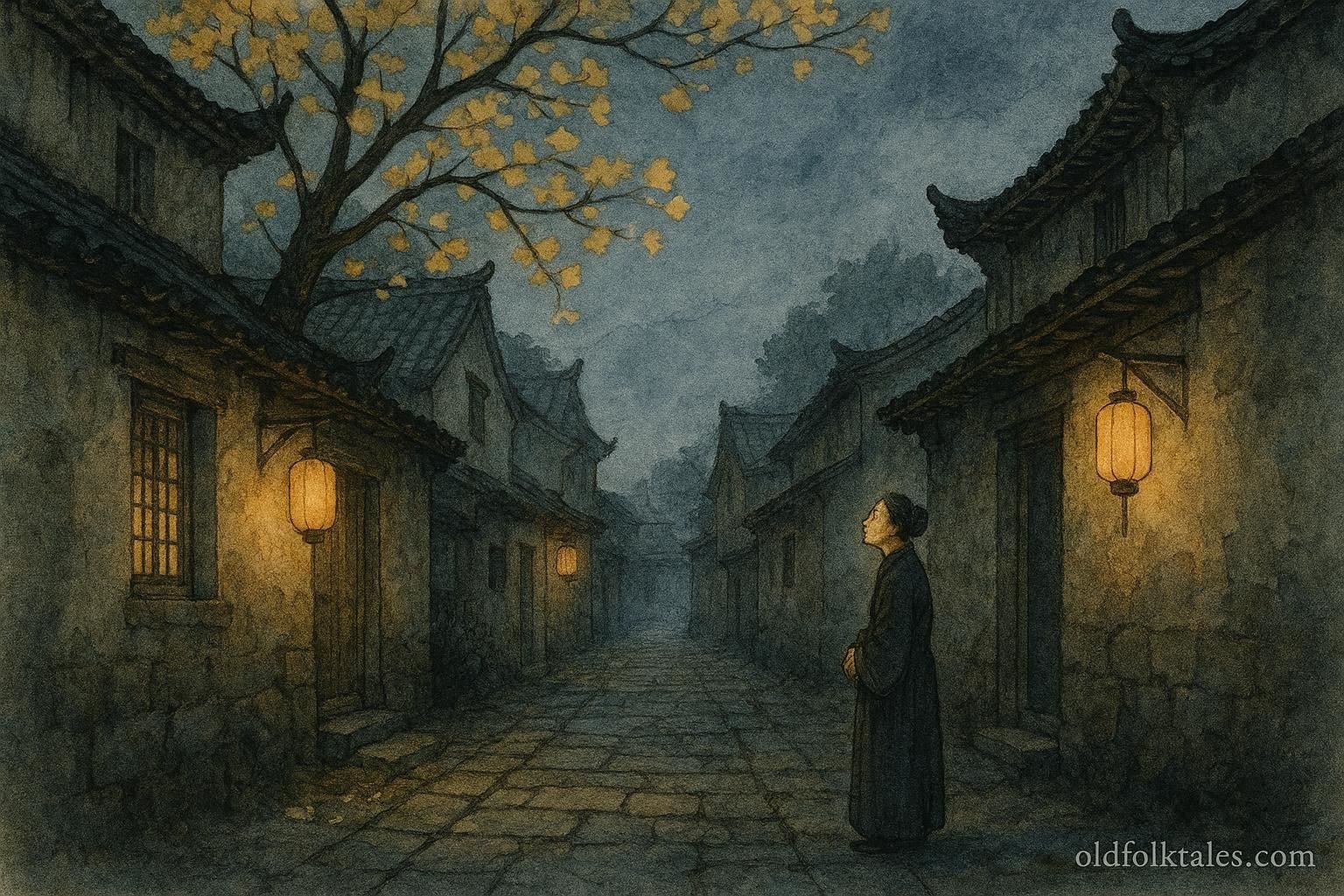
Evening arrived gently in the eastern quarter of the city, not with noise or bells but with lengthening shadows that crept across stone courtyards and tiled roofs. Shopkeepers lowered their shutters. Vendors packed away baskets of herbs and ink stones. It was at this hour, when daylight loosened its hold but darkness had not yet settled, that Widow Shen always stepped outside her door.
Her neighbors noticed the habit long before they understood its meaning. She would stand beneath the old gingko tree near her home, hands folded within her sleeves, eyes focused not on the street but on the ground where shadows gathered and stretched. She did not pray. She did not chant. She simply listened.
Widow Shen had not always lived this quietly. In her younger years she had been known for laughter that carried across courtyards and for the clarity of her singing voice. That voice fell silent after her husband died suddenly of fever, leaving her with no children and little wealth. In the years that followed, grief reshaped her life. She sold embroidery to survive and learned to move through the city without drawing attention.
Explore ancient tales from Thailand, Cambodia, and the Philippines in Southeast Asian Folktales.
One autumn evening, as dusk settled heavier than usual, Widow Shen felt something stir at her feet. The shadow cast by the gingko tree wavered, thickened, and seemed to lean toward her. At first she thought exhaustion had blurred her sight. Then she heard a whisper.
It was not a voice like those of living people. It carried no breath, no warmth. Yet the words were clear in her mind. Beware the alley by the apothecary tomorrow night.
Widow Shen stepped back, heart pounding. The shadow returned to its ordinary shape. The street was empty. The wind moved the leaves. She told herself it was grief playing tricks on her senses. Still, the warning stayed with her.
The next night, a fire broke out in the alley beside the apothecary. Oil lamps overturned by thieves spread flames quickly through stacked crates. Because the apothecary had closed early that evening, no one was harmed. Neighbors spoke of luck. Widow Shen said nothing.
After that, the shadows spoke again. They never spoke at noon or deep night. Only at dusk, when forms blurred and boundaries softened, did they gather their voices. Sometimes they warned of danger. Sometimes they revealed secrets buried beneath polite smiles. A respected merchant planned to poison a rival. A night watchman accepted bribes to look away. A collapsing wall threatened a row of homes.
Widow Shen did not hear every shadow. Only those cast by living things spoke. Walls remained silent. Objects told no stories. But wherever human presence shaped darkness, there were whispers waiting.
She struggled with what to do. To speak openly would invite suspicion or worse. A widow already lived under careful scrutiny. Too much knowledge could be dangerous. So she learned to act quietly. She warned neighbors in indirect ways. She suggested repairs as casual advice. She convinced shopkeepers to close early on certain nights. When confronted, she smiled gently and said she had a feeling.
At first, people dismissed her instincts as coincidence. Then patterns emerged. Every suggestion proved wise. Every warning prevented loss. Slowly, respect replaced doubt.
Not all truths were easy to bear. One evening, the shadows spoke of a plot involving city officials who planned to seize homes in the quarter by accusing residents of tax fraud. Widow Shen felt the weight of fear settle into her bones. This danger could not be avoided with small adjustments. It threatened everyone.
She spent sleepless nights deciding how to act. At last, she sought out Elder Han, a retired magistrate known for integrity. She did not speak of shadows. She spoke instead of rumors, of inconsistencies she had noticed, of documents she believed were being altered. Her calm certainty stirred Elder Han to investigate.
When the scheme was exposed weeks later, the neighborhood was spared. Officials were dismissed quietly. Life continued.
As years passed, Widow Shen aged, but the shadows never left her. They did not praise her or demand worship. They spoke because she listened. In listening, she learned discernment. Not every whisper required action. Some truths existed only to be acknowledged.
Children grew up believing she had extraordinary intuition. Adults sought her counsel during uncertain times. Still, she remained a widow living modestly beneath the gingko tree. She never used her gift for gain. She never revealed its source.
On the evening of her death, neighbors noticed that dusk lingered unusually long. Shadows stretched farther than they should have, overlapping one another in strange patterns. Those who passed her door swore they heard murmurs, not fearful but reverent.
The next morning, Widow Shen was found seated peacefully, hands folded, eyes closed as if listening still. After her burial, the gingko tree cast a shadow that seemed deeper than before. Some said it leaned protectively over her home. Others said the quarter felt quieter but safer.
From that time on, people taught their children to respect the hour of dusk. They said it was a moment when the world revealed what daylight concealed. And they spoke of Widow Shen, who turned grief into vigilance and silence into strength, proving that wisdom does not always speak aloud but watches carefully from the edge of light.
Moral Lesson
Inner awareness and careful listening can protect not only oneself but an entire community. True strength often grows from hardship, and wisdom may speak softly through overlooked spaces.
Knowledge Check
- When did Widow Shen hear the shadows speak?
At dusk when daylight and darkness overlapped. - Why did she not reveal her ability openly?
Because it would bring suspicion and danger in her social position. - How did she protect her community without exposing herself?
By giving indirect warnings and practical advice. - What larger threat did she help prevent?
A corrupt plan by officials to seize homes. - Why did the shadows trust Widow Shen?
Because she listened carefully and acted responsibly. - What does dusk symbolize in the story?
A liminal moment where hidden truths emerge.
Source
Adapted from Peking University Folk Narrative Studies Collection, 2013.
Cultural Origin
Late imperial urban folklore.