
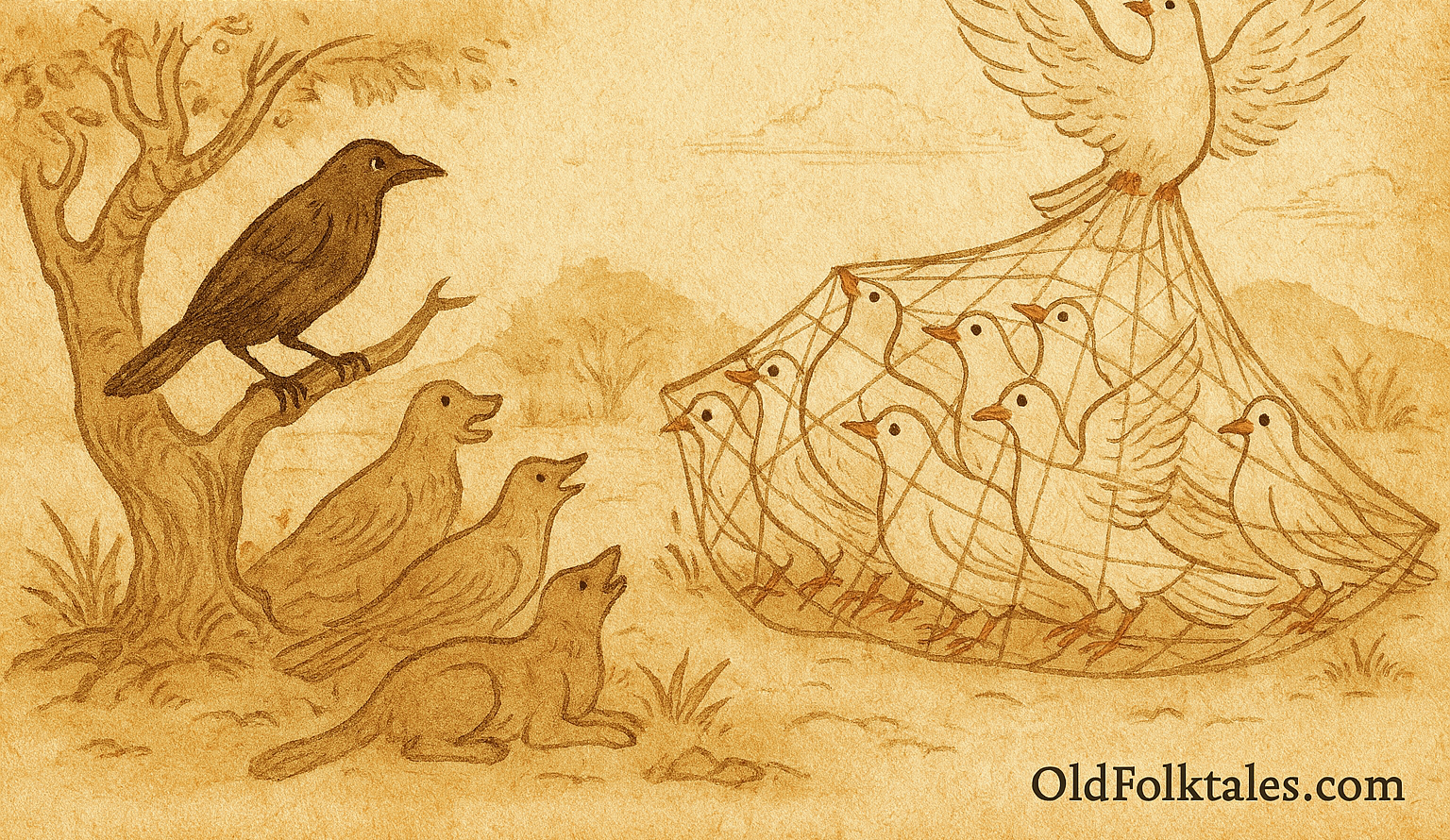
In the shade of a great banyan tree near the mighty River Indus, where the waters flowed wide and silver under the endless sky, there lived a wise old crow named Kallu. His nest was a masterpiece of twigs and mud, built high among the gnarled branches that overlooked the green patchwork fields of Sindh. The tree itself was ancient, its aerial roots hanging like curtains, its canopy so vast that farmers rested beneath it during the hottest hours of the day.
Kallu had lived many seasons. His feathers, once glossy black as a moonless night, now showed touches of gray around his beak and eyes. His beloved wife had long since passed away, leaving him with memories of softer times. His young ones had all grown strong and flown off to make lives of their own in distant trees and far-off villages. Now Kallu lived alone, but he was not lonely, he watched over the world below with sharp, knowing eyes and a thoughtful heart that had seen much of life’s joys and sorrows.
Click to read all South & Central Asian Folktales — home to stories from India, Nepal, Afghanistan, and Sri Lanka.
One warm morning, as the golden sun climbed above the farmlands and painted the river with strokes of amber light, Kallu noticed something unusual. A man was creeping through the tall grass at the base of the banyan tree, moving with the awkward stealth of someone who does not belong. The man carried a long stick in one hand and a wide net in the other, the tools of a hunter. His eyes shifted from side to side like a thief’s, and his whole manner spoke of mischief and greed.
“That man is up to no good,” Kallu muttered to himself, ruffling his feathers with disapproval. “I’ll keep my sharp eyes on him and see what trouble he’s planning.”
The hunter spread his net carefully beneath the spreading branches of the banyan tree, arranging it so it lay flat and nearly invisible against the dusty ground. Then, from a cloth pouch at his waist, he scattered generous handfuls of rice, white grains that gleamed like tiny pearls in the morning light. The rice lay scattered all around the hidden net, an irresistible temptation for any hungry bird. His trap set, the hunter crouched behind the thick trunk of the tree, his breathing shallow, his muscles tense with anticipation.
Time passed slowly. The sun climbed higher. Kallu watched and waited.
Then, from the direction of a nearby shrine with its white dome gleaming in the distance, came a flock of beautiful white doves. They moved through the air like a floating cloud, their wings catching the light, their soft cooing voices carrying on the breeze. At their head flew their king, a noble bird named Badar, whose feathers were the purest white and whose bearing was both proud and gentle.
Badar’s keen eyes spotted the scattered rice from high above. “Look, my friends!” he called to his flock. “Some kind soul has left grain for us. Let us go down and eat our fill!”
The doves, trusting their beloved king and hungry from their morning flight, swooped down eagerly. Their wings folded as they landed, and they immediately began pecking at the rice, their heads bobbing with satisfaction. But they had barely swallowed more than a few grains when suddenly, whoosh! the net sprang up around them like a living thing!
The entire flock found itself caught, tangled in the mesh. They fluttered and cried out in terror, their white wings beating frantically against the ropes. But it was no use, the more they struggled individually, pulling this way and that, the tighter the net wound around them, binding their wings and trapping them hopelessly.
The hunter emerged from behind the tree with a cruel smile spreading across his face, already counting his profits, how many coins these fine white doves would bring at the market!
Kallu watched from his high perch, shaking his head slowly. “Poor foolish things,” he thought with genuine sadness. “This is what happens when greed makes you careless. But let me see what unfolds.”
Down below, King Badar, even in his terror and entrapment, kept his mind calm and clear. He was a true leader, and he knew that panic would only make things worse. He raised his voice above the frightened cries of his companions.
“Brothers! Sisters!” he called out with authority. “Stop struggling separately! Listen to me! Each of you must grab a part of this net firmly in your beak. Yes, like that! Now, we will rise together. Not one by one, but as one! Up, up into the air! Together we are stronger than this trap!”
The doves, hearing the wisdom and confidence in their king’s voice, obeyed. Each bird seized a portion of the net in its beak. Then, at Badar’s command, they all beat their wings as one, a single mighty effort, coordinated and united.
And slowly, miraculously, they began to rise! The net lifted off the ground, heavy with the weight of the trapped birds, but lighter than the combined strength of their unity. Higher and higher they flew, carrying the net with them, moving through the air like a strange white cloud, rising above the banyan tree, above the fields, climbing toward the endless blue sky.
The hunter, still crouched behind the tree trunk, suddenly realized what was happening. His mouth fell open in disbelief. His precious catch was escaping, flying away with his expensive net! He leaped to his feet and ran after them, his legs pumping, his arms waving, shouting curses and complaints that grew fainter and fainter as the doves soared higher and higher. He chased them across the fields, through the mango groves, stumbling over irrigation ditches and jumping over stone walls, but it was useless. The united doves disappeared beyond the distant trees, carrying their prison with them, free because they had worked together.
Kallu watched this entire drama unfold, and his old heart swelled with admiration. “Now that,” he said to himself with a satisfied caw, “is true wisdom! King Badar knows that unity is strength. One dove alone could never lift that net, but together, they became unstoppable. There is a lesson in this for all creatures.”
As the sun climbed higher and the fields grew warm, Kallu settled back into his nest, his sharp eyes still scanning the world below. He had seen much in his long life, but this morning’s events reminded him of an important truth, one he carried in his wise old heart. The hunter packed up his stick and walked away defeated, muttering to himself. And somewhere beyond the mango trees, a flock of white doves was likely working together once more, this time to free themselves from the net completely.
Kallu smiled to himself, if a crow can smile. He had three good friends in this world, though they came and went. Perhaps tomorrow he would seek them out and share this tale. For now, he was content to watch, to think, and to remember that wisdom comes not just from living long, but from watching carefully and understanding what you see.
The Moral of the Story
This timeless tale teaches us that unity and cooperation can overcome even the most dangerous traps. When King Badar and his flock worked together with a single purpose, they achieved what would have been impossible for any individual dove. The story reminds us that wisdom lies in recognizing when to act together rather than struggle alone, and that true leadership means inspiring others to coordinate their efforts for the common good. Greed and carelessness may lead us into danger, but solidarity and collective action can lead us to freedom.
Knowledge Check
Q1: What is the significance of Kallu the crow in this Pakistani folktale?
A1: Kallu represents wisdom gained through experience and careful observation. As an old crow who has lived through many seasons and losses, he watches the world with understanding rather than rushing into action. His role as observer and witness emphasizes that wisdom sometimes means knowing when to watch and learn, and recognizing the lessons in others’ experiences.
Q2: What does the hunter’s trap symbolize in the story?
A2: The hunter’s trap symbolizes the dangers of greed and carelessness. The rice scattered around the hidden net represents temptations that lure us into dangerous situations. The trap teaches that attractive opportunities may hide dangers beneath, and that we must be cautious and thoughtful rather than rushing toward what appears to be easy gain.
Q3: Why is King Badar’s solution to lift the net together significant?
A3: King Badar’s solution demonstrates the power of unity and coordinated action. Rather than each dove struggling individually (which only tightened the net), working together as one transformed their weakness into strength. This reflects an important principle found throughout South Asian philosophy, that collective action guided by wise leadership can overcome obstacles that would defeat individuals.
Q4: What is the cultural significance of the Sindh region setting in this folktale?
A4: The Sindh region, with its River Indus, banyan trees, and agricultural fields, provides an authentic Pakistani cultural context. Sindh has a rich storytelling tradition dating back thousands of years, and its landscape, rivers, shrines, mango groves, creates a vivid setting that grounds the moral lesson in a real place. The mention of white doves from a shrine reflects the religious and cultural landscape of the region.
Q5: What does this story teach about leadership qualities?
A5: Through King Badar, the story teaches that true leadership requires calmness under pressure, clear thinking in crisis, and the ability to inspire coordinated action. A good leader doesn’t panic when trapped but analyzes the situation and guides others toward collective solutions. Badar’s leadership transforms a group of frightened, struggling individuals into a unified force capable of achieving the impossible.
Q6: How does this folktale reflect traditional Pakistani and South Asian values?
A6: The tale embodies core South Asian values including the importance of community over individualism, respect for elders and their wisdom (represented by Kallu), the value of unity in facing adversity, and the belief that cooperation and collective strength can overcome any obstacle. These themes appear throughout Pakistani and broader South Asian folklore, teaching social harmony and mutual support as essential virtues.
Source: Pakistani folktale, Sindh region, Pakistan








