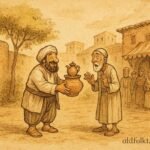
In a humble village on the edge of the Sultan’s vast kingdom lived a poor fellah, a simple peasant who owned little more than a small field, a mud-brick home, and one extraordinary treasure: his daughter. Though her clothes were simple and her life modest, her mind shone brighter than jewels. People whispered of her insight, her sharp humor, and her uncanny ability to solve the trickiest problems with ease.
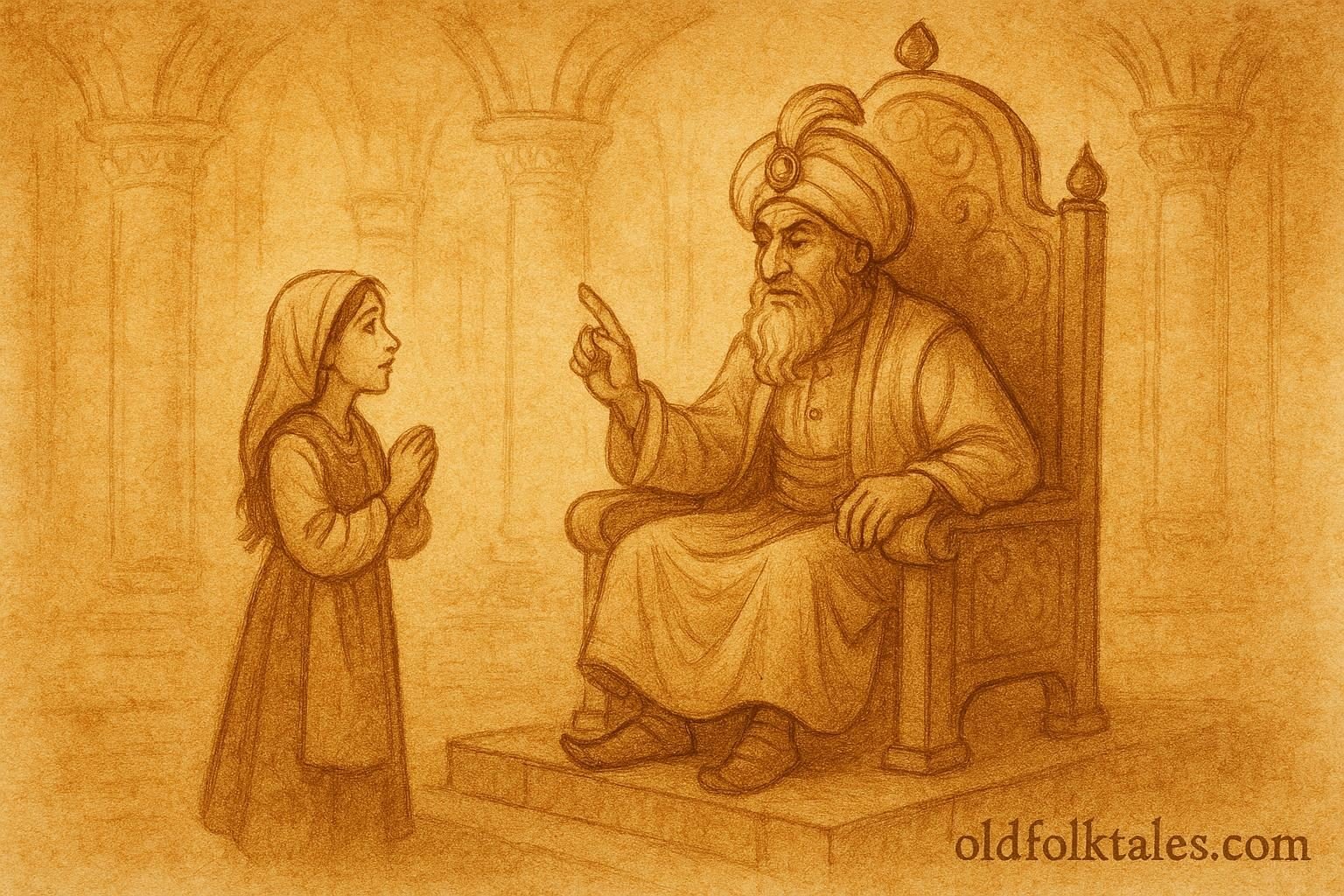
Word of her brilliance eventually reached the Sultan, a ruler accustomed to being the wisest voice in any room. Curious, and perhaps a bit challenged, he summoned the fellah and his daughter to the palace. The grand halls overwhelmed the father, but the young woman walked calmly, her eyes steady and thoughtful.
To test whether she truly possessed rare wisdom, the Sultan presented three impossible riddles, each crafted to trap the mind.
For the first challenge, he demanded she bring him a cloth made of stone. The court erupted in whispers. How could soft fabric come from unyielding rock? But the young woman simply bowed and replied, “Majesty, weave for me a thread made of air, and I shall spin from it a cloth of stone.”
Her answer rippled through the chamber, drawing stunned silence. The Sultan, impressed, moved to the second test.
He ordered her to count the countless, a task designed to defeat her. But she knelt, gathered a pinch of dust from the palace floor, and asked the Sultan to tell her how many grains lay in his hand. When he could not, she smiled gently. “If even this handful cannot be numbered by a king, how can one count the immeasurable world?”
Murmurs of admiration echoed across the hall.
For the third test, he asked her to determine the exact center of the earth. Without hesitation, she struck her walking stick into the ground. “Here, Majesty. And if you doubt it, measure the world yourself.”
The Sultan could not deny the brilliance of her literal reasoning. His admiration turned to desire. Despite her humble origins, he married her, elevating her from a peasant’s daughter to the Sultan’s wife.
But with his proposal came one decree:
She must never again give advice or solve riddles.
Perhaps he feared being outshone. Perhaps he wanted peace in his palace. Whatever the reason, she obeyed, silently, gracefully.
Time passed. One day, a foreign king sent an extravagant gift to challenge the Sultan’s intellect: a magnificent stone horse, carved with perfect detail. Along with it came an impossible demand: the Sultan must make the stone horse bear a colt, or admit defeat.
The Sultan’s confidence crumbled. For days, he paced the palace, unable to think of a solution. Ministers whispered anxiously; the kingdom’s honor was at stake. Yet he could not ask his wife, his own decree forbade it.
But she watched him suffer. Though forbidden, she could not let her husband fall into humiliation. One night, when the palace slept, she approached him softly and whispered the answer.
“Tell the foreign king that his stone horse will bear a colt only when he first sends the diamond stallion that fathered it.”
The next day, the Sultan repeated her words. The foreign king, recognizing the clever reply, had no choice but to withdraw his challenge.
But triumph soon turned to turmoil.
News spread through the palace that someone had advised the Sultan. When he discovered that it had been his wife, anger clouded his judgment. Feeling his authority had been undermined, he declared she must return to her father’s home. Yet out of lingering affection, he granted her one privilege:
She could take with her the single thing she valued most.
Quietly, she accepted the command. But her wisdom remained sharper than any royal decree.
That evening, she invited the Sultan to a farewell meal. She served him food and drink, and with a heavy heart, she added a sleeping draught to his cup. When he slipped into slumber, she arranged for him to be carried, gently, respectfully, to her father’s humble house.
At dawn, the Sultan awoke on a straw mat, blinking at the familiar mud-brick walls. Confused, he called out, and his wife calmly explained:
“You said I may take what is dearest to me. And, my lord, the most precious thing in my life is you.”
Her words disarmed him completely. In that moment, the Sultan realized what he had failed to appreciate: her wisdom was not a threat to his rule but a gift to his life. Her loyalty, courage, and intelligence were worth more than the pride he had tried to protect.
He took her hands and vowed never to silence her again. Together, they returned to the palace, where she resumed her rightful place, not only as queen, but as the kingdom’s most trusted voice.
And so, the fellah’s wise daughter changed the course of a kingdom, proving that true wisdom guides, strengthens, and transforms even the mightiest rulers.
Moral Lesson
Wisdom is a treasure that thrives when shared, not silenced. True strength lies not in pride, but in recognizing the value of those who see the world with clear eyes and a compassionate heart.
Knowledge Check
1. Who is the main heroine in “The Wise Daughter of the Fellah”?
A peasant’s daughter whose extraordinary wisdom transforms her life and kingdom.
2. What challenges does the Sultan give her?
Three impossible riddles that she solves through clever, literal interpretations.
3. How does the stone horse challenge work in this Israeli folktale?
A foreign king demands a stone horse bear a colt, but the queen solves it by requesting the “diamond father.”
4. Why does the Sultan exile his wife?
He discovers she secretly advised him despite his decree forbidding her to do so.
5. How does the queen choose her “most precious possession”?
She takes the sleeping Sultan to her father’s home, showing he is what she values most.
6. What cultural theme appears in this Middle Eastern folktale?
Folk wisdom triumphing over royal arrogance, especially through a clever woman challenging power structures.
Source
Adapted from the Israeli folktale “The Wise Daughter of the Fellah,” Israel Folktale Archives (IFA 6115), University of Haifa. Collected from Rachel Shabtai (born in Baghdad, Iraq) in Jerusalem, 1964.