In the ancient island of Socotra, surrounded by the deep blue waters of the Arabian Sea, there once lived a wise man blessed with great wealth and three beautiful daughters. He loved them more than his own life and raised them with patience, discipline, and deep affection. As they grew into young women, graceful and well-mannered, he knew the time had come to find them suitable husbands.
The man had a curious way of announcing this wish to others. When he met people of standing in society, he would deliberately unbutton three buttons of his shirt. To ordinary villagers, this meant nothing, but to the wise and discerning, it was a clear message, he had three daughters ready for marriage.
Soon, suitors came. A rich man sought the hand of the eldest daughter. A well-off man proposed to the second. And a poor but humble man asked for the youngest’s hand. The father approved all three matches, and his daughters were married with joy and celebration.
For a time, all was well. But one evening, as the man sat with his old friends, a debate began. One friend claimed that wealth determined a man’s faithfulness; another argued that comfort bred loyalty; while a third insisted that only the poor remained true in hardship. The father listened quietly, then decided to test this belief for himself. He wished to see which of his sons-in-law, rich, well-off, or poor, truly possessed the heart of a good man, and who deserved that his wife inherit a share of his property when he died.
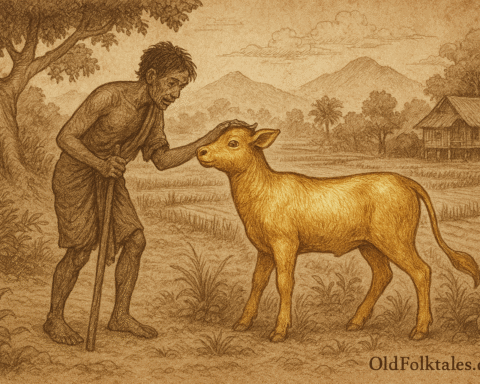
To begin the test, the man spread word throughout the town that he had lost all his wealth. He acted the part of a man ruined by misfortune, clothes worn, face weary, and hands trembling with false hunger. Then, to deepen his deception, he pretended to commit a terrible act: he stole one of the ruler’s goats, a beloved animal named Assas, famed for its rare beauty and colour. Everyone in the land knew the ruler cherished that goat more than gold.
The man hid the animal safely in his house, away from public sight. Then, whispering to one of the ruler’s servants, he confessed that he had stolen and slaughtered the prized goat. The servant reported it at once. Enraged, the ruler commanded that the thief be brought before him.
When questioned, the old man did not deny it. “Yes, my lord,” he said humbly. “I stole your goat and slaughtered it.”
The ruler, astonished by his boldness, gave him two options for punishment:
– Death by beheading, or
– Redemption through forty black she-camels, each bearing a silk rope around its neck.
The man bowed and chose to redeem himself. The ruler granted him time to find the camels, though he doubted the man could manage it.
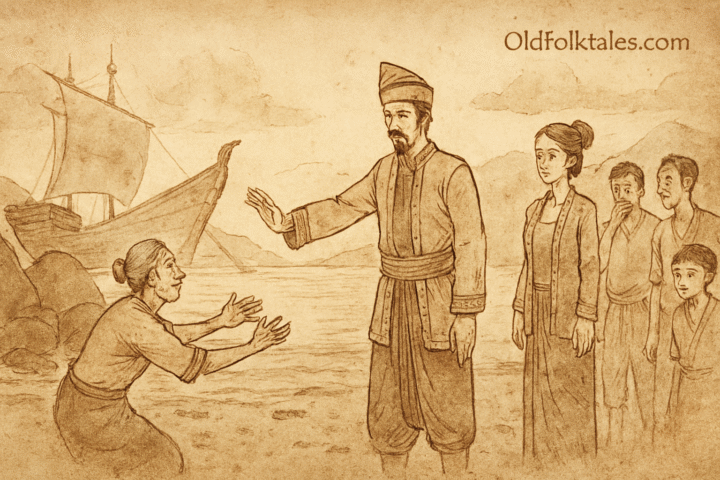
The father went first to the rich son-in-law. Standing at his grand door, he bowed and explained everything. “My life is at stake,” he pleaded. “Help me redeem myself, and I will forever be in your debt.”
The rich man frowned and replied coldly, “I am sorry, but this matter is not mine to fix.” He shut the door.
Disappointed but undeterred, the father went to his well-off son-in-law and repeated his plea. “I wish I could help you,” the man said with hesitation, “but I have many obligations. Forgive me.”
The father left again, his heart heavy.
Finally, he turned toward the humble home of his poor son-in-law. The young man listened carefully, then placed a reassuring hand on the old man’s shoulder. “Do not fear, Father,” he said. “We will find a way.”
He thought for a long while. Then, lighting a great fire before his house, he called to the people of the village to gather. When they came, he welcomed them warmly. Before explaining anything, he slaughtered his only she-camel, the only wealth he owned, and prepared a feast for everyone present.
When they had eaten their fill, he rose and spoke: “My father-in-law has fallen into great trouble. The ruler demands forty black she-camels for his life. I ask you, as brothers, to help us.”
The villagers, moved by his generosity and loyalty, agreed at once. “Give us until tomorrow,” they said. “We will return.”
The next morning, the poor man awoke to see a wondrous sight, forty black she-camels, each adorned with silk ropes, standing before his home. His heart swelled with gratitude. He immediately went to his father-in-law and handed them over.
“May God bless you, my son,” the old man said with tears in his eyes. “You have saved me.”
Taking the camels, the man went to the ruler. But before he presented them, he secretly released the hidden goat, Assas, from its shelter. The goat ran home, bleating joyfully. The ruler’s servants, seeing the animal alive, cried out in astonishment, “Assas has returned! The goat lives!”
The ruler, hearing the commotion, summoned the old man again. “What trickery is this?” he demanded. The father smiled and explained everything, how he had pretended to commit the theft only to test the loyalty of his sons-in-law.
The ruler, impressed by his wisdom, forgave him completely. “You are not guilty,” he said. “You are a man of great understanding.”
The father returned home, gave the camels back to his poor son-in-law, and declared before everyone:
“You are the worthiest among my daughters’ husbands, loyal, selfless, and wise. All that I own shall pass through your wife, for you have proven that virtue is richer than gold.”
And from that day, the poor man and his wife lived in honour and abundance, remembered across Socotra as symbols of humility, love, and righteousness.
Moral of the Story
True virtue is not measured by wealth or comfort, but by compassion, loyalty, and integrity. Generosity of heart is the greatest treasure a person can possess.
Knowledge Check
-
Who was tested in the story “The Wise Father’s Test”?
The three sons-in-law: one rich, one well-off, and one poor. -
What was the purpose of the father’s deception?
To determine which son-in-law was truly loyal and deserving of his inheritance. -
What did the ruler demand for the father’s redemption?
Forty black she-camels with silk ropes around their necks. -
Who helped the father in his time of need?
The poor son-in-law, through kindness and the support of his village. -
What symbolised virtue and generosity in the tale?
The poor son-in-law’s sacrifice of his only she-camel and his selflessness. -
What cultural origin does this folktale come from?
Socotra Island, Yemen (Yemeni folklore).
Source: Adapted from “A Tale of the Man Testing His Sons-In-Law” in Folk Tales from Socotra (2023), pp. 27–34.
Cultural Origin: Socotra Island, Yemen (Yemeni folklore)