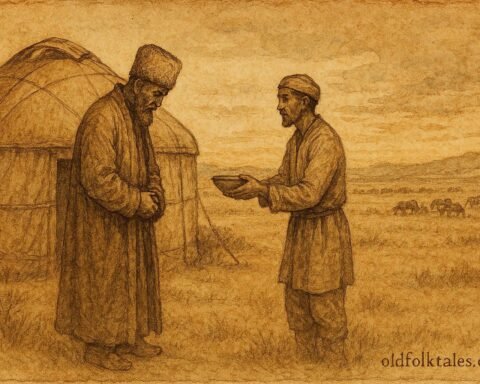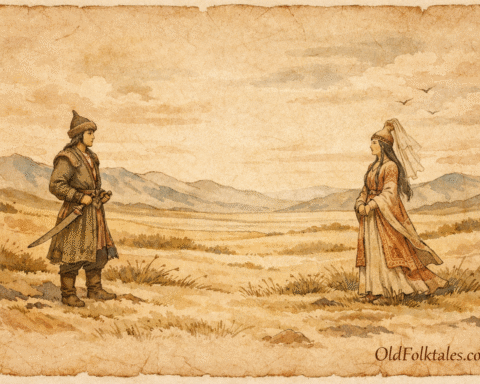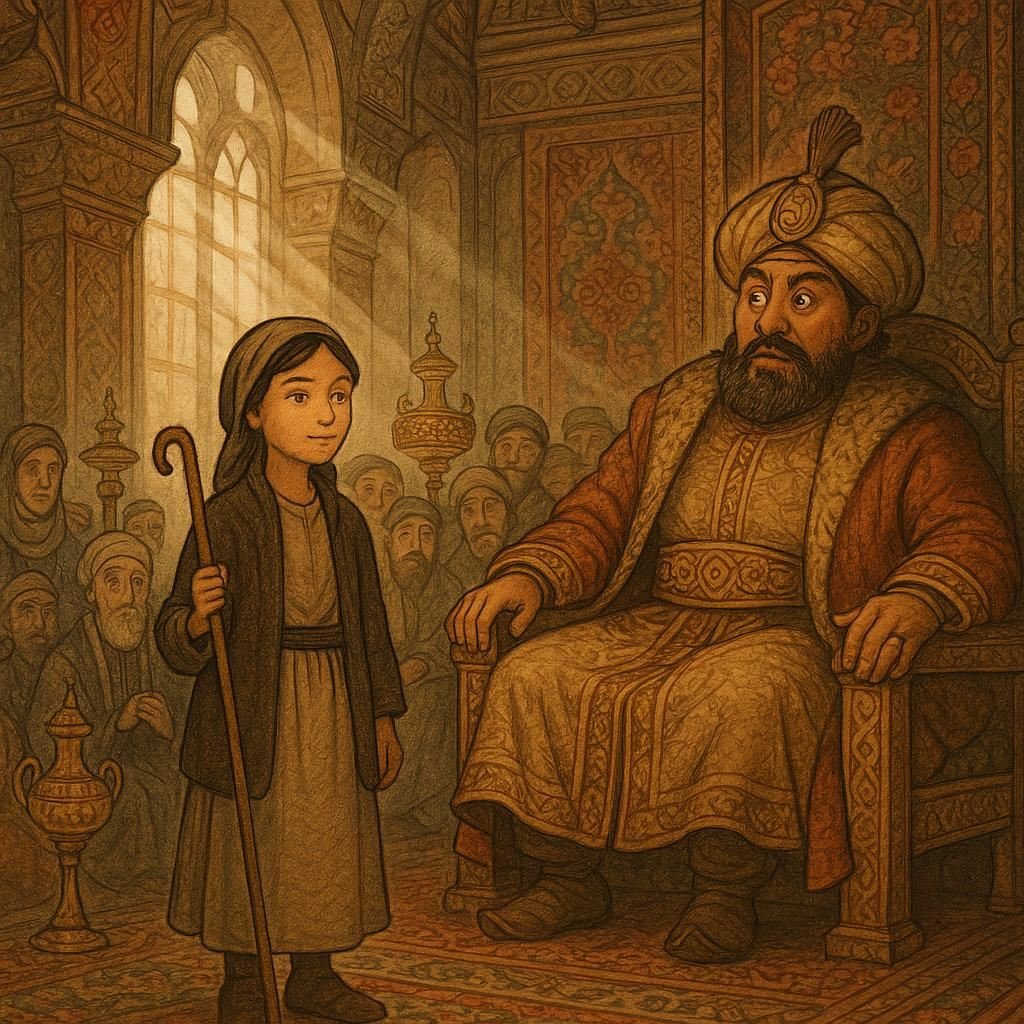
In the vast steppes of Kazakhstan, where the wind sweeps endlessly over golden grasses and jagged mountains touch the sky, a proud Khan ruled his people with might and grandeur. Though he was strong and clever, he loved a challenge above all else, boasting that no mind could surpass his own. Seeking a bride, he declared that only a girl capable of answering three impossible riddles would win his hand.
Many daughters of the nobles tried their fortune, their fine garments rustling in the palace halls and voices echoing with practiced elegance. Each gave answers that pleased the courtiers but failed to satisfy the Khan’s piercing mind. One by one, they faltered, their pride exposed.
Then came Aigul, a shepherd’s daughter, carrying nothing but a basket of dried herbs and a calm, observant gaze. She had grown up among the hills and flocks, learning the ways of the land and the people who worked it. Though simple in attire, her eyes held quiet determination. The Khan laughed when he saw her approach but welcomed her nonetheless.
“What is the swiftest thing in the world?” he asked, his voice echoing in the grand hall.
The young girl’s eyes sparkled. “The human mind,” she answered confidently. “It can journey beyond mountains, cross seas, and imagine countless wonders in a single breath.”
The Khan’s eyebrows lifted, surprised by the depth of the answer. He motioned for the next question.
“And what is the sweetest thing in all the world?”
The court murmured among themselves, certain that such a question required riches, jewels, or honey from the far lands. But Aigul replied without hesitation: “A mother’s milk. It nourishes life, comforts the weary, and binds hearts with love unmatched by any treasure.”
A hush fell over the hall. Even the Khan felt a flicker of humility stir in his chest.
Finally, he posed his most daunting riddle: “And what is the dearest thing a person can possess?”
Aigul’s gaze never wavered. “One’s own honour,” she said, her voice steady and true. “It cannot be bought, borrowed, or taken without a lifetime of loss. With honour, all else has value; without it, nothing remains precious.”
The Khan, for the first time in years, lowered his head. The pride he had worn like armor melted in the light of her insight. “You shall not be my bride alone,” he said, “but my closest advisor. Your wisdom will guide this court better than any law or decree I have known.”
Though some nobles snickered at her humble origins, Aigul accepted the challenge. With gentle firmness, she taught them to value fairness over flattery and justice over pride. She settled disputes with reason, listened to the poor as attentively as the powerful, and demonstrated that intelligence was not measured by birth or wealth but by perception and compassion.
Under her guidance, the Khan’s court became a place where virtue and wisdom were honored above all else. The people flourished, disputes diminished, and even the proud Khan learned the lesson that a true ruler must listen as much as he commands.
Aigul never lost her humility, walking the halls of the palace with the same quiet dignity she had shown as a shepherd’s daughter. She reminded everyone, in word and action, that the greatest leaders are those who understand the hearts of those they serve.
Moral Lesson
wisdom and virtue often come from humble origins. Intelligence, fairness, and honour are more valuable than wealth, status, or pride.
Knowledge Check
-
Who is the main character of the folktale?
The shepherd’s daughter, Aigul, whose wisdom surpasses that of the Khan. -
What are the three riddles posed by the Khan?
Swiftest: the human mind; sweetest: a mother’s milk; dearest: one’s own honour. -
What theme does Aigul’s success illustrate?
Wisdom can come from humble origins and guides moral leadership. -
How does the Khan’s court change under Aigul’s guidance?
It becomes fair, just, and attentive to both the powerful and the common people. -
What cultural region does this tale originate from?
Kazakhstan, specifically the Zhetysu region, reflecting Turkic oral folklore. -
What lesson does the tale teach about pride and social hierarchy?
True insight and virtue are not determined by status; humility and honour hold greater value.
Source & Cultural Origin
Source: Folk Tales from the Soviet Union: Central Asia and Kazakhstan (Raduga Publishers, 1983).
Cultural Origin: Kazakhstan, Zhetysu region, Kazakh folklore