In the old villages of Mount Lebanon, where vineyards terrace the slopes and cool springs shimmer in the quiet valleys, there lived a wolf and a fox who, for a time, called themselves partners. The wolf was large, powerful, and feared by every creature that crossed his shadow. The fox, smaller in size but unmatched in wit, understood the ways of the forest and survived through sharp eyes and a sharper mind.
When the wolf suggested they join forces, the fox agreed, hoping partnership meant shared work and shared meals. Yet from the start, their bond was unequal. The wolf used his might to raid barns, frighten shepherd dogs, and scatter flocks, while the fox slipped silently behind him, ready to help gather whatever food they acquired. But when the time came to divide the spoils, the wolf growled, showed his teeth, and claimed everything for himself.
Night after night, the fox watched the wolf eat until his belly swelled while his own stomach remained painfully empty. Whenever the fox dared to speak of fairness, the wolf snapped back, “You are small. I am strong. Strength earns the meal.” The fox swallowed his anger, but inside him grew a burning resolve. No partnership, he realized, binds a creature to misery forever.
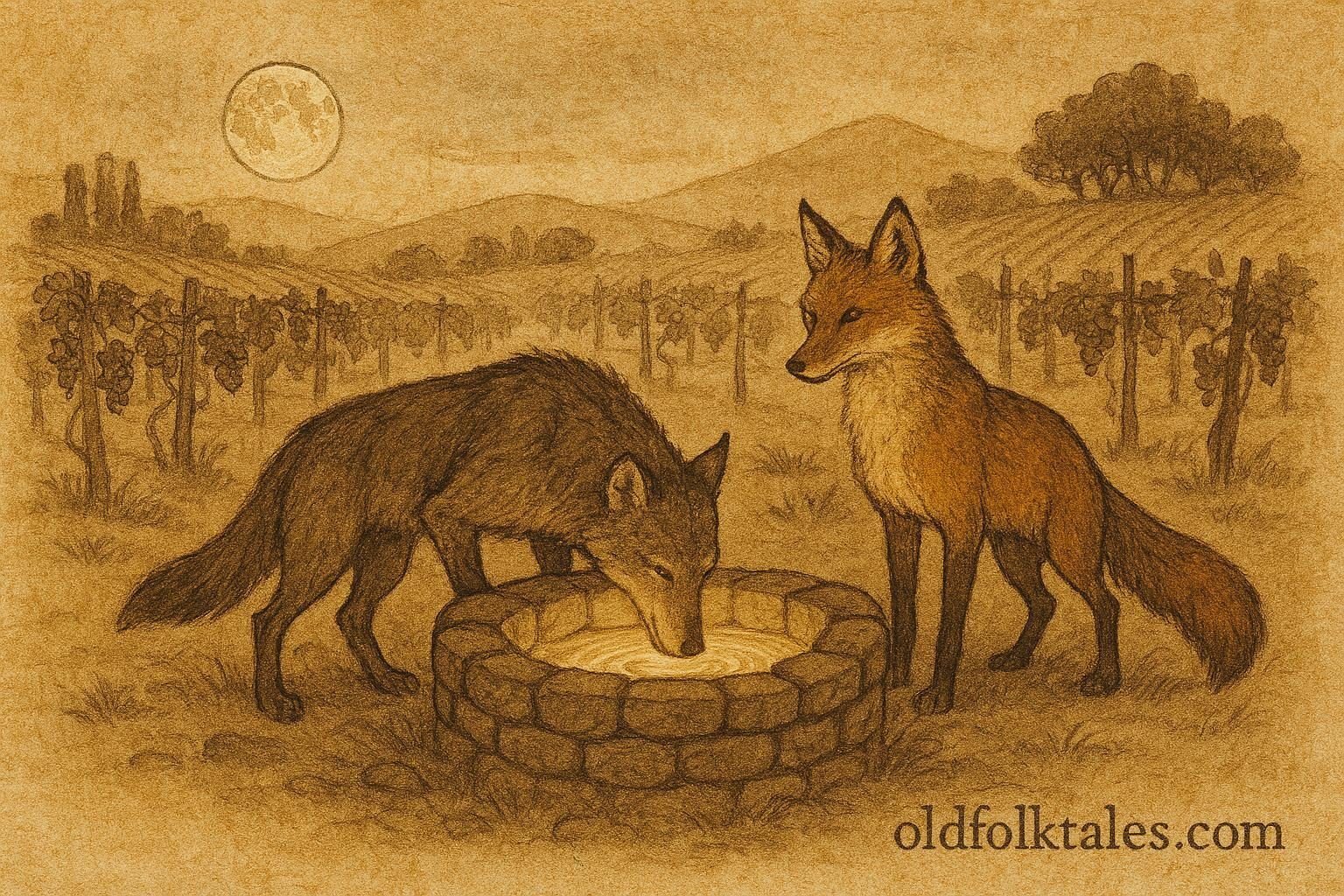
One evening, after another long day of hunger, the fox wandered alone under the rising moon. Its pale glow shimmered across the hillside, lighting the path to an old vineyard. The vines were bare, harvest season had long passed, but at the far edge of the vineyard stood a deep stone well. Curious, the fox peered into its darkness. At the bottom, the moon’s reflection lay round and golden, resting upon the water’s still surface like a perfect wheel of cheese.
The fox’s eyes brightened. A plan formed instantly, one that could free him from the wolf’s cruelty forever.
The next night, when the wolf once again barked orders and prepared to drag the fox along for more foraging, the fox spoke humbly.
“I have found something better than scraps, my mighty partner. There is a hidden treasure in a vineyard nearby: a cheese so large and shining you could feast for days.”
The wolf’s ears flicked with interest. “A cheese?”
“Yes,” the fox answered. “It lies in a deep well, cool and untouched. Only the bravest and strongest can claim it. When I saw it, I thought of you.”
Flattered, and hungry for more than stolen meat, the wolf agreed to follow him. The fox guided him through terraced fields until they reached the quiet vineyard under the moonlit sky. The well stood still, its circular stones glinting faintly.
“There,” whispered the fox, pointing down.
The wolf leaned over the edge. At the bottom of the well, the golden reflection floated gently. His eyes widened. “It is real!” he exclaimed, mistaking the moon’s reflection for an enormous cheese.
“Indeed,” said the fox. “But only one who dares enter the bucket can reach it.”
Hanging from a sturdy rope was the well’s wooden bucket, still damp from recent use. Below it, the water glowed faintly with the illusion of treasure.
The wolf hesitated only briefly. Greed weighed heavier than caution. He climbed into the bucket, and his heavy body immediately began to descend. As he sank, the bucket on the opposite side of the pulley system rose, carrying the fox effortlessly upward and away from danger.
From below came the wolf’s startled growl. “Fox! Why am I sinking?”
“That is the way of the well,” the fox called down, now safely at the top. “The heavier goes down. The lighter goes up.”
The wolf’s descent continued until the bucket hit the water with a splash. The “cheese” broke apart into shimmering ripples. Only then did the wolf understand the trick.
“You deceitful creature!” he roared, paddling frantically in the cold water. “How dare you!”
“You have always eaten while I starved,” the fox answered calmly. “You took everything for yourself. Now take this as your share.”
The wolf howled and clawed at the sides of the well, but the stones were slick and high. His weight kept him trapped in the water, and the fox, having endured humiliation for too long, did not stay to watch the final struggle. He slipped silently into the night, light of step and light of heart, free at last from the tyranny of his false partner.
From that day onward, the animals of the mountains said the animosity between wolf and fox was born from this very tale. One was blinded by greed; the other survived through cleverness. And in the end, each met the fate his nature invited.
Moral of the Story
Greed destroys itself, while cleverness protects those who cannot rely on strength alone. Partnerships without fairness unravel in the end.
Knowledge Check
1. What is the origin of “The Wolf and the Fox” folktale?
It comes from a Lebanese village tradition collected in Bteghrine, Metn District.
2. Why does the fox decide to trick the wolf in the story?
The wolf repeatedly hoards all the food, leaving the fox starving and mistreated.
3. What does the “cheese” at the bottom of the well actually represent?
It is the moon’s reflection, symbolizing deception and the danger of greed.
4. How does the fox escape the well safely?
He uses the counterweight of the wolf’s heavier body in the bucket to lift himself up.
5. What cultural lesson does this Lebanese folktale teach?
It warns that power without fairness leads to downfall, while intelligence ensures survival.
6. Why does the wolf drown at the end of the tale?
Because he is trapped in the deep well, deceived by his own greed and inability to see through the illusion.
Source
Adapted faithfully from the Lebanese folktale “The Wolf and the Fox,” in Folktales of Lebanon, collected by Anis Frayha (1953), American University of Beirut. Origin: Bteghrine, Metn District.