In a peaceful Kyrgyz valley surrounded by green hills and wildflower meadows, a mother goat lived happily with her seven young kids. They spent their days playing by the brook and grazing among the clover while their mother watched over them with love. She often warned them of the dangers that lurked beyond their meadow, especially the cunning wolf who roamed the forests nearby.
One sunny morning, the mother goat prepared to gather food from the far slopes. Before leaving, she gathered her little ones and spoke firmly yet gently. “My dear children,” she said, “I must go for a while to find food. While I’m away, keep the door locked and never open it to anyone but me. The wicked wolf is near, and though he may try to trick you, remember this, my voice is soft and sweet, and my hooves are white as snow. The wolf’s voice is rough, and his paws are black.”
The little goats nodded eagerly. “We’ll be careful, Mother,” they promised. She nuzzled them lovingly and trotted away toward the distant pastures, her bell tinkling softly with each step.
Not long after she had gone, a shadow crept near the cottage. It was the wolf, sly and hungry, who had overheard the mother’s warning. He rapped on the door and called out in a deep, gruff voice, “Open the door, my dear children! It’s your mother. I’ve brought delicious food for you!”
But the eldest goat listened closely and frowned. “That’s not our mother’s voice,” she said. “It’s too rough and low. You’re the wolf!” The wolf growled in frustration and hurried away to a nearby shop. There, he bought a lump of chalk and swallowed it, hoping it would soften his voice.
He returned and knocked again, this time calling out sweetly, “My dear little ones, open the door! It’s your mother, and I’ve brought you treats from the meadow.” The kids hesitated. The voice now sounded more like their mother’s, but the youngest one peered through the crack beneath the door and cried, “Show us your hoof! Mother’s hooves are white as snow!”
The wolf stuck his paw through the gap, revealing his dark, furry claws. The kids screamed, “You’re the wolf!” and refused to open the door. Furious, the wolf ran off again, this time to the mill. “Mill keeper,” he demanded, “cover my paw with flour, quick!” The frightened miller obeyed, dusting the wolf’s paws until they were white.
For the third time, the wolf went back to the cottage and knocked softly. “My dear children,” he said, “your mother has come home. Look at my white hoof and hear my gentle voice.” When the kids saw the flour-covered paw and heard the softened tone, their fear faded. Thinking it was their mother, they unlatched the door.
In rushed the wolf, his eyes gleaming with hunger. The terrified kids scattered, hiding wherever they could, under the bed, behind the stove, in the cupboard, and inside the clock case. One by one, the wolf found them and swallowed them whole. Only the youngest goat, small and clever, managed to hide inside the grandfather clock, trembling silently as the wolf finally left, his belly round and heavy.
When the mother goat returned home and saw the open door, her heart froze. She called out for her children, but only silence answered. Then she heard a faint sob from the clock. The youngest goat tumbled out and told her everything, how the wolf had come, tricked them, and devoured his brothers and sisters. Tears filled the mother’s eyes, but she quickly gathered her courage. “Do not weep, my child,” she said. “We will make things right.”
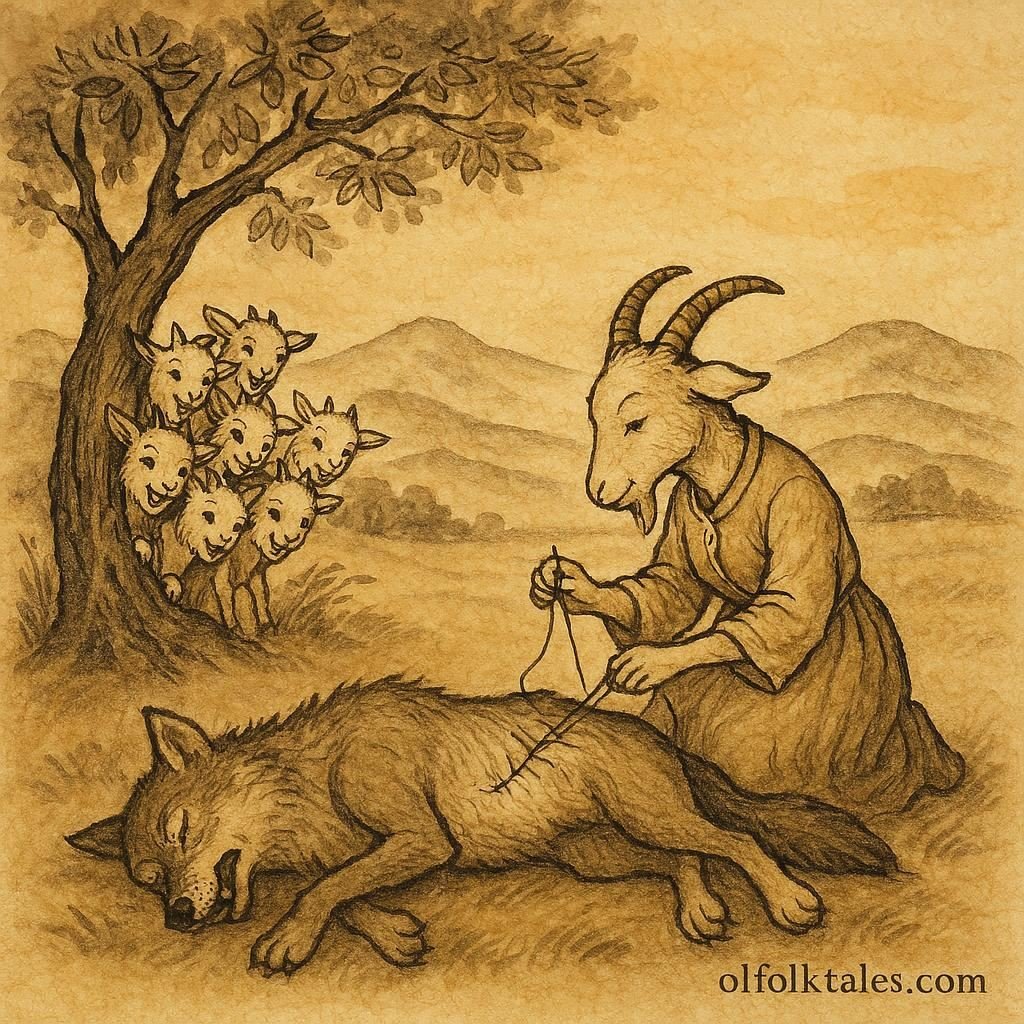
Following the wolf’s heavy footprints, they found him fast asleep under a large tree by the riverbank, snoring loudly. His belly bulged and moved as though something inside was still alive. The mother goat crept close and listened carefully. From within came the muffled cries of her children. With determination burning in her heart, she sent the youngest goat back to fetch scissors, needle, and thread.
Gently, she cut open the wolf’s belly, and to her joy, all six of her children jumped out unharmed. They hugged their mother tightly, promising never to disobey her again. The mother then filled the wolf’s belly with stones and sewed it neatly back up. When the wolf awoke, feeling heavy and thirsty, he stumbled toward the river to drink. But as he bent down, the weight of the stones dragged him into the water, and he was swept away by the current forever.
The mother goat and her children returned home, grateful for their safety. They locked their door firmly and lived peacefully thereafter, never forgetting the lessons learned that day.
Moral Lesson
This Kyrgyz folktale teaches the value of caution, obedience, and unity. The young goats’ tragedy reminds us that wisdom and teamwork can overcome deception and danger. Trust and prudence are the truest shields against harm.
Knowledge Check
- Who are the main characters in The Wolf and the Seven Little Goats?
– The mother goat, her seven kids, and the cunning wolf. - What warning did the mother goat give her children?
– To open the door only for her soft voice and white hooves, not the wolf’s rough voice and black paws. - How did the wolf trick the goats?
– He softened his voice with chalk and whitened his paws with flour to imitate their mother. - Which goat escaped the wolf’s attack?
– The youngest goat, who hid inside the grandfather clock. - What does the wolf’s downfall symbolize?
– That greed and deceit ultimately destroy those who use them to harm others. - What moral lesson does this Kyrgyz folktale teach?
– It teaches lessons on caution, obedience, and unity in the face of deception.
Source & Origin: Kyrgyz Folk Tales (1998 Edition)