In the heart of the Najd Plateau, where the desert stretches red beneath the fading sun and the wind carries stories as old as the dunes, lived a poor but hardworking woodcutter named Suleiman. His days were long and demanding, for he relied on selling firewood to feed his family, and the harsh terrain of Al-Thu’air tested the strength of even the most resilient workers.
Every morning, Suleiman led his loyal donkey into the wilderness. The donkey, a small grey creature with calm, expressive eyes, had served him faithfully for years. Together they traversed wadi beds, acacia groves, and stony hillsides, always returning home with bundles of wood to sell in the village market.
One evening, Suleiman worked later than usual. The sun had dipped behind the dunes, turning the sky into a quilt of purple and amber, and the desert night, cold and unpredictable, crept closer. With his donkey heavily loaded, he turned toward home. But the long route would take hours, and Suleiman was tired. He considered a shortcut through a nearby wadi, a dry valley known among the villagers as a place one should avoid after dusk.
Elders whispered that a Ghoul, one of the desert’s shape-shifting demons, haunted that wadi. Sometimes it appeared as a crying woman, sometimes as a limping old man. Other times, it hid behind dunes waiting for travelers to pass. Suleiman had never personally seen a ghoul, but he had grown up listening to the warnings of his grandmother, who would say, “The desert hides as much danger as beauty. Listen to your animals, they see what human eyes cannot.”
Still, exhaustion outweighed caution, and Suleiman tugged gently at his donkey’s reins and headed toward the wadi path.
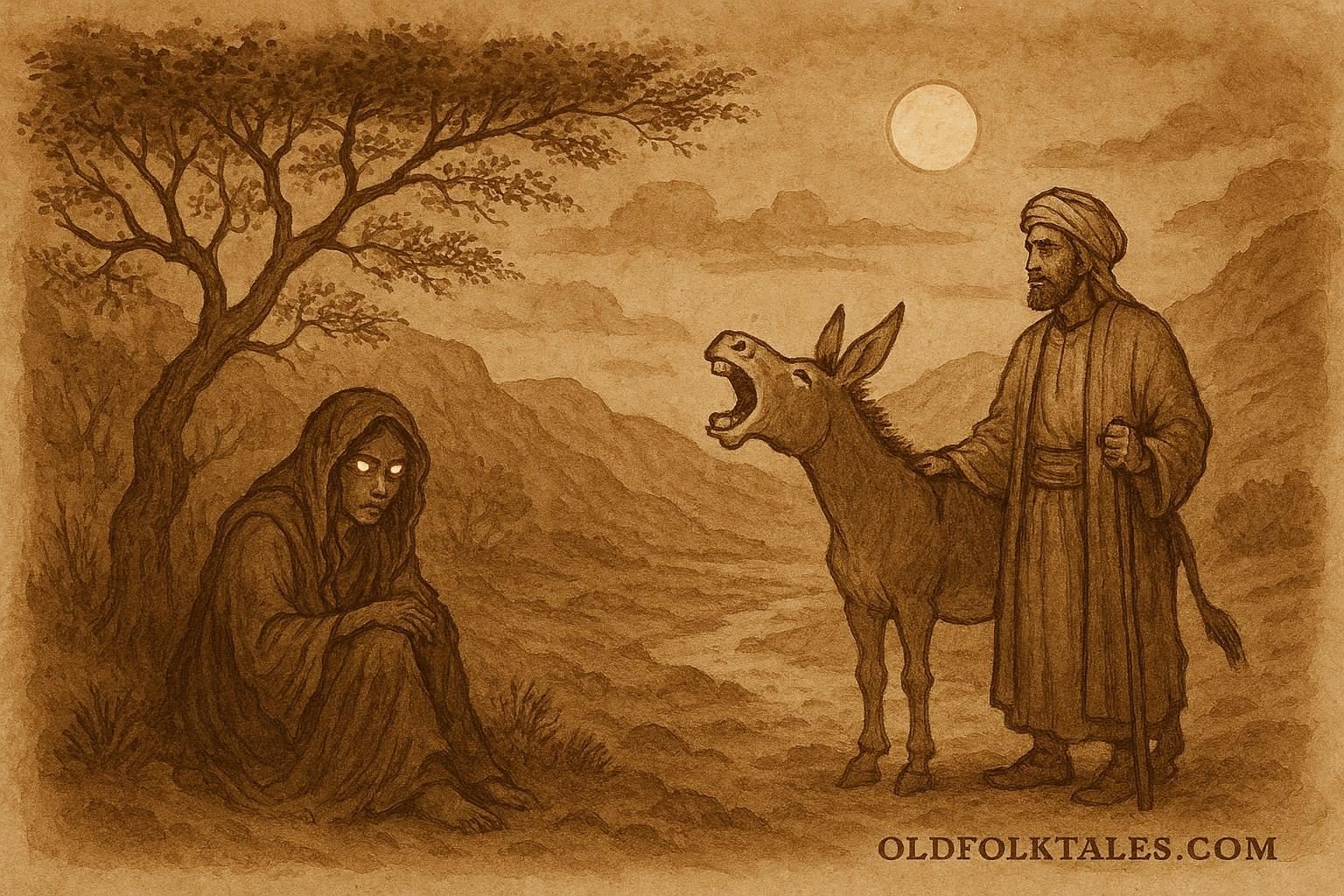
As they reached the center of the valley, the air grew unsettlingly still, and the donkey slowed. Its ears twitched nervously. Then, without warning, it refused to move, planting its hooves firmly into the sand. It brayed sharply, a loud, distressed sound that echoed off the stone walls of the wadi.
“Come now,” Suleiman whispered, believing the donkey was only tired. But the animal backed away, trembling.
That was when Suleiman saw her.
Under the shadow of an acacia tree sat a woman with long, dark hair veiling her face. She wore a flowing dress that shimmered faintly in the moonlight, and her shoulders shook with the force of her sobs. She appeared lost and helpless, too helpless, Suleiman realized, for someone wandering alone in a desert valley at night.
“Help me, kind sir,” the woman cried, her voice strangely hollow, as if it echoed from a cavern. “My family left me behind. I am alone, hungry, and thirsty.”
The donkey brayed again, louder, more desperate. It yanked at its reins, refusing to step closer to the figure.
A chill swept down Suleiman’s spine. His grandmother’s voice filled his mind: “If the donkey fears what you do not see, trust him.”
Suleiman steadied his breath. Something was wrong, deeply wrong.
Then he remembered another of his grandmother’s teachings: “Ghouls hate purity and fear the invocation of God’s name. Salt, too, is a binding protection.”
Every woodcutter carried salt to keep water fresh and to ward off evil spirits. Suleiman reached into his pouch, his hands shaking, and whispered with all the strength he could muster:
“In the name of God, the Most Merciful!”
The moment the words filled the air, the woman stopped crying.
Slowly, her head lifted.
What Suleiman saw next froze him in place. Her eyes glowed like burning embers. Her hair writhed as though alive. Her mouth stretched far too wide for any human face.
He threw a handful of salt toward the creature.
The reaction was immediate.
The woman’s form began to blur, her outline twisting and unraveling like smoke caught in a sandstorm. She rose to her full, towering height, revealing her true shape: a ghoul, massive and hulking, covered in tangled hair, its limbs long and distorted, its eyes burning with hatred.
A shriek tore through the valley, a sound that rattled the stones themselves.
Wind surged from every direction, spiraling into a whirlwind as the ghoul writhed in pain. Sand whipped through the air until Suleiman could barely keep his eyes open. Then, just as suddenly as it had appeared, the creature vanished, erased into a swirling column of dust that dissolved into the night.
Silence followed. The donkey’s trembling eased, and it nudged Suleiman gently, as if to reassure him.
Suleiman stroked its neck, grateful beyond words. He realized that without the donkey’s warning, and without the wisdom passed down through generations, he would never have survived the encounter.
He led his loyal animal out of the wadi, choosing the longer path home but feeling safer with every step.
From that night onward, Suleiman would tell his story to anyone who would listen. The villagers repeated it to their children, reminding them that the desert is ancient, alive, and full of beings that hide behind beautiful illusions.
Moral of the Story
Trust the instincts of animals, value ancestral wisdom, and remember that faith and presence of mind can overcome even unseen dangers.
Knowledge Check
1. What warning signs helped Suleiman detect the Ghoul in the Najdi folktale?
His donkey sensed danger first, refusing to move and braying loudly.
2. How does the Ghoul typically appear in Arabian desert legends?
As a shape-shifting demon that often disguises itself as a weeping or helpless human.
3. What protective actions does Suleiman use against the Ghoul?
He invokes God’s name and throws salt, a traditional Bedouin protection.
4. What cultural belief does the donkey symbolize in this Najd folktale?
Animals possess heightened awareness of supernatural danger.
5. What core lesson does the folktale teach about faith and ancestral wisdom?
Old teachings and religious invocations provide protection in unpredictable environments.
6. Why is the wadi setting important in Arabian folklore?
Dry valleys are believed to attract spirits, ghouls, and shape-shifting beings after dark.
Source
Adapted from the Najdi folktale “The Woodcutter, the Donkey, and the Ghoul,” referenced in Folktales from the Arabian Peninsula by Nadia Jameel Taibah and corroborated by traditional oral variants.