In the misty valleys of old Sri Lanka, where thick tamarind trees shaded the paths and birds sang above the paddy fields, there lived a poor woodcutter and his only daughter. Their hut stood at the edge of a forest, built from rough timber and thatched with palm leaves. Each morning, the woodcutter rose before sunrise, his axe slung over his shoulder, while his daughter prepared a simple meal of rice and water for his journey.
Despite their poverty, peace filled their little home. The girl was gentle and dutiful, tending to her father’s needs with quiet devotion. Her laughter often softened his weariness after long hours in the forest.
Journey through enchanted forests and islands in our Southeast Asian Folktales collection.
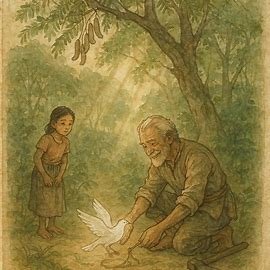
One hot afternoon, as the sun glimmered through the treetops, the woodcutter heard a faint cry among the bushes. Following the sound, he discovered a small silver bird caught in a hunter’s snare. Its feathers shimmered like moonlight, and its black eyes glistened with fear.
“Oh, poor creature,” murmured the man, kneeling beside it. He carefully loosened the cords and freed the delicate bird. The moment it fluttered from his hands, the bird spoke in a clear, melodious voice.
“Kind woodcutter, your mercy will not be forgotten,” it said. “Tell your daughter to rise before dawn and look beneath the great tamarind tree that stands by your hut. There she will find your reward.”
Before the astonished man could reply, the silver bird spread its wings and soared into the forest canopy, vanishing into the morning light.
That night, the woodcutter shared the tale with his daughter. Though she was amazed, she did not doubt his words. “We shall do as the bird said, Father,” she promised with a smile.
At first light, the girl walked barefoot to the old tamarind tree, its roots twisting deep into the soil. Beneath its wide shadow, something gleamed faintly. She knelt and brushed away the earth, and there, half-buried, was a clay pot filled with shining silver coins.
When she carried the treasure home, her father wept with joy. “At last,” he said, “we shall never go hungry again.”
With care and humility, they used the silver to build a small house in the nearby town, no longer fearing the storms or the lean seasons. Yet they did not forget their simple ways. The woodcutter still worked when he could, and his daughter shared what they had with those in need.
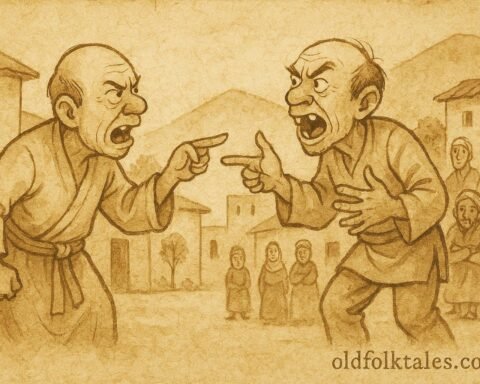
But news of their fortune spread quickly through the village, carried on tongues eager for gossip. The greedy village headman, a man known for his envy and pride, grew suspicious. “No poor woodcutter could come by such wealth honestly,” he grumbled. “There must be a secret.”
When he heard about the talking silver bird, his eyes gleamed with desire. “If that bird brought silver to a peasant, it shall bring gold to me,” he declared.
The next morning, he set a snare near the same forest clearing. Sure enough, as dawn broke, the silver bird appeared, alighting on a low branch. The headman threw his net and caught it.
“Now, bird,” he said, clutching it greedily, “give me gold, more than any man in this land possesses!”
The bird only gazed at him silently, its eyes calm and sorrowful.
“Gold, I said!” the man roared. “You gave silver to a beggar; surely you can give gold to me!”
Still, the bird did not speak. In his rage, the headman’s greed turned to cruelty. “If you will not obey, then you are useless!” he shouted, and struck the bird down.
The forest grew eerily silent as its silver feathers scattered upon the ground. The headman left, thinking he had taught the bird a lesson. But from that day onward, his fields refused to bear fruit. The rains avoided his land, his cattle grew thin, and his wealth dwindled into dust.
Meanwhile, the woodcutter and his daughter continued their quiet, thankful lives. Though their riches were modest, their hearts were full. The girl often placed small bowls of grain beneath the tamarind tree, whispering prayers of gratitude for the blessing they had received.
And when the moonlight fell through the leaves, some said they could see a faint silver glimmer there, like wings in flight, guarding the home of the kind-hearted.
Moral Lesson
True fortune blossoms only from kindness and gratitude. Greed may promise gold, but it leaves the heart barren. Compassion, even in poverty, brings lasting peace.
Knowledge Check
1. Who are the main characters in “The Woodcutter’s Daughter”?
The main characters are a poor woodcutter, his gentle daughter, a magical silver bird, and the greedy village headman.
2. What reward does the woodcutter receive for freeing the bird?
His daughter finds a pot of silver coins buried beneath a tamarind tree, a gift for their compassion.
3. How does the headman react to the woodcutter’s fortune?
Driven by envy, he captures the bird and demands gold, but his greed leads to his downfall.
4. What happens after the headman kills the bird?
His lands turn barren, symbolising how greed and cruelty destroy blessings.
5. What is the symbolic meaning of the silver bird?
The bird represents purity, gratitude, and the spiritual rewards of compassion in Buddhist moral tradition.
6. How does this folktale reflect Sri Lankan village culture?
It mirrors rural Buddhist teachings that kindness and humility attract blessings, while greed disrupts natural harmony.
Source:
Adapted from the Sinhalese folktale “The Woodcutter’s Daughter” in Village Folk-Tales of Ceylon, Vol. III, collected by H. Parker (1910), London: Luzac & Co.
Cultural Origin: Sri Lanka (Sinhalese folklore)