In a remote village nestled among the rolling plateaus of Central Tibet, the winds whispered through the grasslands carrying news of hardship and scarcity. For months, the villagers had endured a severe famine. Crops failed, streams ran low, and the herds of sheep and yaks, which had long sustained the people, grew thin and weak. Families struggled to feed even their youngest children, and despair settled over the village like a heavy blanket.
Among the villagers was a young herder named Lobsang, known for his careful attention to the animals and his respectful demeanor toward the mountains and sky. Every morning, he tended the remaining herds, guiding them to the few patches of green that had survived the drought. Each evening, he offered prayers at the small shrine near the village, asking the spirits of the land for guidance and sustenance.
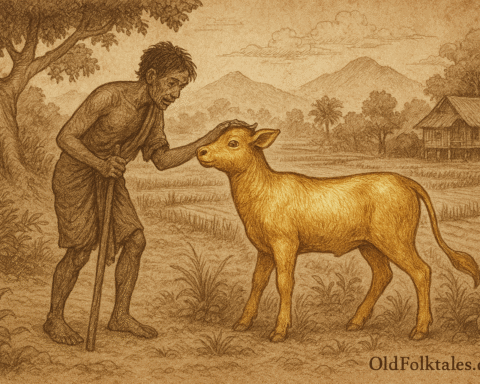
One day, as Lobsang led his emaciated yaks across the barren plains, he noticed a strange figure approaching from the distance. At first, he thought it might be another herder or a wandering traveler. But as the figure drew closer, he saw that it was a yak unlike any he had ever encountered. Its coat shimmered with a golden hue that caught the sunlight like liquid metal, and its eyes glowed with a gentle, knowing light. A faint aura of mist swirled around its hooves, and its breath carried a warm, fragrant scent.
Journey through enchanted forests and islands in our Southeast Asian Folktales collection.
The villagers gathered as Lobsang led the herd back to the village. Murmurs ran through the crowd. Some whispered that the yak was a spirit sent from the heavens, while others feared it might be an omen of more trials to come. Lobsang, however, felt a deep sense of calm. The yak moved gracefully toward the village center, pausing as if to acknowledge the suffering people, its presence radiating reassurance.
The yak lowered its head and touched the earth with its nose. Suddenly, the ground trembled softly, and from the barren soil sprouted shoots of grass, tender and green. Streams that had dried up for weeks began to trickle, carrying clear, cool water to the villagers. The people gasped in awe, realizing that this was no ordinary yak. They gathered their remaining crops and animals around the sacred creature, offering their gratitude in whispered prayers.
Over the following days, the yak guided the villagers to hidden patches of edible plants and to springs where water still flowed. Its presence brought not only physical sustenance but also a renewed sense of hope. Families shared their food more generously, elders taught the young to care for the land with patience, and Lobsang learned to communicate silently with the yak, understanding when to move the herd and when to rest.
One evening, as the sun set behind the distant mountains and painted the sky in shades of rose and gold, the yak stood at the edge of the plateau, looking toward the high peaks. It seemed to bow slightly, as if acknowledging that its work among the villagers was complete. With a gentle snort, it trotted toward the mountains and disappeared among the mist and crags, leaving behind a land now lush with life and a community strengthened in spirit.
The villagers continued to honor the yak in their daily prayers. Each year, during the festival celebrating the return of spring, they left offerings of butter and grains at the highest ridge where the yak had appeared. Children were told stories of the sacred yak that came from the heavens to protect the people, teaching the importance of gratitude, patience, and harmony with nature. And though generations passed, the memory of the golden yak endured, reminding all who heard the tale that even in the darkest times, divine guidance and kindness could restore life and hope.
Explore timeless legends from China, Japan, and Korea in our East Asian Folktales collection.
Moral Lesson
Compassion, respect for the natural world, and gratitude invite divine guidance into human life. Even in times of despair, faith, and care for the environment can restore balance and bring sustenance to both people and animals. Helping others and living harmoniously with nature ensures blessings for the community.
Knowledge Check
- Why did the villagers suffer in the story?
Answer: Because of a severe famine that caused crops to fail and herds to weaken. - How did Lobsang care for his animals during the famine?
Answer: He carefully guided them to the few remaining green patches and offered prayers to the spirits. - What made the yak appear unusual to the villagers?
Answer: Its golden shimmering coat, glowing eyes, and the mist surrounding its hooves indicated it was a divine creature. - What actions did the yak take to help the villagers?
Answer: It caused grass to grow, restored water to streams, and led villagers to hidden food and water sources. - How did the yak teach the villagers spiritual or moral lessons?
Answer: By demonstrating divine guidance, encouraging gratitude, and promoting care for the land. - What did the villagers do after the yak returned to the mountains?
Answer: They honored the yak with annual offerings, told stories of its deeds, and maintained care for their land and animals.
Source
Adapted from Tibetan and Himalayan Library Pastoral Folktales Manuscripts, 2014.
Cultural Origin
Central Tibetan nomadic tradition.