In the rugged highlands of the Cordillera region, where mist clings to ancient pine forests and mountain peaks pierce the clouds like the spears of forgotten giants, the trails wind through terrain that belongs as much to the spirits as to mortal travelers. These are lands where the old ways still hold power, where farmers planting rice terraces speak in hushed tones of creatures that walk between the seen and unseen worlds.
Among all the supernatural beings that inhabit these misty mountains, none is more feared or more misunderstood than the Tikbalang.
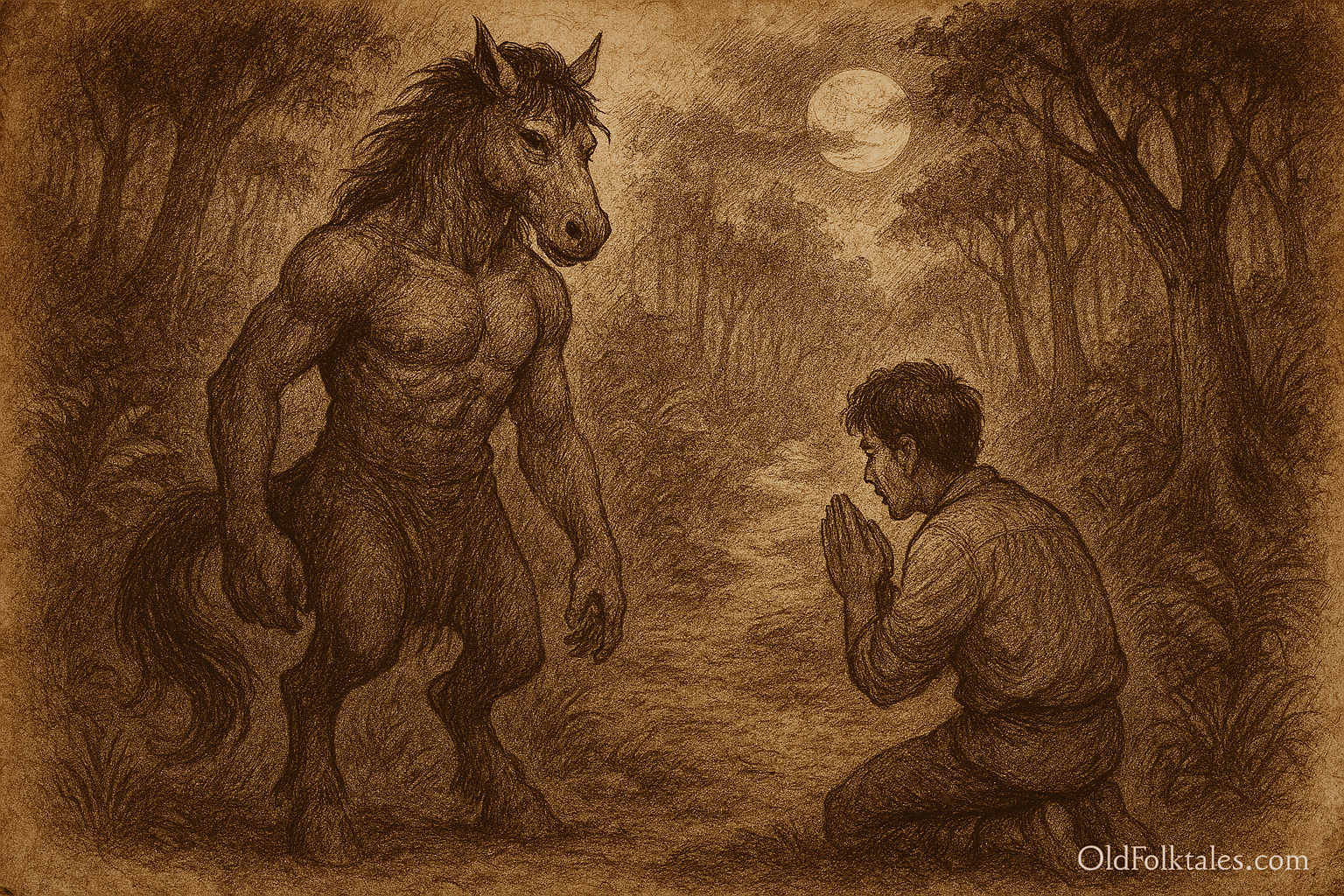
The Tikbalang stands impossibly tall, towering over even the tallest man, with the muscular body of a human warrior but the head and mane of a wild horse. His legs end in powerful hooves that leave distinctive prints in the mud of mountain paths, and his eyes gleam with an intelligence that is neither fully animal nor entirely human. Long, wild hair flows down his back like a waterfall of darkness, and his laugh when travelers are unfortunate enough to hear it echoes through the valleys like distant thunder.
Click to read all East Asian Folktales — including beloved stories from China, Japan, Korea, and Mongolia.
These beings are the ancient guardians of the mountain trails, protectors of the forest paths that humans have walked for generations. They are not inherently evil, but they are tricksters, testing those who enter their domain to see if they carry the proper respect for the natural and supernatural worlds. To encounter a Tikbalang is to face a challenge of humility, wisdom, and presence of mind.
This is the story of one such encounter, a tale still told in the villages at the foot of the Cordillera, where grandmothers warn their grandchildren and where travelers still remember to carry certain protections when venturing into the highland mists.
There once lived a young man named Ramon, a trader who regularly traveled the mountain paths between coastal towns and highland villages, carrying goods that each region needed salt and dried fish going up, mountain coffee and sweet potatoes coming down. Ramon was skilled at his trade, strong and capable, but he had grown proud over the years. He had walked these trails so many times that he believed he knew every twist and turn, every landmark and shortcut. He scoffed at the old folks’ warnings about showing respect to the spirits of the forest.
“Superstition and foolishness,” Ramon would say, waving his hand dismissively. “I am a practical man. I trust in my own knowledge and strength, not in invisible beings and old wives’ tales.”
One afternoon, Ramon set out on a familiar journey, climbing into the foothills as afternoon shadows began to lengthen. The weather was pleasant, and he walked with confidence, his pack heavy with goods for trade. He expected to reach the village of San Miguel before nightfall, where a warm meal and comfortable bed awaited him.
But as the sun dipped lower, Ramon began to notice something strange. The trail seemed different somehow. A landmark tree that should have been on his left appeared on his right. A stream he thought he had crossed twenty minutes ago appeared before him again. The path that should have led upward seemed to be taking him in circles.
“Impossible,” Ramon muttered, checking the position of the sun. “I know this trail like the back of my hand.”
He pressed forward with determination, certain that he had simply made a small error and would soon recognize his surroundings. But the more he walked, the more lost he became. The forest seemed to shift around him, familiar landmarks appearing in wrong places or not appearing at all. The light was fading fast now, and the mist was rolling in thick and cold.
Hours passed. Ramon’s confidence crumbled into confusion, then frustration, and finally fear. He had been walking in circles for what felt like an eternity. His legs ached, his pack felt impossibly heavy, and the darkening forest seemed to press in around him with menacing closeness. Strange sounds echoed through the trees rustling that seemed too deliberate, branches snapping with no visible cause, and once, unmistakably, the sound of hoofbeats on the trail behind him, though when he turned, nothing was there.
Then Ramon heard it a laugh, deep and wild, rolling through the forest like wind through a canyon. It was the laugh of something that was enjoying his predicament immensely, taking pleasure in his mounting panic and exhaustion.
In that moment, Ramon understood. All the old stories he had dismissed, all the warnings he had ignored, came flooding back to him with terrible clarity. He was being led astray by a Tikbalang. The mountain guardian was teaching him a lesson about pride and disrespect.
Ramon stopped walking and stood still on the path, his heart pounding. The mist swirled around him, and in its depths, he could sense a presence something massive and powerful, watching him with ancient eyes. Fear gripped his throat, but alongside it came understanding. He had entered this creature’s domain with arrogance, dismissing the spirits as mere superstition. Now he was at the Tikbalang’s mercy.
Ramon remembered fragments of the old teachings his grandmother had shared long ago, before he had become too sophisticated to listen. There were ways to break free from a Tikbalang’s enchantment, but they required humility, not force. They required acknowledging the power of the unseen world and showing proper respect.
With trembling hands, Ramon removed his shirt. Following the old custom he had once mocked, he turned it inside out and put it back on. This simple act was a symbol of reversal, a way of breaking the spell by reversing one’s perspective, acknowledging that the normal rules did not apply in the domain of spirits.
But Ramon knew that the gesture alone was not enough. He needed to show genuine respect, genuine humility. He stepped off the trail and bowed deeply in the direction where he sensed the Tikbalang’s presence.
“Forgive me,” Ramon called out into the mist, his voice carrying none of its former arrogance. “I have walked your trails with pride and disrespect. I dismissed the old wisdom and entered your domain as if it were mine alone. I ask for your forgiveness and permission to pass. I acknowledge your power and your guardianship of these mountains. I am merely a guest here.”
For a long moment, there was only silence and swirling mist. Ramon remained bowed, his heart hammering, wondering if he would spend the night lost in these mountains or worse.
Then he heard it again that deep, rumbling laugh, but this time it carried a different tone. Not mockery, but something almost like approval. A massive shape moved through the mist, too tall and too strange to be fully seen, and Ramon kept his eyes lowered respectfully, not daring to look directly at the creature.
A voice spoke, deep and resonant, seeming to come from the earth itself: “You have learned, little trader. Not all who enter here show such wisdom. Go now, and remember this lesson. The spirits of these mountains are real, and respect costs you nothing but serves you well.”
Ramon felt a change in the air, as if a veil had been lifted. When he raised his eyes, the mist had cleared slightly, and the trail ahead was suddenly, unmistakably familiar. He knew exactly where he was the village lay just beyond the next ridge, perhaps only twenty minutes away.
With profound gratitude, Ramon bowed once more in the direction where he had sensed the Tikbalang. Then he gathered his pack and walked forward with careful, respectful steps. Within the promised twenty minutes, he saw the lights of San Miguel twinkling in the valley below.
Ramon never again dismissed the old stories. He taught his own children and grandchildren the lessons he had learned on that misty trail that there are powers in the world beyond human understanding, that respect for the unseen is wisdom not weakness, and that the mountains belong first to their guardians, with humans merely grateful guests passing through.
To this day, travelers in the Cordillera foothills carry these teachings. When paths seem to shift and landmarks disappear, they remember to turn their shirts inside out, to bow with genuine respect, and to acknowledge the Tikbalang and other spirits who watch over the ancient trails. For in these mountains, humility is not just a virtue it is survival, and respect for the unseen world is the price of safe passage through domains far older than human memory.
Click to read all Southeast Asian Folktales — featuring legends from Thailand, Indonesia, Vietnam, and the Philippines.
The Moral Lesson
The legend of the Tikbalang teaches profound lessons about humility, respect, and acknowledging forces beyond ourselves. Ramon’s experience demonstrates that pride and dismissiveness toward traditional wisdom and the spiritual world can lead us astray, both literally and metaphorically. The story emphasizes that showing respect for nature, for guardians of the land, and for beliefs we may not fully understand is not weakness but wisdom. It reminds us that we are guests in the natural world, not its masters, and that humility opens doors that arrogance closes. The simple acts of turning one’s shirt inside out and bowing represent the willingness to change perspective, admit error, and show genuine respect lessons as relevant in human relationships as in encounters with the supernatural.
Knowledge Check
Q1: What is a Tikbalang and what does it look like? A: A Tikbalang is a tall supernatural creature from Philippine folklore that serves as a guardian of mountain trails. It has the muscular body of a human but the head and mane of a wild horse, with legs ending in powerful hooves. Tikbalangs stand impossibly tall, towering over humans, with long wild hair and eyes that gleam with intelligence beyond that of animals or humans.
Q2: What was Ramon’s attitude toward the spirits before his encounter? A: Ramon was proud and dismissive of supernatural beliefs, calling them “superstition and foolishness.” As an experienced trader who had traveled the mountain paths many times, he trusted only his own knowledge and strength, openly mocking the old warnings about showing respect to forest spirits and refusing to believe in invisible beings.
Q3: How did the Tikbalang mislead Ramon on the trail? A: The Tikbalang used its supernatural powers to make Ramon lose his way despite his familiarity with the trail. Landmarks appeared in wrong places, streams he thought he’d crossed reappeared, and paths that should have led upward took him in circles. The forest seemed to shift around him, and familiar landmarks either appeared incorrectly or didn’t appear at all, trapping him in confusion for hours.
Q4: What two actions did Ramon take to break free from the Tikbalang’s enchantment? A: Ramon performed two traditional acts to break the spell: First, he removed his shirt, turned it inside out, and put it back on a symbolic reversal representing a change in perspective. Second, and most importantly, he stepped off the trail and bowed deeply while speaking words of genuine respect and humility, acknowledging the Tikbalang’s power and asking forgiveness for his arrogance.
Q5: Why did the Tikbalang release Ramon instead of keeping him lost? A: The Tikbalang released Ramon because he demonstrated genuine humility and respect. The spirit was not inherently malicious but was testing Ramon to see if he would learn the lesson about respecting the unseen world. When Ramon showed sincere acknowledgment of the Tikbalang’s guardianship and asked for forgiveness with true humility, the spirit approved of his wisdom and allowed him to pass safely.
Q6: What is the cultural significance of the Tikbalang in Philippine tradition? A: The Tikbalang represents the importance of respecting nature and the spiritual world in Philippine culture, particularly in highland communities. These beings embody the concept that humans are guests in the natural world, not its masters. The Tikbalang stories preserve traditional wisdom about showing humility, following old customs, and acknowledging forces beyond human understanding lessons passed down through generations to ensure safe and respectful interaction with the land and its guardians.
Source: Adapted from Philippine folklore as documented in Maximo D. Ramos’s The Creatures of Midnight
Cultural Origin: Philippines, Southeast Asia.