In the golden age of the Khmer Empire, when pagodas rose like lotus blossoms across the Cambodian countryside and the chanting of monks mingled with the songs of rice farmers, there lived a young novice monk named Tum. He resided in a peaceful monastery nestled among sugar palm trees, where the morning mist clung to the temple grounds and the scent of incense drifted through carved wooden doors.
Tum was no ordinary monk. Though he had taken temporary vows to study the dharma and serve the Buddha, as was customary for young Khmer men, he possessed a voice so pure and melodious that even the birds would fall silent to listen when he chanted the sacred sutras. His fellow monks said that when Tum sang, it was as if the heavens themselves were speaking. His talent brought honor to the monastery, and pilgrims would travel from distant villages just to hear him recite the ancient Pali verses during religious ceremonies.
Click to read all East Asian Folktales — including beloved stories from China, Japan, Korea, and Mongolia.
One fateful day, Tum’s abbot sent him on an errand to a neighboring village to deliver Buddhist texts and blessings to a household preparing for an important ceremony. The journey took him through emerald rice paddies where water buffalo grazed peacefully, past wooden stilt houses where families waved in greeting, and finally to the home of a respected family.
It was there that Tum first saw Teav.
She appeared like a vision from the celestial realms a young woman of extraordinary beauty, with eyes that sparkled like the Tonle Sap Lake at sunrise and a smile that could make the sternest heart soften. Teav was the daughter of a widow, raised with traditional Khmer virtues of grace, modesty, and kindness. She had been educated in classical dance and poetry, skills that marked her as a woman of refinement in Cambodian society.
When Teav brought Tum water and refreshments, as hospitality demanded, their eyes met. In that instant, something profound and irrevocable occurred. It was as if the threads of fate, woven by invisible hands, had suddenly pulled taut, binding their destinies together. Tum felt his monk’s discipline waver. Teav felt her heart flutter in a way she had never experienced.
As custom required, Tum returned to the monastery, but his mind remained in that village house. He found himself unable to concentrate during meditation, his chanting lost its former clarity, and his heart ached with a longing he had been taught to transcend. Teav, too, found herself thinking constantly of the young monk with the beautiful voice and gentle eyes.
Unable to resist the pull of their hearts, Tum began to find reasons to visit the village. He and Teav would meet secretly, sharing whispered conversations beneath the tamarind trees, their love growing stronger with each stolen moment. They spoke of poetry and dharma, of dreams and hopes, of a future they dared to imagine together. Tum knew that to pursue this love, he would have to disrobe and leave the monastery a decision not taken lightly, but one he was willing to make for Teav.
Their secret romance, conducted with the utmost discretion and respect for propriety, seemed to promise a beautiful future. Tum planned to formally leave the monkhood and ask for Teav’s hand in marriage, following the proper customs. Their love, though it had begun in forbidden circumstances, would be sanctified through righteous means.
But fate, cruel and unyielding, had other plans.
News of Teav’s exceptional beauty reached the ears of a powerful provincial governor, a man of wealth and influence who was accustomed to having whatever he desired. Despite being significantly older and already having wives, the governor became obsessed with possessing Teav. He sent intermediaries to Teav’s mother with generous gifts and thinly veiled threats, making it clear that refusing his proposal would bring dishonor and danger to their family.
Teav’s mother, a widow without powerful male relatives to protect them, found herself trapped. The governor’s position gave him authority over their lives and livelihoods. Fearful of retribution and swayed by promises of security and status, she reluctantly agreed to the arrangement, despite Teav’s desperate pleas and tears.
When Tum learned of the forced engagement, his world shattered. The young monk, who had been preparing to leave his robes honorably, now faced the loss of his beloved to a corrupt official who viewed Teav as property rather than a person. Teav, heartbroken and powerless against the combined forces of her mother’s fear and the governor’s authority, wept bitterly but could find no escape from her fate.
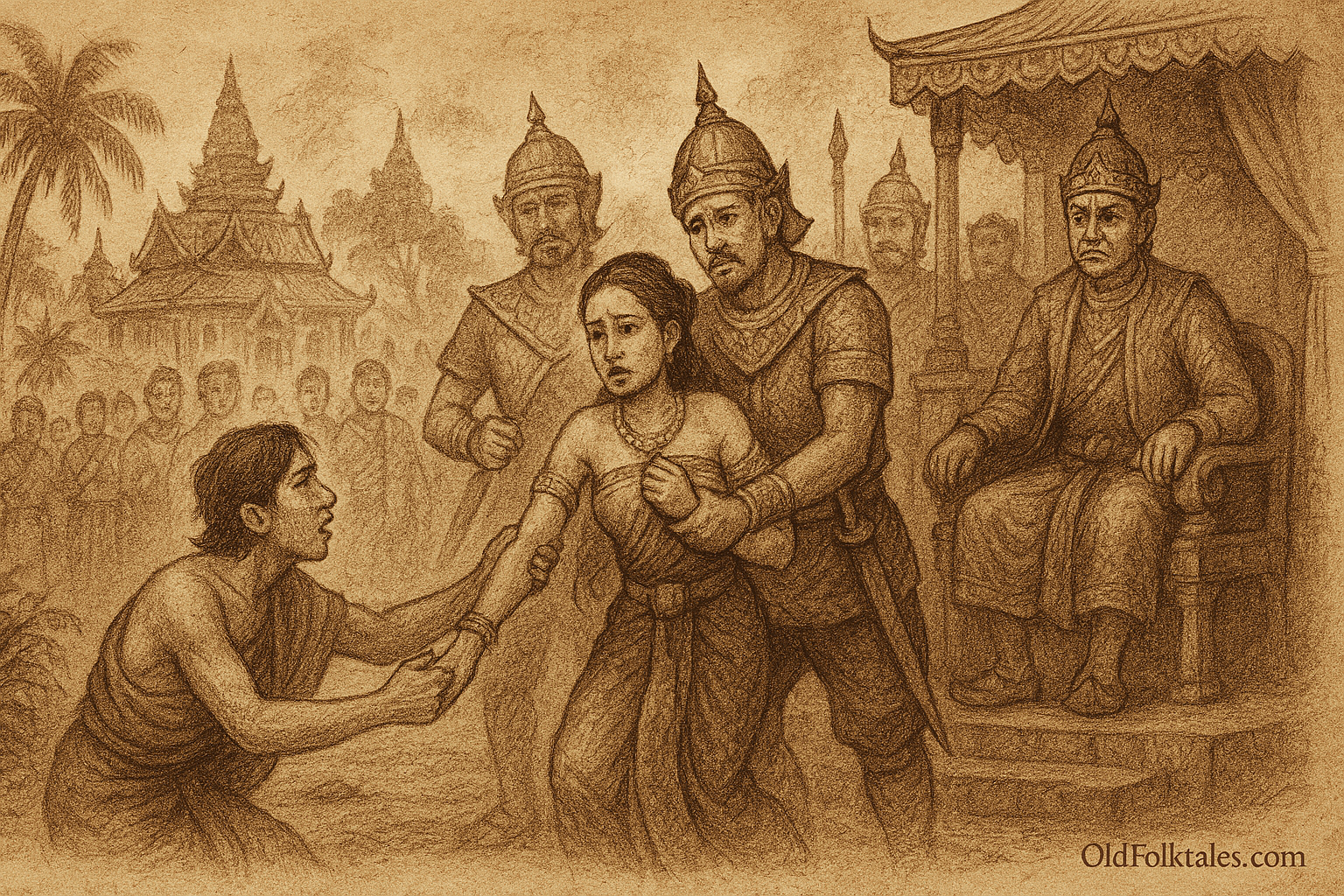
The wedding ceremony was arranged quickly. Teav went through the rituals like a ghost, her spirit already broken. The governor, satisfied with his acquisition, displayed his new wife as a trophy, oblivious to or uncaring about her suffering.
Tum, consumed by grief and righteous anger, could not accept this injustice. He formally left the monastery and, gathering his courage and what little resources he possessed, set out to reclaim his beloved. His plan was to appeal to higher authorities, to expose the governor’s abuse of power, and to free Teav from a marriage built on coercion and greed.
But the governor, learning of Tum’s intentions, moved with swift brutality. He sent his guards to intercept the young man. In a remote area between villages, where the jungle pressed close to the dirt road, Tum was ambushed and murdered, his blood spilling onto the earth as he called out Teav’s name with his final breath.
When news of Tum’s death reached Teav, something inside her broke beyond repair. The young woman who had once danced with grace and smiled with joy became a hollow shell. Unable to live in a world without her beloved and refusing to continue as the wife of his murderer, Teav took her own life, choosing to join Tum in whatever realm awaited them beyond this world of suffering.
The double tragedy sent shockwaves throughout the region. The people, who had heard whispers of the forced marriage and Tum’s murder, rose up in outrage. The governor’s crimes could no longer be hidden or ignored. According to legend, divine justice manifested swiftly the governor was struck down by illness, his house consumed by mysterious fire, and his name became synonymous with tyranny and cruelty.
The story of Tum and Teav spread across Cambodia like wildfire, told and retold in markets and monasteries, in royal courts and rice fields. Poets transformed their tragedy into verse, dancers interpreted their love through movement, and their names became eternal symbols of pure love destroyed by corruption and abuse of power.
Click to read all Southeast Asian Folktales — featuring legends from Thailand, Indonesia, Vietnam, and the Philippines.
The Moral Lesson
The tale of Tum and Teav carries profound moral teachings that resonate through Khmer culture. It warns against the abuse of power and authority, showing how corruption and selfish desire lead to destruction and divine retribution. The story emphasizes the virtue of true love based on mutual respect and shared values, contrasting it sharply with possession and coercion. It also highlights the vulnerability of the powerless in society and the importance of protecting the innocent from those who would exploit them. Finally, it serves as a reminder that actions have consequences that injustice, even when committed by the powerful, cannot escape judgment, whether from the people or from the heavens themselves.
Knowledge Check
Q1: Who was Tum and what made him special in the monastery? A: Tum was a young novice monk in a Cambodian monastery who possessed an extraordinarily beautiful voice. His chanting of sacred sutras was so melodious and pure that pilgrims would travel from distant villages to hear him recite Buddhist verses, and his talent brought great honor to his temple.
Q2: How did Tum and Teav first meet? A: Tum and Teav met when Tum’s abbot sent him to Teav’s village to deliver Buddhist texts and blessings to her family’s household for a ceremony. When Teav brought him water and refreshments as hospitality required, their eyes met and they fell instantly in love, feeling an immediate and profound connection.
Q3: Why was Teav forced to marry the governor despite her love for Tum? A: The powerful provincial governor became obsessed with Teav’s beauty and demanded to marry her. He sent gifts and threats to Teav’s widowed mother, who, lacking male relatives to protect them and fearing retribution from someone with authority over their lives, reluctantly agreed despite Teav’s desperate protests.
Q4: What happened when Tum tried to reclaim Teav? A: After formally leaving the monastery, Tum attempted to appeal to higher authorities to expose the governor’s abuse of power and free Teav from her forced marriage. However, the governor learned of his intentions and sent guards to ambush and murder Tum on a remote road before he could reach the authorities.
Q5: What is the symbolic significance of Tum and Teav’s story in Khmer culture? A: Tum and Teav symbolize pure, authentic love destroyed by corruption and abuse of power. Their story represents the eternal conflict between virtue and vice, powerless innocence versus tyrannical authority. They have become cultural icons of tragic romance in Cambodia, similar to Romeo and Juliet in Western culture, and their tale serves as a moral warning about injustice.
Q6: What happened to the governor after the deaths of Tum and Teav? A: According to the legend, divine justice struck down the governor. Public outrage erupted when his crimes were exposed, and he was reportedly afflicted with illness, his house destroyed by mysterious fire. His name became eternally associated with tyranny and cruelty, serving as a warning about the consequences of abusing power.
Source: Adapted from Tum Teav, the classic Khmer poem documented by U. Bun Heang and preserved in French colonial archives and Cambodian national literary collections.
Cultural Origin: Cambodia (Kingdom of Cambodia), Southeast Asia.