
In a small village nestled among the rice paddies and coconut groves of Indonesia, there lived two half-sisters whose names were taken from the humble ingredients of every kitchen: Bawang Merah, meaning “Red Onion,” and Bawang Putih, meaning “Garlic.” Though they shared a home, their lives and hearts could not have been more different.
Bawang Putih was the daughter of a merchant who had passed away when she was still young, leaving her in the care of his second wife. The girl had inherited her late mother’s gentle nature and beautiful face, but more importantly, she possessed a kind heart that no amount of hardship could embitter. Each day before the roosters crowed, she would rise to begin her endless tasks, sweeping the earthen floors, drawing water from the well, cooking rice over the wood fire, washing clothes in the river, and tending to the small garden behind their wooden house.
Click to read all Southeast Asian Folktales — featuring legends from Thailand, Indonesia, Vietnam, and the Philippines.
Her stepmother showed her no affection, and her stepsister Bawang Merah treated her with open contempt. Bawang Merah, the stepmother’s biological daughter, lived a life of pampered idleness. She spent her days lying on woven mats, admiring herself in polished bronze mirrors, and demanding treats from the market, sweet dodol candy, fragrant jasmine flowers for her hair, and colorful batik cloth for new sarongs. The stepmother indulged her every whim, while Bawang Putih received only harsh words and the heaviest chores.
Despite this cruelty, Bawang Putih never complained. She completed every task with quiet diligence, her hands rough and calloused but her spirit unbroken. When her stepmother scolded her for imagined faults, she bowed her head respectfully. When Bawang Merah mocked her worn clothing and simple appearance, she simply smiled and returned to her work.
One morning, the stepmother sent Bawang Putih to the river to wash a large basket of clothes. The girl knelt on the smooth stones at the water’s edge, scrubbing each garment carefully in the cool, flowing current. As she worked, she sang softly to herself, her voice mingling with the sound of the water and the chirping of birds in the banana trees.
Suddenly, she noticed something gleaming in the shallows, a small fish with scales that shimmered like mother-of-pearl, gasping weakly in water too shallow for it to swim. Its eyes seemed to look at her with desperate intelligence. Without hesitation, Bawang Putih gently scooped up the fish and carried it to a deeper pool where the current was gentler.
“There you are, little one,” she whispered, releasing it into the water. “You’ll be safe here.”
To her amazement, the fish did not swim away. Instead, it circled near her, its scales catching the sunlight like tiny rainbows. When Bawang Putih returned to the river the next day, the fish appeared again, swimming close to greet her like an old friend. She began bringing small portions of her meager meals to feed it, grains of rice, tiny pieces of tapioca cake and the fish would eat from her hand.
Days turned into weeks, and the magical fish grew larger and more beautiful. Bawang Putih found comfort in visiting her aquatic friend, sharing her troubles with it as she worked. The fish seemed to understand, its large eyes sympathetic as it listened to her gentle voice.
But one day, the stepmother discovered Bawang Putih at the river, laughing and talking to the fish. Jealousy and suspicion twisted in her heart. That evening, after Bawang Putih had gone to sleep exhausted from her day’s labor, the stepmother crept to the river with a net. She caught the magical fish, killed it, and cooked it for dinner, serving it only to herself and Bawang Merah.
When Bawang Putih returned to the river the next morning, her fish was gone. She searched the pools and shallows, calling for it softly, but found nothing. Heartbroken, she sat on the riverbank and wept, her tears falling into the water like pearls.
As her tears touched the river, something miraculous happened. The water began to glow with a soft, golden light, and a gentle voice spoke from the depths. “Do not weep, dear child. Though I am gone, my bones remain. Search for them in the garden behind your house, and bury them beneath the papaya tree. Water them with your tears, and you shall be rewarded for your kindness.”
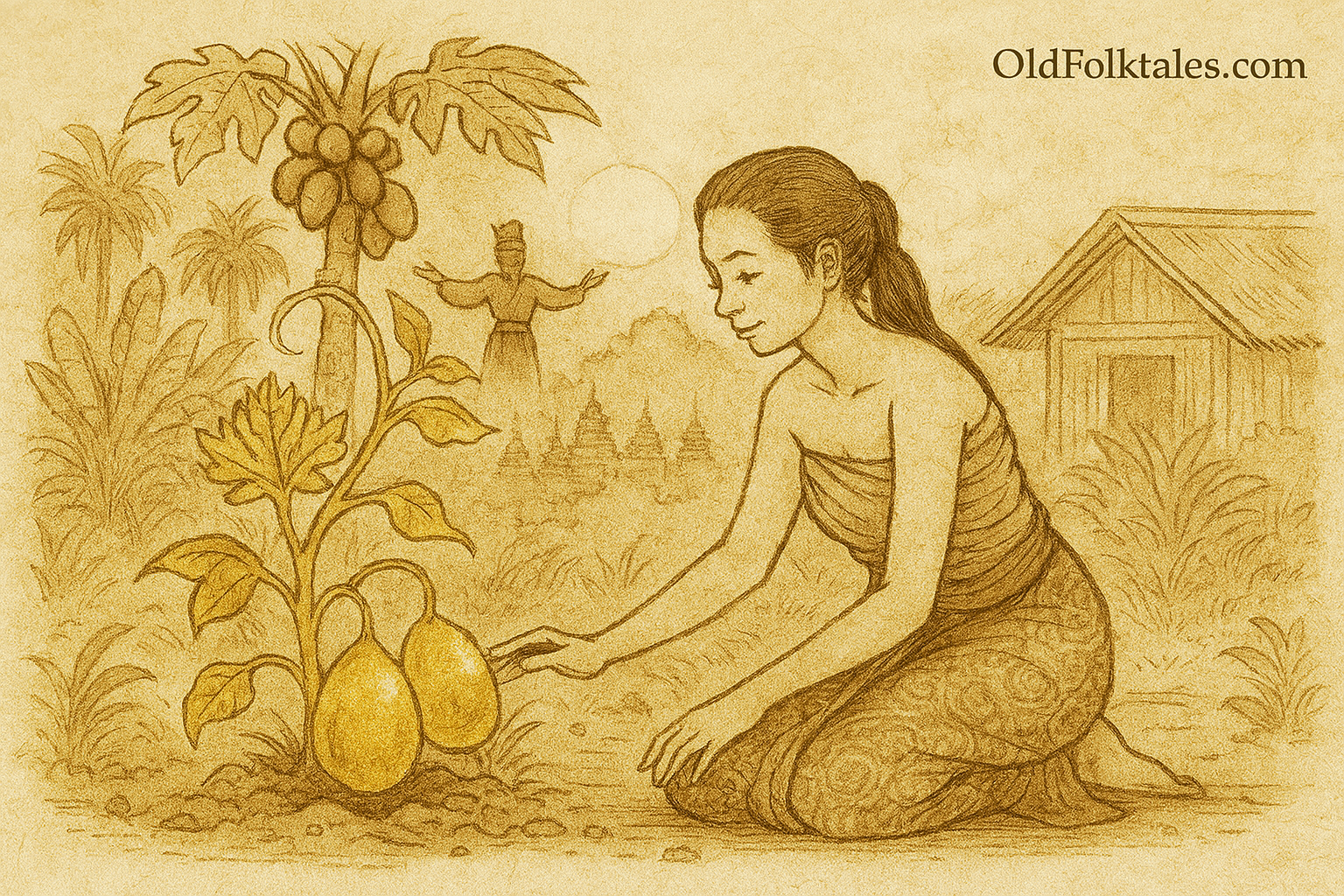
Bawang Putih hurried home and searched the refuse pile where her stepmother had thrown the fish bones. She gathered every tiny bone carefully, carried them to the papaya tree, and buried them as instructed. She watered the spot with her tears and tended it lovingly.
Within days, a strange plant sprouted from that very spot—not a papaya, but a golden vine that grew with supernatural speed. It climbed the tree, spreading leaves that glittered in the sunlight. Soon, magnificent golden gourds hung from the vine, each one humming with magical energy.
That night, Bawang Putih dreamed that the fish’s voice spoke to her again: “Take the largest gourd and open it when you are alone.”
The next morning, when her stepmother and Bawang Merah had gone to the market, Bawang Putih carefully picked the largest golden gourd. Her hands trembled as she cut it open. Instead of seeds and flesh, the gourd was filled with treasures, gold coins, precious jewels, fine silk cloth, and beautiful jewelry that sparkled like captured starlight.
Bawang Putih stared in wonder at the riches. With this wealth, she could buy her own home, fine clothes, and good food. But her first thought was of gratitude to the magical fish that had blessed her even after death.
When the stepmother and Bawang Merah returned and saw the treasure, their faces turned purple with rage and envy. “Where did you get this?” the stepmother shrieked.
Unable to lie, Bawang Putih told them everything about the fish, its death, and the magical gourd. The stepmother’s eyes gleamed with greed. If Bawang Putih could receive such rewards, surely Bawang Merah deserved even greater riches!
The very next day, the stepmother sent Bawang Merah to the river, instructing her to find a fish and care for it. Bawang Merah went grudgingly, complaining about the heat, the mud, and the tedious work of washing clothes. When she spotted a fish in the shallows, she snatched it up roughly and dumped it in a bucket, feeding it only when convenient and treating it with careless disdain.
After a few days of half-hearted care, Bawang Merah grew impatient. She caught the fish, killed it as her mother had done, and buried its bones hastily beneath a mango tree. She watered them only once, with plain water rather than tears, and then waited impatiently for her reward.
A plant did grow, bearing gourds that looked similar to those that had blessed Bawang Putih. Bawang Merah and her mother’s excitement knew no bounds. They picked the largest gourd and tore it open eagerly, already imagining the vast fortunes inside.
But instead of jewels and gold, the gourd exploded with a cloud of wasps, centipedes, and venomous snakes. The creatures swarmed out in fury, stinging and biting the screaming women. Bawang Merah and her mother fled their house in terror, pursued by the angry swarm, their greedy dreams turned into a nightmare of pain and fear.
Meanwhile, Bawang Putih used her blessing wisely. She bought a modest but comfortable home, shared her wealth with the poor of her village, and lived a life of quiet contentment. She never forgot the magical fish that had rewarded her simple acts of kindness, and she continued to help others whenever she could, knowing that true wealth comes not from what we receive, but from what we give.
The villagers often spoke of the two sisters, one whose gentle heart brought blessings, and another whose greed brought only suffering. And parents would tell their children: “Be like Bawang Putih, not Bawang Merah, for kindness is its own reward, and greed its own punishment.”
Journey through enchanted forests and islands in our Southeast Asian Folktales collection.
The Moral of the Story
The tale of Bawang Merah and Bawang Putih teaches us that genuine kindness, patience, and compassion are rewarded, while greed, cruelty, and selfishness lead to misfortune. Bawang Putih’s tender care for the fish came from a pure heart, not from expectation of reward, and that authentic goodness brought her blessings. In contrast, Bawang Merah’s actions were motivated entirely by greed and entitlement, and her lack of genuine care resulted in punishment. The story reminds us that our intentions matter as much as our actions, and that treating all living beings with kindness and respect brings its own rewards, while selfishness ultimately leads to suffering.
Knowledge Check
Q1: Who are Bawang Merah and Bawang Putih in this Indonesian folktale?
A1: Bawang Merah (“Red Onion”) and Bawang Putih (“Garlic”) are two half-sisters in this Indonesian tale. Bawang Putih is kind and hardworking but mistreated by her stepmother and stepsister Bawang Merah, who is lazy and spoiled. The story is similar to the Cinderella tale.
Q2: What role does the magical fish play in the Bawang Putih story?
A2: The magical fish is a supernatural being that Bawang Putih rescues and cares for with genuine kindness. After the fish is killed by the stepmother, it rewards Bawang Putih’s compassion by guiding her to plant its bones, which grow into a vine bearing golden gourds filled with treasure.
Q3: How does Bawang Putih receive her reward in this Indonesian legend?
A3: After caring for the magical fish with true kindness, Bawang Putih is instructed to bury the fish’s bones under a papaya tree and water them with her tears. A golden vine grows, producing magical gourds. When she opens the largest gourd, she finds it filled with gold, jewels, and fine cloth.
Q4: Why does Bawang Merah fail to receive the same reward as her sister?
A4: Bawang Merah’s actions are motivated by greed rather than genuine kindness. She treats her fish carelessly and with disdain, showing no true compassion. When she opens her gourd, it releases wasps, centipedes, and snakes instead of treasures, punishing her selfish intentions.
Q5: What cultural values does the Bawang Merah Bawang Putih folktale emphasize?
A5: The folktale emphasizes important Indonesian and Asian values including kindness, patience, hard work, humility, and respect for all living beings. It teaches that genuine compassion brings blessings while greed, cruelty, and entitlement lead to suffering and misfortune.
Q6: What is the origin and significance of this Indonesian tale?
A6: Bawang Merah and Bawang Putih is a classic Indonesian folktale popular throughout the archipelago, particularly in Java. It serves as Indonesia’s version of the Cinderella story, using local cultural elements like the naming convention based on kitchen ingredients to teach moral lessons to children.
Source: Indonesian folktale, Indonesia








