In the vast, sun-scorched expanse of the Empty Quarter, where rolling dunes stretched endlessly under a scorching sky and the air shimmered with heat, a small caravan struggled to maintain its course. The caravan was led by Zayed, a young and inexperienced guide whose hands were steady but whose knowledge of the desert’s caprices was still limited. Camels plodded wearily through the sand, their sides slick with sweat, while the travelers’ mouths cracked and tongues stuck to parched throats.
A sudden khamsin swept over the dunes, a fierce hot wind that whipped sand into their faces and erased all familiar markers. Panic crept into the caravan as Zayed realized they had strayed far from the safe paths. He called to his companions, but their voices were swallowed by the roaring gusts. Despair hung heavy in the golden haze.
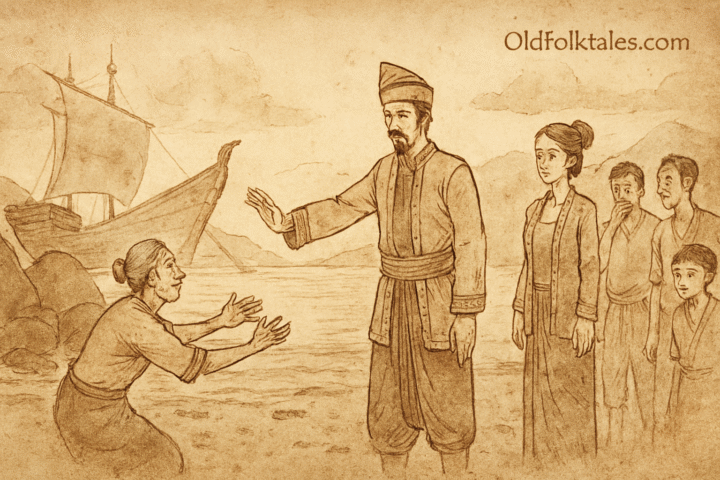
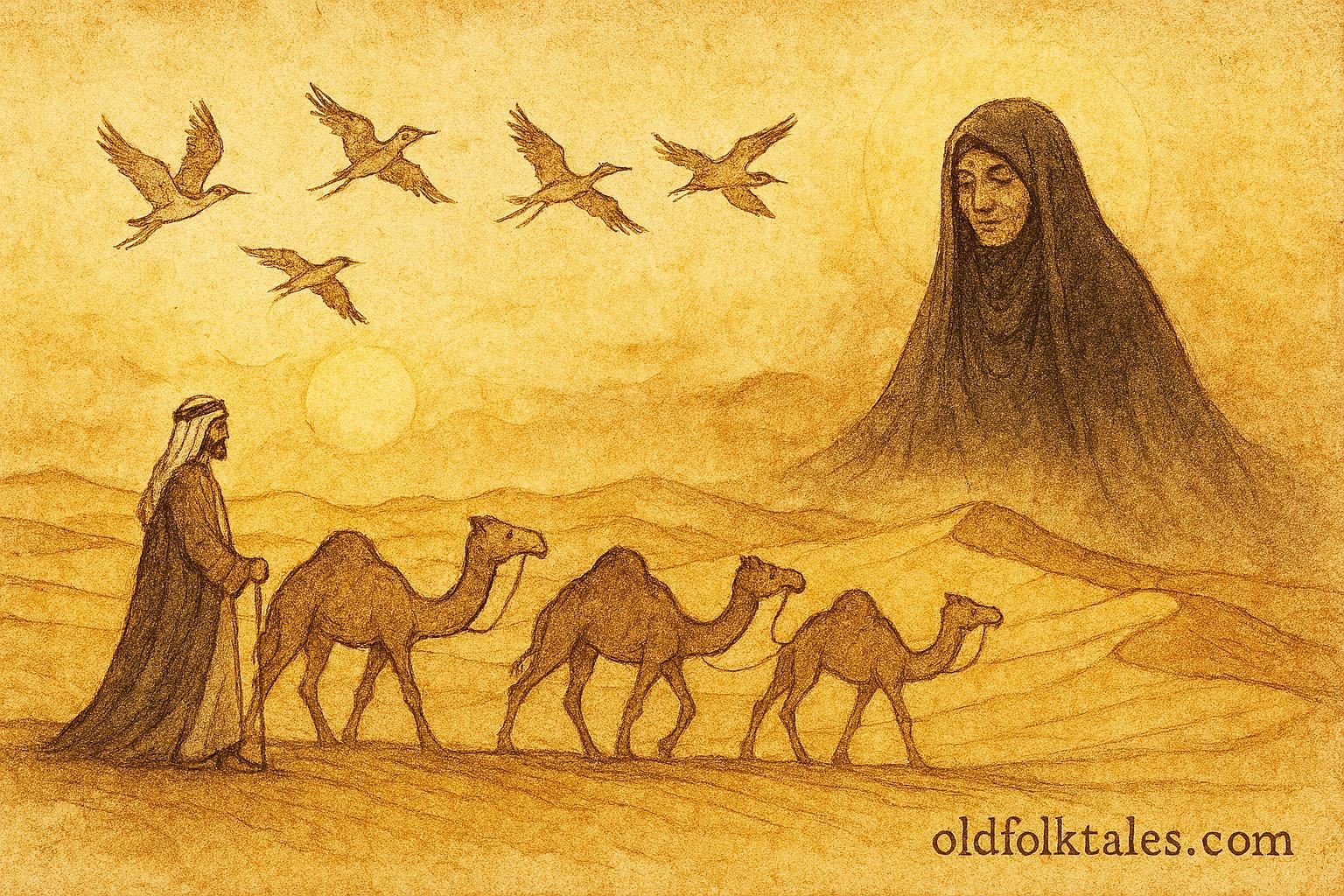
Amid the swirling dust, a shimmering figure emerged like a mirage on the horizon. It was an old woman, draped in black robes that fluttered as if alive, her eyes gleaming with the mysteries of the desert. The travelers froze, unsure whether to flee or approach. The woman spoke in a voice that seemed to rise and fall with the sand itself, soft yet commanding.
“I am Umm al-Sa’af,” she said, “Mother of the Sandstorm. You are lost in my realm. I can show you the way, but there is a price. Give me your finest bisht, and at dawn, follow the flight of the hubara.”
Zayed hesitated, knowing the cloak was a gift from his father, embroidered with threads of silver and gold. But the desperation in the eyes of his companions left no room for doubt. With reverent hands, he offered the bisht. The old woman nodded once, a faint smile tracing her lips, and vanished as suddenly as she had appeared.
Night fell with a chilling quiet, the winds softened, and the caravan huddled against the cold sands. Zayed’s mind replayed the encounter, the shimmering figure of Umm al-Sa’af and her cryptic instructions. As dawn painted the desert in hues of orange and rose, they spotted the hubara bustards taking flight in the distance. Following the birds’ graceful arcs over the dunes, Zayed led the caravan with renewed hope.
Hours passed, and the desert seemed endless, yet the birds maintained their course, unerringly. Finally, beyond a crest of dunes, a hidden khabra appeared—a natural depression collecting precious water, partially shielded from the sun by thorny acacias. Relief washed over the travelers as they quenched their thirst and rested in the rare shade. Zayed whispered a silent prayer of gratitude, his heart swelling with reverence for the mysterious desert spirit.
Days later, as stories of their survival spread, the bisht was discovered draped over a solitary thorn tree on a distant ridge, untouched by sand, its embroidery glinting in the sunlight. The villagers marveled at this sign, speaking in hushed tones of Umm al-Sa’af’s mercurial nature. She was not wholly kind, nor entirely cruel; she embodied the desert’s duality, rewarding respect, courage, and humility, yet exacting what she deemed fair.
Zayed’s experience became a lesson repeated in campfires and Bedouin tents for generations. He spoke not only of the survival of his caravan but also of the importance of listening to the desert, respecting its spirits, and understanding that guidance often comes with a price. The desert, vast and unforgiving, was also a keeper of secrets, rewarding those who approached it with humility and care.
The legend of Umm al-Sa’af endures as a symbol of the desert’s capricious guardianship, reminding travelers that the sands hold both peril and protection, and that wisdom lies in observing, yielding, and honoring the forces beyond human control.
Explore desert legends and palace tales in our Western Asian Folktales archive.
Moral Lesson
This tale teaches that guidance and survival in harsh circumstances require respect, humility, and the willingness to offer something in return. True wisdom is understanding the balance between giving and receiving in the natural and spiritual world.
Knowledge Check
1. Who led the lost caravan?
Zayed, a young and inexperienced guide.
2. Who is Umm al-Sa’af?
A desert spirit known as Mother of the Sandstorm, a guardian of the Rub’ al Khali.
3. What did Umm al-Sa’af ask in exchange for guidance?
Zayed’s finest bisht (embroidered cloak).
4. How did the travelers find the hidden water source?
By following the flight of hubara bustards at dawn, as instructed by Umm al-Sa’af.
5. What does the bisht symbolize in the story?
Respect, humility, and the willingness to make a meaningful offering for guidance.
6. Where was this folktale collected?
The Empty Quarter (Rub’ al Khali) in Saudi Arabia, from Bedouin oral tradition.
Source and Cultural Origin
Source: Bedouin narrative from the Saudi Oral History Project, retold in academic studies of Najdi folklore.
Origin: Saudi Arabia, Empty Quarter (Rub’ al Khali), emphasizing Bedouin respect for desert spirits and the wisdom of humility.