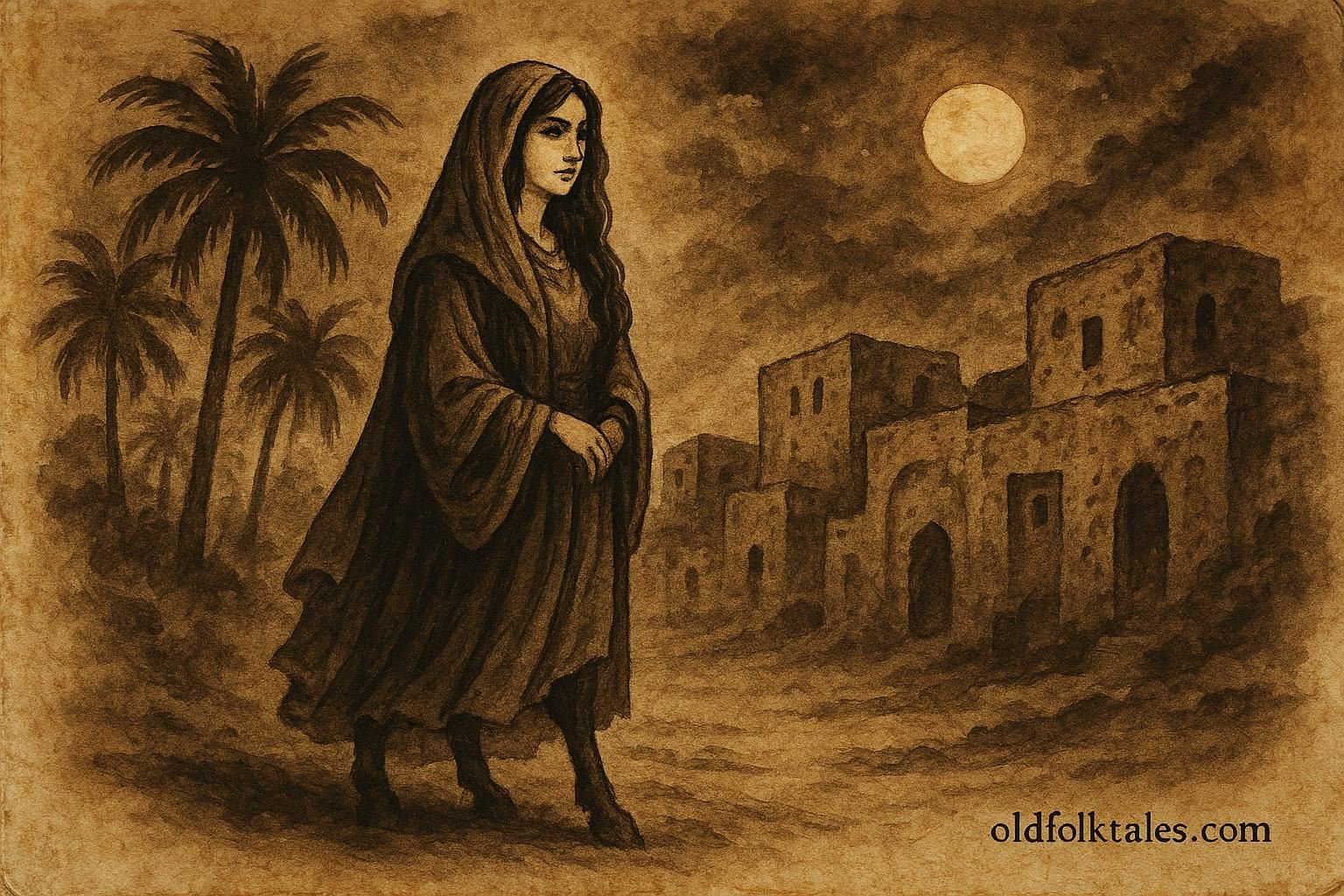
In the quiet villages of old Bahrain, places like Karzakan, Karranah, and Bani Jamra, the desert night carried more than the whisper of wind through date palms. Long before electricity lit the streets, elders warned of a being whose beauty could shatter a man’s caution and whose laugh could freeze his blood. She was Umm al-Subyan, the Mother of Boys, a jinniyah whose legend drifted through generations like smoke rising above a dying fire.
By day, these villages bustled with fishermen mending their nets and families tending palm groves. But once the sun dipped below the horizon, shadows thickened, and the world felt older, closer to the unseen realm. It was then, so the elders said, that Umm al-Subyan awakened.
She was known to walk the abandoned alleys at the edges of villages, the ruins where crumbling walls still held the warmth of past lives. Some claimed she lingered around the deserted outskirts of Karzakan, where half-collapsed homes stood like ancient skeletons. Those who saw her from afar described a woman of mesmerizing beauty, long black hair flowing like ink, skin glowing faintly in the moonlight, a face too perfect to belong to any earthly being.
But beauty was only her mask.
Hidden beneath her flowing garments were the unmistakable legs of a donkey, a feature that marked her as something not of this world. Those who made the mistake of stepping too close discovered this too late.
Her voice was her most powerful weapon. It drifted through date groves at night, soft at first, like a woman humming to herself, then rising into a haunting laugh that echoed across the palms. Children recognized it instantly, for their mothers repeated the same warning every evening:
“Home before sunset, or Umm al-Subyan will come for you.”
One story told in Karranah spoke of a young fisherman named Hassan, who often returned from the shore late at night. The moon hung full and bright the evening he met her. As he walked along a narrow path between the palms, he heard footsteps behind him, light, graceful, almost floating. He turned and saw a woman standing beneath the moonlight, her hair veiling half her face, her eyes gleaming like water under starlight.
“Are you lost?” she asked, her voice soft as the desert wind.
Hassan felt a strange calm wash over him, as if her words pulled him forward. He knew no one should be in the groves at this hour. Yet she smiled, and caution slipped from his grasp.
“I can guide you,” she whispered. “Walk with me.”
He stepped closer, and that was when he saw them. Not feet. Not human. Hooves. Donkey’s legs beneath her dress, planted firmly in the sand.
His blood ran cold.
Before he could scream, her laugh cut through the darkness, sharp and wild. Hassan fled, running blindly through the palms toward the glow of his village. Only when he burst into the open square, panting, trembling, did the sound of her laughter fade behind him.
Other tales spoke of children who wandered too far after dusk. Mothers believed that Umm al-Subyan watched for any youngster who strayed from the safety of home. In some versions, she carried off disobedient children into the desert, leaving nothing behind but their footprints and the echo of her laughter. Whether she sought to harm them or simply frighten them into obedience, no one dared find out.
Fishermen, too, claimed encounters with her. On nights when the sea lay calm beneath the moon, some swore they saw her reflection ripple across the water—not on land, but floating over the waves as though the sea welcomed her shape. The bravest, or most foolish, men leaned closer to look. Those who did described the same impossible sight: a perfect face above, inhuman legs below.
These stories were not meant as entertainment. They were warnings woven into the rhythm of daily life. Old men told them around majlis fires, voices low, while women passed them along as part of nightly lessons to their children. Whether Umm al-Subyan was a jinn from pre-Islamic lore or a cautionary spirit shaped by generations of fear, no one could say for certain. But belief in her was consistent, stretching across villages like a shared thread in the cultural fabric.
Even travelers passing through deserted pathways reported hearing her laughter drift over the dunes, sometimes close, sometimes chillingly distant. Those who ignored the warnings often returned with tales of a “woman” who appeared from nowhere, beckoning with a smile that never reached her eyes.
Over time, the story of Umm al-Subyan became deeply rooted in Bahraini identity. She embodied the dangers of the dark, of abandoned places, of wandering alone. She served as a protector in a twisted way, frightening children into safety, reminding men not to follow beauty blindly, and urging communities to respect the boundaries between the human world and the jinn.
In the end, all who heard her story understood the same truth: not every beautiful face belongs to a harmless soul, and not every voice in the night should be trusted.
Moral Lesson
The tale warns against wandering into dangerous places and trusting appearances. Beauty can deceive, and safety lies in heeding wisdom, respecting boundaries, and avoiding the temptations of the unknown.
Knowledge Check
1. Who is Umm al-Subyan in Bahraini folklore?
She is a supernatural jinniyah who lures men at night and sometimes kidnaps wandering children.
2. What physical feature reveals her true nature?
Her donkey’s legs, hidden beneath her clothing, mark her as a non-human being.
3. Where is Umm al-Subyan said to appear?
Near abandoned villages, date palm groves, ruins, and moonlit coastal areas.
4. Why did Bahraini mothers warn children about her?
To keep children from wandering after sunset, reinforcing a cultural safety lesson.
5. What common sign of her presence do villagers describe?
Her eerie laughter echoing through palm groves or deserted pathways.
6. What cultural themes does the legend represent?
Obedience, the dangers of night travel, respect for jinn lore, and caution against deceptive appearances.
Source
Adapted from Bahraini oral traditions documented in Bahrain This Week and village oral histories from Karranah, Bani Jamra, and Karzakan.