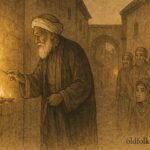
Once upon a time in a quiet Syrian village surrounded by golden plains and distant olive groves, there lived a humble farmer and his wife. They were growing old and had only two daughters, each married and settled far away. The eldest had married a prosperous farmer who owned wide fields of grain. The younger had married a skilled potter, known for shaping clay into fine urns, jars, and bowls.
Years passed, and neither daughter came home. The old couple missed them deeply. One evening, as the sun set behind the village hills, the wife sighed and said,
“My dear husband, our daughters have not visited in so long. I worry about them. Go and see how they are faring. I wish to know they are well before death calls me.”
The farmer agreed. Early the next morning, he packed a small parcel of bread, cheese, and dates, mounted his faithful donkey, and set out across the dusty road. As he rode through the quiet countryside, he murmured prayers for safety and the health of his children.
The First Daughter’s Home
By sunset, he arrived at the home of his eldest daughter. She and her husband greeted him joyfully. They washed his feet, brought cool water for his thirst, and slaughtered a sheep in his honour. That night, they feasted beneath the bright Syrian moon, laughing and telling stories of the past.
The next morning, as the first call to prayer echoed across the valley, the farmer prepared to leave. His daughter drew him aside, her eyes warm with affection.
“My dear father,” she said softly, “look to the east—what do you see?”
“I see fertile fields,” he replied.
“And to the west? The north? The south?”
“Fields everywhere,” he said with pride.
She smiled. “These are ours. My husband and I sow wheat, barley, lentils, and chickpeas each year. All that we need now is rain. Without it, the soil will dry, the crops will fail, and we will have nothing. Please, father, pray for heavy rain this year.”
The old man nodded, touched by her hope and hard work. As he rode away, he repeated quietly to himself,
“Dear God, let it rain. Dear God, let it rain.”
The Second Daughter’s Home
After several hours of travel, the farmer reached the village of his younger daughter. She and her husband, the potter, greeted him with joy, offering him food and tea. The smell of wet clay hung in the air, and rows of earthen jars dried in the sun outside their humble home.
They ate, drank, and talked late into the night, remembering old days. The next morning, before departing, the farmer asked gently,
“My dear child, how are you faring in this place?”
The potter’s daughter smiled and said, “Father, look to the east, what do you see?”
“I see lands of clay,” he answered.
“And to the west? The north? The south?”
“All I see is more clay,” he said, puzzled.
“These are the clay pits from which we shape our pottery. But, father, if it rains, all the clay will turn to mud and wash away. We will lose our work and our livelihood. Please pray that it does not rain.”
The farmer blinked. Just this morning, his other daughter had begged for the opposite.
Still, he smiled, embraced her, and mounted his donkey once again. As he rode back through the winding paths, he began to murmur, shaking his head with a faint smile:
“Dear God, let it not rain. Dear God, let it rain. Dear God, let it not rain. Dear God, let it rain…”
When he finally reached home, his weary wife hurried to greet him. “Tell me, husband,” she said eagerly, “how are our daughters?”
He sighed deeply and replied,
“My dear, if it rains, we shall cry, and if it doesn’t rain, we shall also cry.”
And that is how the old couple learned that life’s blessings may please one and trouble another, and that happiness, like rain, never falls evenly on every home.
Moral Lesson
Life is full of contrasts and opposing needs. What brings joy to one may bring sorrow to another. True wisdom lies in understanding that fortune and hardship are often two sides of the same coin, and that contentment comes not from controlling the rain, but from accepting life’s balance with grace.
Knowledge Check
1. What is the main theme of Whether It Rains or Not, We Shall Cry?
The story explores acceptance, fate, and how different livelihoods depend on opposite fortunes.
2. Who are the key characters in the Syrian folktale?
The story features an old farmer, his wife, and their two daughters, one married to a farmer, the other to a potter.
3. What conflict drives the folktale’s message?
The father realises that one daughter needs rain for her crops, while the other prays for dry weather to preserve her clay.
4. What cultural values are reflected in this Syrian folktale?
It highlights family bonds, respect for parents, humility before God, and acceptance of fate, values central to Syrian rural life.
5. What is the moral lesson of the story?
Contentment comes from understanding life’s balance; what benefits one may harm another.
6. Why is the title Whether It Rains or Not, We Shall Cry significant?
It symbolises life’s unavoidable contradictions, sometimes, there is no perfect outcome that satisfies everyone.
Source
Adapted from the Syrian folktale “Whether it Rains or Not, We Shall Cry” in Syrian Folktales Anthology, collected by Cultural Heritage without Borders (CHwB, 2015).
Cultural Origin: Syria (Middle Eastern folklore)