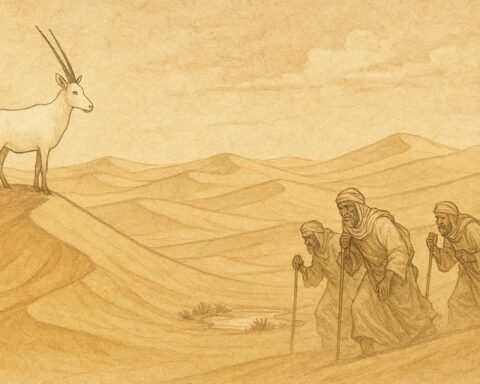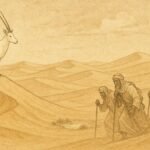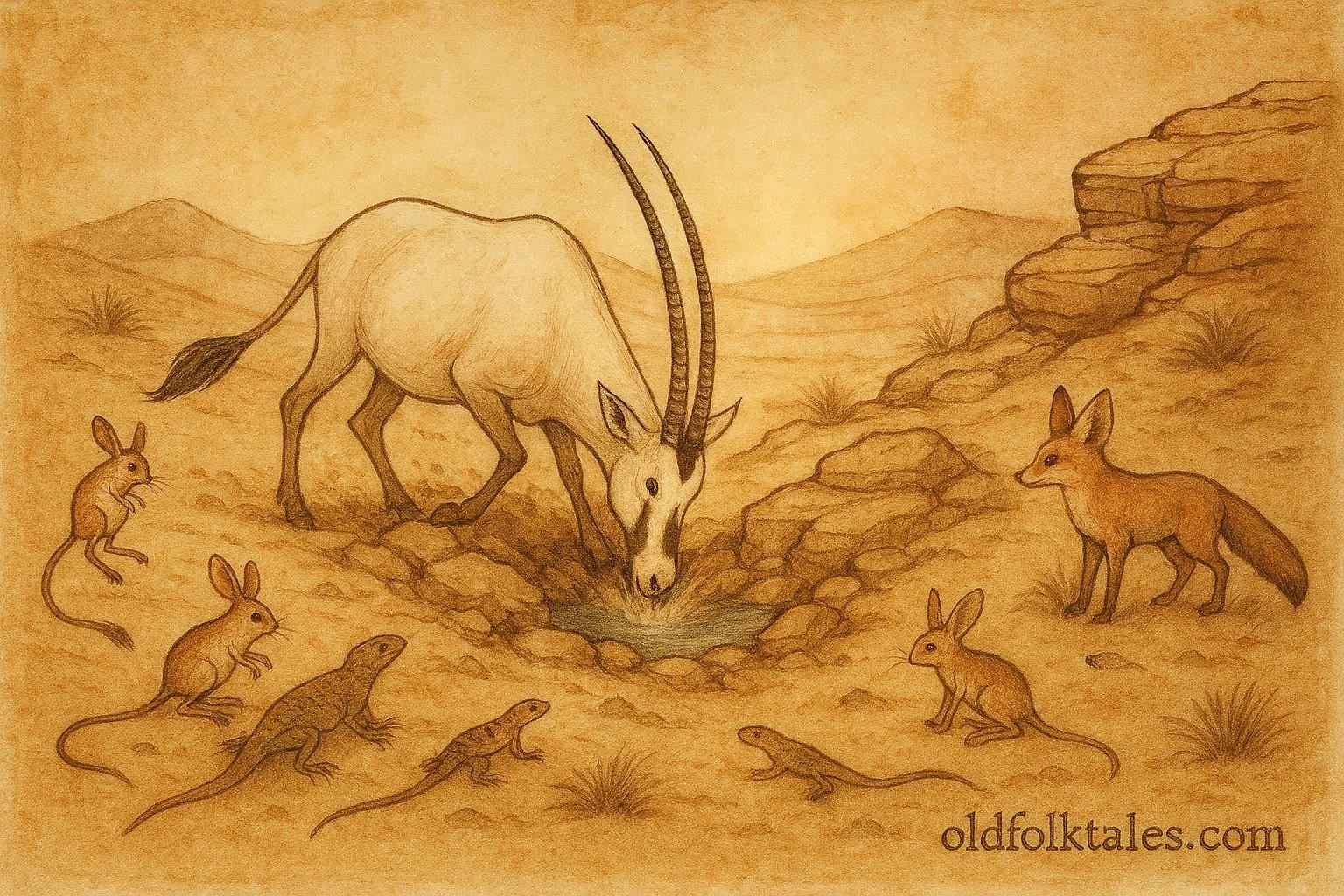
Long before the desert learned to endure silence, when the sands of Dhofar still remembered the sound of flowing water, the Arabian oryx was known for her beauty as much as for her strength. She moved across the plains like a pale mirage, her coat reflecting the sun, her hooves steady upon gravel and stone. Most admired of all were her horns. They were long and spiraled, curling elegantly like desert vines shaped by a patient wind. Among all the creatures of the Nejd deserts, none carried such grace upon their brow.
In those days, the seasons were not kind. A great drought settled over the land, lingering far longer than anyone remembered. The wadis cracked and dried. Grass withered to dust. Even the hardy shrubs that fed the gazelles shrank into brittle shadows of themselves. Each dawn rose hotter than the last, and each night brought no relief.
The smallest creatures suffered first. Jerboas scratched desperately at the sand, finding nothing but heat. Sand foxes wandered farther from their dens, their ribs visible beneath their fur. Lizards lay still beneath stones, too weak to move. The desert that had once sustained them now seemed to turn away.
The animals gathered beneath the weak shade of a lone acacia tree, their eyes dull with thirst. They spoke in low voices, for even sound felt heavy in the air. No spring answered their need. The only water they knew lay far beneath a shelf of hard rock, sealed away like a secret the desert refused to share.
The oryx watched them in silence. She had endured thirst before, but she was strong. She could survive longer than most. Yet as she looked upon the trembling jerboa and the fox panting in the dust, her heart grew restless. Strength, she knew, meant nothing if it was used only for oneself.
“I will dig,” she said at last.
The others stared at her in disbelief. The rock was ancient and unyielding. Many had tried to scrape at it before, only to give up in exhaustion. But the oryx stepped forward, lowering her head. Her spiraled horns gleamed in the sun as she pressed them against the stone.
She worked from dawn until the sun stood overhead. Her horns scraped and struck, prying at cracks no one had noticed before. Each movement sent a sharp echo through her skull, but she did not stop. Dust filled the air. The rock resisted, biting back with every blow.
Day after day, she returned. The drought did not ease. Her horns chipped, their elegant curves wearing thin where they met the stone. The pain traveled down her neck into her bones, yet still she dug. At night, she rested beneath the stars, her breath slow, her resolve unbroken.
Gradually, the spirals began to fade. The smooth curves fractured, straightening where they had once curled. Each strike stole a little more of their beauty, but brought her closer to the hidden water.
On the final day, as the sun burned white above the desert, her horns struck something different. A hollow sound answered her blow. With one last effort, she drove her horns deep into the rock. It cracked open, and from the wound in the earth flowed cool, clear water.
The oryx stepped back at once. She did not drink. Instead, she turned her head toward the gathered animals. “Come,” she said. “Drink first.”
The jerboa rushed forward, then the fox, then the lizards and birds. They drank until their strength returned, until life flowed back into their limbs. Only then did the oryx lower her head to the water.
When she lifted it again, she caught her reflection in the pool. Her horns were no longer spiraled. They stood long, sharp, and perfectly straight, stripped of all their former ornament. For a moment, she felt the weight of what she had lost.
The air shifted. A presence rose from the heat and the wind. The Desert Spirit, Ruh al-Sahra, appeared, neither man nor beast, but something shaped of sand and breath. Its voice carried the stillness of endless dunes.
“You traded beauty for life,” the spirit said. “You gave what made you admired so others might endure.”
The oryx lowered her head, unsure whether she should grieve or stand proud.
“From this day,” the spirit continued, “your horns shall remain straight and true. They will be a spear against danger and a sign of leadership. All creatures will know that strength guided by compassion is the highest form of power.”
The spirit faded, leaving only wind and silence.
From that time onward, the Arabian oryx led herds across the deserts of Oman. Her straight horns caught the light of dawn, unmistakable against the sand. Predators learned to keep their distance, and animals followed her path, trusting her judgment. The water she uncovered became a place of memory, spoken of in quiet tones whenever drought returned.
And so it is said that the oryx carries her story upon her head. What she lost in beauty, she gained in honor. What she gave, the desert remembered.
Moral Lesson
This Omani folktale teaches that true leadership is born from sacrifice. The oryx’s willingness to give up her beauty for the survival of others shows that compassion and responsibility define lasting strength.
Knowledge Check
1. Why did the drought threaten the desert animals?
The drought dried all surface water and food sources, leaving small animals unable to survive.
2. What made the oryx capable of helping the others?
Her great strength and powerful horns allowed her to break through hard rock.
3. How did the oryx’s horns change?
Her spiraled horns wore down through digging and became straight and sharp.
4. Who is Ruh al-Sahra?
The Desert Spirit who represents the moral balance and memory of the desert.
5. What do the straight horns symbolize?
Selfless leadership, protection, and inner integrity.
6. What cultural value does this story reflect?
Omani respect for sacrifice, communal survival, and moral responsibility in harsh environments.
Source & Cultural Origin
Source: Adapted from an Arabian animal legend recorded in Arabian Studies Journal, Vol. VI.
Cultural Origin: Dhofar Desert, Sultanate of Oman.