In the heart of the Lebanese mountains, where olive trees whisper secrets to the wind and evening lamps flicker in stone courtyards, lived a group of villagers who loved nothing more than storytelling. One night, after supper, the men gathered in the village square, boasting of their cleverness. “Women,” they said with laughter, “may be good at cooking and spinning, but when it comes to wit, no one surpasses a man.” Their wives, listening nearby, exchanged knowing glances. Among them was wise old Zahra, famed for her quick tongue and clever tricks. She smiled quietly and said, “Tomorrow, we shall see whose wits are sharper.” Thus began the famous folktale of how women’s wisdom triumphed over men’s pride.
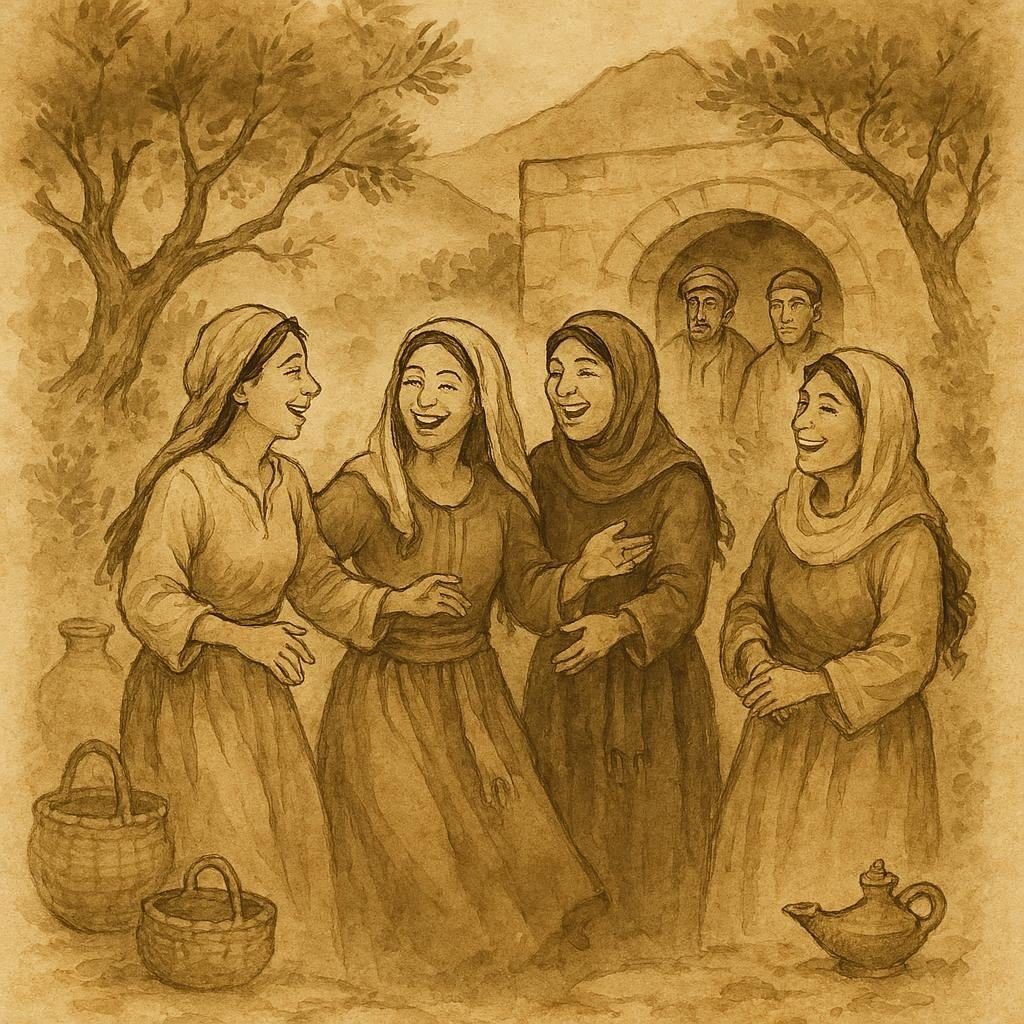
The next day, Zahra called the women together in her courtyard. “Men think themselves too clever,” she told them, “so let us play a lesson that will humble their tongues.” The women whispered and giggled, forming a plan. They decided each would trick her husband in a small but clever way, proving that quiet wit can overturn loud boasting.
The first to act was Layla, whose husband was a merchant. She knew he guarded his gold coins more closely than his own shadow. That evening, she sighed deeply and told him, “Husband, I saw a dream that your chest of coins must be buried for one night in the garden, or misfortune will strike.” Alarmed, he agreed and buried it under the fig tree. When he fell asleep, Layla dug it up and hid it in another spot. In the morning, she told him that thieves must have taken it. He ran shouting through the village, and only after hours of searching did she lead him to the chest again. “You see,” she said sweetly, “had you not listened to me, your treasure would be gone.” The merchant, red-faced, dared not speak of men’s intelligence again.
The second was Samira, wife of a proud blacksmith. Her husband often mocked her curiosity about his forge. “A woman’s hand,” he said, “belongs at the loom, not in the fire.” So one day, when he was away, Samira invited the neighbours to watch her “forge like a man.” When he returned, he found his workshop spotless, his tools polished, and the bellows repaired. “Who did this?” he asked. Samira smiled: “A woman who knows more than you think.” From that day, the blacksmith never mocked her again.
But Zahra saved her trick for last. Her husband, Abbas, was the loudest braggart in the village. He declared he could never be deceived by a woman. Zahra smiled and made him his favourite dish of lentils, sprinkling it with salt and sweetness. As they ate, she spoke calmly, “I met a wise traveller who said a husband’s trust in his wife is the measure of his own wisdom.” Abbas, flattered, nodded proudly. That night, Zahra took his best cloak and gave it to a neighbour, claiming a merchant had borrowed it. When he asked the next morning where it was, she said innocently, “The wise traveller told me to test your trust.” Realising he had fallen for her trick, Abbas laughed heartily and said, “Zahra, your wits are sharper than any sword.”
That evening, the men gathered again in the square, their pride subdued. “Tell us,” one asked Abbas, “did you outsmart Zahra?” Abbas shook his head. “A man may lift stones,” he said, “but he cannot lift the weight of a woman’s cleverness.” Laughter filled the air as the women joined, carrying trays of figs and bread. From that day on, no man in the village dared claim that men’s wits were greater. The story of Zahra and her companions spread across Lebanon, carried by hakawatiyat, the women storytellers, as a gentle reminder that intelligence wears many faces, and humility is the truest wisdom.
Moral Lesson
The tale teaches that true wisdom is not bound by gender. Through patience, creativity, and intelligence, women can achieve justice and balance even in a world that underestimates them.
Knowledge Check
1. What is the main theme of “Women’s Wiles Beat Men’s Wiles”?
It explores how women’s intelligence and wit can match or surpass men’s pride and boastfulness.
2. Who was Zahra, and what role did she play?
Zahra was the wise woman who led the other women in teaching their husbands a lesson in humility.
3. How did Layla trick her merchant husband?
She made him bury his money and later moved it, showing that his trust in her protected his treasure.
4. What is the cultural significance of the story?
It reflects Lebanese social life and the oral storytelling traditions where humour teaches moral balance.
5. What lesson did Abbas learn from Zahra?
He learned that wisdom lies in trust and humility, not in pride or domination.
6. How is humour used in the story?
Humour softens the critique of gender roles and highlights intelligence as a shared human quality.
Source: Adapted from “Women’s Wiles Beat Men’s Wiles” in Abu Jmeel’s Daughter & Other Stories by Jamal S. Nuweihed (Interlink Books, 2002).
Cultural Origin: Lebanon (Levantine Folklore)